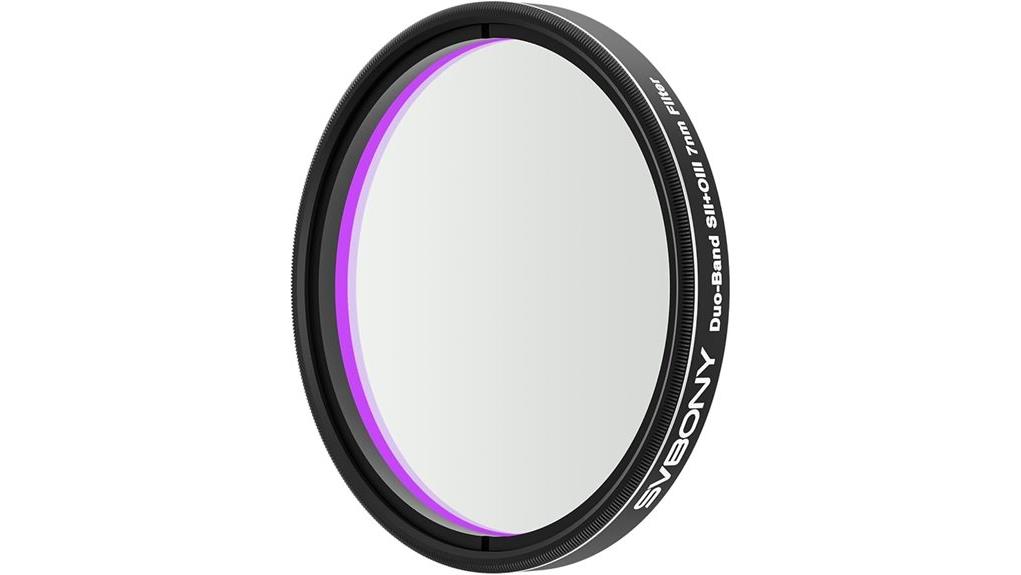
You’ll get a predictable, cost-effective boost in nebula contrast with the SVBONY SV220, which passes 7 nm SII and OIII bands while sharply rejecting streetlight and skyglow (OD5 out of band) to lower background RMS and cut integration time. Peak transmission is high and coatings are durable, with minimal vignetting and negligible focus shift on f/4+ systems; fits 2" slots and 48 mm threads. Keep going for test data, mounting notes, and alternatives.
Some Key Takeaways
- Dual 7 nm bands transmit SII and OIII while sharply blocking streetlight and skyglow, boosting nebula contrast in polluted skies.
- High peak transmission and OD5 out-of-band rejection deliver strong emission-line signal with minimal continuum contamination.
- Urban and partial-moon tests show reduced background RMS and shorter integration times to reach target SNR on emission lines.
- Fits standard 2" slots and 48 mm threads; sits close to the sensor, so confirm backfocus and use only in imaging train.
- Best for f/4 or faster refractors imaging emission nebulae; alternatives include single-band or narrower 3–6 nm premium filters.
What the SVBONY SV220 Dual Narrowband Filter Does for Your Nebula Photos
When you mount the SVBONY SV220 on your imaging train, it selectively transmits the SII and OIII emission lines with 7 nm bandwidths while sharply blocking common streetlight and skyglow wavelengths, increasing contrast for emission nebulae and revealing fainter filamentary structure. You’ll notice measurable contrast enhancement: background sky noise drops, signal-to-noise on narrowband features rises, and faint filaments become extractable with shorter total integration. In post-processing you’ll apply targeted color mapping to assign SII/OIII to specific channels, preserving scientific detail while producing visually informative composites. The filter’s effect is predictable, repeatable, and suited to polluted sites. This makes the SV220 a practical choice for photographers and hobbyists who use drones and related camera gear to capture aerial astrophotography drone camera gear in urban or light-polluted areas.
Key Specs and Optical Performance: SII/OIII 7nm, OD5, Transmission, and Coatings
Although designed for practical field use, the SVBONY SV220’s optical specification is straightforward and focused: it transmits two narrow 7 nm bands centered on the SII and OIII emission lines while delivering deep out-of-band rejection to OD5, giving you a high-contrast signal from nebular emission against suppressed streetlight and skyglow. You’ll see high peak transmission within each band due to multi-coating and quality optical glass, with sharp cutoffs that block sodium/mercury lines. The build supports narrowband durability; coatings resist modest handling abrasion. Expect predictable performance, though long-term coating longevity and environmental limits warrant conservative care. For photographers seeking optimal exposure control and creative effects, pairing narrowband filters with ND filters can expand your imaging options.
Real-World Test Results: Imaging Under City Lights, Moonlit Nights, and at F/4+ Systems
The lab-measured bandpasses and OD5 rejection described above translate into predictable improvements in field imaging: under urban skyglow and partial moonlight the SV220 cuts continuum background markedly while passing SII and OIII emission with high peak transmission, so you’ll record stronger nebular contrast without excessive exposure stretching. In city testbeds you’ll notice background RMS drop and shorter integration to reach target SNR on emission lines; stars remain suppressed less than in single-band H-alpha. On lunar contrast trials the filter maintains line signal with manageable sky pedestal. At f/4+ speeds vignetting is minimal and focus shift is negligible, enabling efficient workflows. Using a calibrated workflow with color checker cards can help ensure consistent color rendition and documentation across sessions.
Compatibility, Mounting, and Practical Tips for Cameras and 2 Telescopes
Because the SV220 is built for standard 2" filter slots and a 48 mm thread, you’ll find it directly compatible with most DSLR/mirrorless camera adapters and SCTs, refractors, and Newtonians that accept 2" accessories. You’ll mount it in a 2" nosepiece or screw it into a 48 mm adapter; tighten gently to avoid stress. For imaging, use parfocal camera adapters and maintain backfocus; the filter sits close to the sensor, so confirm spacing for your flattener. When using guide scopes, keep the filter only in the imaging train—don’t expect guide cameras to benefit. Carry a protective pouch for safe transport. For a clean shooting environment, consider adding backdrops for photography to your setup.
Who Should Buy the SV220 and Alternatives to Consider
If you shoot emission nebulae from an urban or moonlit site and use an optical system at f/4 or faster, you'll find the SVBONY SV220 a practical, cost-effective way to boost contrast by passing SII and OIII lines while sharply rejecting common light-pollution bands. You should consider it if you’re a beginner astrophotographer seeking measurable improvement without narrowband monochrome gear or expensive branded filters. It suits fast refractors and short focal lengths for Ha-poor targets. For budget alternatives, compare single-band OIII or SII filters, uncooled dual-band clones, or higher-spec 3–6 nm filters from established makers depending on goals and sensor QE. Many astrophotographers also pair NAS-based image storage workflows with their post-processing to keep large RAW files organized and safe, which is especially helpful for those who shoot frequently with high-resolution sensors and large image sets secure NAS.
Some Questions Answered
Does the Filter Require a Parfocal Adjustment When Stacked With Other Filters?
No, you typically won't need a parfocal adjustment when stacking this filter, provided mechanical tolerances are within standard ranges. You should check stacking order to avoid added optical path differences from thick adapters or mismatched threads. If you stack multiple heavy or non‑standard filters, you might notice slight focus shift; in that case you’ll adjust focus, not parfocalize. Measure and document any shift and prioritize low‑tolerance holders to minimize issues.
Can It Be Used for Visual Observing Through an Eyepiece?
Yes — you can use it for visual observing, but expect limitations. You’ll get visual suitability primarily on bright emission nebulae, where the SII/OIII bands boost contrast improvement against light-polluted or moonlit skies. Stars and continuum detail will appear dimmer, and faint broadband targets won’t benefit. You’ll need a 2" eyepiece holder and faster optics (>f/4) for best results; don't expect water resistance or full-color rendition.
Is the Filter Temperature-Sensitive for Wavelength Shift During Long Exposures?
You’re unlikely to see significant temperature drift affecting long exposures; the filter exhibits good thermal stability. Dual 7 nm bands in quality optical glass with multi-coating minimize wavelength shift as ambient temperature changes, so line-center drift should be small for typical night-time variations. For extreme temperature swings or precision narrowband work you’ll want to characterize any residual shift in your setup, but for normal astrophotography it’s not usually problematic.
Does It Introduce Noticeable Reflections With Off-Axis Cameras/Otas?
You’re unlikely to see strong off axis reflections with typical off-axis cameras/OTAs. The multi-coated optical glass and sharp cut-off reduce internal ghosting, so reflections stay minimal across the field, preserving field illumination. However, very fast optics, extreme backscatter from bright stars or incorrect filter tilt can produce faint ghosts at the edges. Test in your setup—tilt and baffling adjustments usually eliminate residual off axis reflections without harming illumination.
Are There Any Special Cleaning Instructions to Avoid Coating Damage?
Yes — to avoid coating damage, you should use blower brush first to remove loose dust, then gently sweep with a soft microfiber or optical tissue. Don’t use solvents or abrasive cloths; avoid solvents unless manufacturer explicitly approves. If oily marks persist, moisten tissue with a small amount of distilled water or specialized optical cleaner and dab lightly. Handle edges, store in the protective pouch, and minimize contact to preserve multi-coatings.