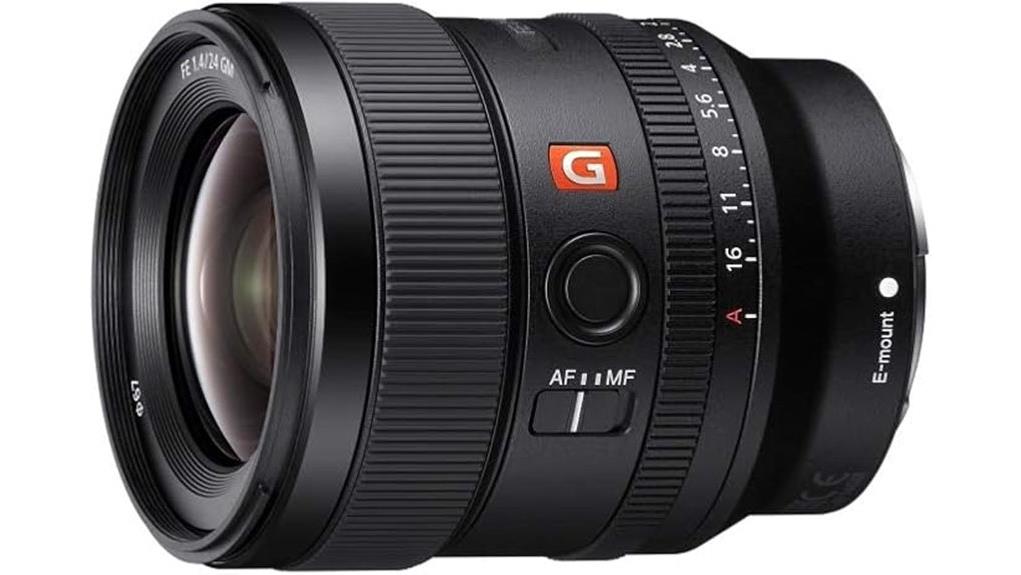
You’ll find the Sony FE 24mm F1.4 GM gives you a fast, sharp wide prime that’s built for serious mirrorless shooters who need low-light reach, creamy bokeh, and reliable AF in a compact, weather-sealed body. Center detail is outstanding at f/1.4, corners tighten by f/2.8–f/5.6, and aberrations and coma are well controlled for night work. It’s pricey but versatile for landscapes, portraits, and video—keep going to see measured results and real-world tradeoffs.
Some Key Takeaways
- Exceptional center sharpness at f/1.4 with strong microcontrast, improving slightly toward f/5.6 for maximum detail.
- Smooth, creamy bokeh from an 11-blade diaphragm and well-controlled spherical aberration for pleasing subject separation.
- Fast, near-silent DDSSM autofocus with minimal focus breathing, suitable for stills and run-and-gun video.
- Robust build with weather sealing and compact balance, practical for handheld, travel, and outdoor shoots.
- Trade-offs: premium price, modest weight, and occasional mild vignetting wide-open; excellent value for low-light and cinematic needs.
What the 24mm F1.4 GM Is and Who It’s For
What makes the Sony 24mm F1.4 GM stand out? You get a fast, full-frame wide prime that balances size, weather resistance, and optical sophistication for demanding creators. It’s designed for landscape, street, environmental portraiture, and low-light work where you need speed and edge-to-edge consistency. You’ll appreciate its class-leading portability for compact travel without sacrificing professional controls or build. If you’re moving into astro work, treat this as an astrophotography primer: fast aperture, wide field, and reliable focus drive let you capture stars with shorter exposures. It’s aimed at hybrid shooters who want one versatile, high-performance lens. The lens pairs exceptionally well with mirrorless camera systems popular among enthusiasts.
Optical Performance: Sharpness, Bokeh, and Aberration Control
Having established where the 24mm F1.4 GM fits in your kit, let’s look at how it renders detail, out-of-focus areas, and controls common aberrations. You’ll find center resolution exceptionally high at f/1.4, with microcontrast preserving texture. Corner sharpness is surprisingly robust wide open, improving marginally by f/2.8 and peaking around f/5.6. The 11-blade diaphragm and optical formula produce creamy bokeh with smooth shifts, especially for close subjects against distant backgrounds. Chromatic aberration is well suppressed by ED elements and Nano AR coating; spherical aberration and coma remain controlled, yielding reliable point-source rendition at night. It’s also well suited for portrait work thanks to its portrait-friendly focal length and fast aperture.
Autofocus, Stabilization, and Handling in Real Shoots
Expect the 24mm F1.4 GM to lock quickly and reliably in real-world use: its DDSSM direct-drive focusing system delivers near-silent, fast AF shifts for both stills and video, and manual focus feel is smooth with a responsive, linear ring when you need fine adjustments. You’ll notice consistently fast focusing across contrast levels and subject distances, with minimal focus breathing that preserves framing during pulls. The lens’ compact, balanced build aids handheld stabilization on body-stabilized cameras, and weather sealing lets you keep shooting in light rain or dust. Handling is intuitive, offering tactile controls and class-leading mobility for field work. For on-location shoots you may also want to carry essential accessories like high-quality HDMI cables to monitor footage on external displays.
Video Use, Low-Light Capability, and Real-World Sample Results
How does the 24mm F1.4 GM perform when you push it into video and low-light work? You’ll find its optical stabilization and camera-body IBIS pair for cinematic stabilization that reduces micro-shake in handheld 4K clips. Fast f/1.4 aperture delivers usable exposure and creamy bokeh for night portraits without cranking ISO; practical lowlight shooting stays clean on recent Sony bodies. Autofocus keeps pace for motion tracking during slow pans and run-and-gun takes, though focus breathing is modest. Real-world samples show sharp center resolution, controlled coma, and pleasing highlight roll-off — a lens that balances technical rigor with cinematic character. For consistent results in continuous-light setups, pairing it with LED photo lights often yields cleaner colors and more reliable exposures.
Final Verdict: Pros, Cons, and Should You Buy It?
The lens’ real-world video and low-light strengths set the stage for a concise verdict: the Sony 24mm F1.4 GM is a high-performing wide prime that pairs excellent sharpness and bokeh with reliable AF and stabilization for run-and-gun and cinematic work. You’ll get class-leading image quality, solid Build Durability, weather resistance, and comfortable handling for prolonged shoots. Cons: premium price, modest size/weight tradeoffs, and occasional mild vignetting wide-open. Value vs. Cost depends on your needs—if you prioritize low-light performance, cinematic rendering, and long-term reliability, this lens is worth the investment; otherwise consider lighter, cheaper alternatives. For extended shoots, also consider keeping spare camera batteries to avoid downtime and maintain continuous shooting battery management.
Some Questions Answered
Is This Lens Weather-Sealed for Shooting in Rain?
Yes — you get weather sealing and moisture resistance, but with practical limits. The lens is built with water-resistant construction and sealed mounts to resist light rain and splashes, so you can keep shooting in damp conditions. Don’t treat it as fully waterproof: prolonged exposure, heavy downpours, or submersion can still let moisture in. Use additional protection (rain cover) for extended wet-weather work to guarantee longevity and reliability.
What Filter Thread Size Does the Lens Use?
The lens uses a 67mm filter thread, so you’ll need 67mm filters despite references to 52mm filters for other accessories. You’ll still want quality Lens caps to protect the front when filters aren’t attached. Choose multi-coated 67mm screw-on filters to avoid vignetting and preserve corner performance. If you already own 52mm filters, get a step-up adapter or replace them to match the correct 67mm thread size.
Does It Include Optical Image Stabilization (OSS)?
No, it doesn’t include optical image stabilization (OSS). You should rely on camera-body stabilization—sensor shift—if you need steady shots. That means you’ll get stabilization only with bodies that offer in-body image stabilization (IBIS); the lens itself is built for optical performance and fast focusing rather than lens-based optical stabilization. Factor that into handheld low-light or video plans, and pair it with a stabilized Sony body when possible.
Is It Compatible With APS-C Sony E-Mount Bodies?
Yes — you can use it on APS-C Sony E-mount bodies. You’ll get a 36mm equivalent focal length and full crop coverage of the frame, with AF field mapping confined to the smaller sensor area. That means autofocus performance and AF field behavior remain fast and precise, though peripheral rendering differs versus full-frame. You’ll retain excellent sharpness and bokeh, but field-of-view and depth-of-field characteristics will change due to the crop.
How Long Is the Manufacturer’s Warranty Period?
The manufacturer’s warranty duration is one year. You’ll want to note that this covers defects under normal use; you should register the product and retain proof of purchase. If an issue arises, contact Sony’s authorized service centers for diagnosis and repair—service centers handle warranty claims and can explain coverage specifics and exclusions. You’ll also have Amazon’s voluntary 30-day return window, but warranty repairs go through Sony’s support channels.