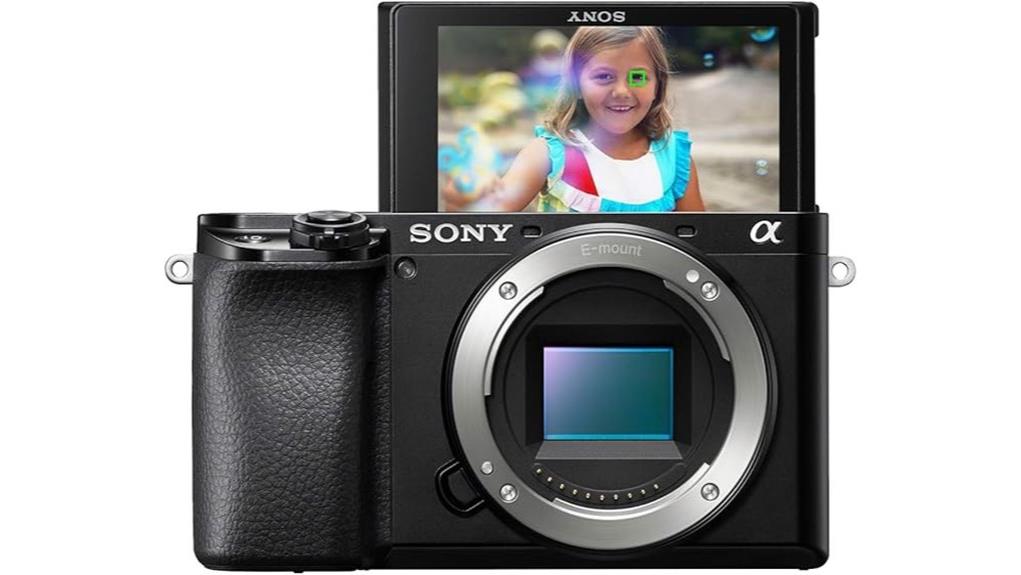
You’ll find the Sony Alpha A6100 a compact, fast mirrorless that balances a 24.2MP APS‑C sensor, BIONZ X processing, and 4K video for hybrid shooters. Its 425‑point Real‑time AF and 11 fps bursts outpace many entry models for tracking and vlogging, though dynamic range and 4K shadow performance lag higher‑end sensors. The pocketable body and kit 16–50mm zoom favor travel and run‑and‑gun work; keep extra batteries and consider alternatives for longer support if you want more detail.
Some Key Takeaways
- Compact APS-C mirrorless balancing speed, autofocus sophistication, and 4K video in a pocketable body ideal for vloggers and travelers.
- 24.2MP Exmor sensor with BIONZ X delivers low-noise stills and usable 4K, though dynamic range and highlight retention are limited.
- Hybrid AF with 425 points, Real-time Eye/Animal AF, and 0.02s claim enable fast, reliable subject acquisition and tracking.
- 11 fps continuous shooting with AF/AE is strong, but sustained RAW bursts depend on card speed (UHS-I/V10 limits apply).
- No in-body stabilization; kit 16–50mm lens has optical IS, and battery life is modest—spares and accessories recommended.
Why the Sony Alpha A6100 Is Worth Considering for Photographers and Vloggers
Consider the A6100 if you want a compact mirrorless body that balances speed, autofocus sophistication, and 4K video without a pro-sized price or bulk. You’ll get hybrid AF with 425 points and Real-time Eye AF that outperforms many entry models, plus 11 fps burst for action. Video captures 4K UHD with usable autofocus and a pocketable form factor that favors run-and-gun creators. Battery longevity won’t match larger bodies, but included cells and efficient processing keep shoots reasonable; plan spares for extended sessions. Menu customization is deep enough to streamline workflows, making the A6100 a pragmatic choice. It’s also well-supported by a range of mirrorless camera accessories tailored to compact bodies.
Key Specs at a Glance: Sensor, AF, Lens, Video, and Battery
While compact, the A6100 packs a 24.2MP APS-C Exmor CMOS sensor and BIONZ X processor that deliver high-resolution stills and 4K video with low-noise performance comparable to higher-tier APS-C bodies. You get hybrid AF across ~84% of the frame with 425 points, supporting Real-time Eye AF and tracking for decisive composition. The 16–50mm kit lens is a small, variable-aperture zoom suited to general use; sensor crops and field-of-view changes are predictable when switching lenses. Video: 4K UHD MP4 up to 90-minute clips. Battery performance is modest—expect moderate shooting days; carry a spare for extended sessions. Proper softbox lighting can brighten your photos and complement the A6100’s image quality.
Autofocus and Speed in Real Shooting: Real‑World AF Tracking and Burst Performance
Having covered sensor, AF coverage, and burst basics, let’s focus on how the A6100’s autofocus and frame rates perform in real shooting. You’ll find the hybrid AF with 425 points locks rapidly; the 0.02s claim manifests in decisive subject acquisition, especially with real-time tracking and eye AF. Edge detection sharpens shifts, reducing focus hunting on busy backgrounds. At 11 fps with AF/AE, sustained bursts are useful, but effective buffer management depends on card speed and RAW vs JPEG choice; UHS-I/V10 limits sustained RAW run. Compared to higher-tier bodies, tracking is excellent for its class but not flawless. Many users pair these cameras with handheld gimbals to achieve smooth shots when tracking moving subjects.
Image and Video Quality: Low‑Light, Dynamic Range, and 4K Footage Tested
Because the A6100 pairs a 24.2 MP APS‑C sensor with Sony's BIONZ X processor and front‑end LSI, you'll get remarkably clean images up to moderately high ISOs and usable 4K footage, but there are trade‑offs versus higher‑end models in dynamic range and noise control. You’ll find low light portraits retain decent skin tone and AF reliability, though shadow recovery is limited compared with newer sensors. 4K H.264 MP4 is detailed and ready for basic cinematic grading, but highlights clip earlier and fine noise appears when pushing exposure. For hybrid shooters it's efficient; pros may want greater DR headroom. This camera is well suited to enthusiast photographers and camera fans seeking a compact mirrorless system with strong autofocus performance and everyday usability, making it a solid choice for enthusiast photographers.
Lenses, Stabilization, and Handling: Kit Lens Behavior and Ergonomics for Travel and Street
If you’re shooting travel or street, the A6100’s 16–50mm f/3.5–5.6 kit zoom stays compact and unobtrusive, trading aperture speed for portability and discreet handling. You’ll find stabilization effective for walk‑and‑shoot frames; optical IS tames shake at longer focal lengths but won’t match IBIS for low‑light handholding. Compare the kit to compact primes: primes offer wider apertures, crisper bokeh and faster AF response, while the zoom wins on versatility and size. Ergonomics favor photographers who prioritize mobility: controls are logical, exposure dials responsive, and tactile controls on the body aid quick adjustments without menu diving. For those looking to expand creative options, consider lens mount adapters to use a wider range of lenses while maintaining the A6100’s portability.
Who Should Buy the A6100 : Ideal Use Cases and Limitations to Know
Think of the A6100 as a compact, fast-focusing tool aimed at enthusiasts and semi-pros who need a lightweight mirrorless for travel, street, and hybrid photo/video work. You’ll appreciate its 0.02s AF, real-time eye/animal AF, and 11 fps burst for action, making it stronger than most entry-level bodies for compact wildlife and fast-paced scenes. It suits beginner portraiture with sharp APS-C detail and reliable eye AF, though kit-lens aperture limits shallow-depth control. Don’t expect in-body stabilization, professional weather sealing, or top-tier low-light ISO performance—those are constraints if you prioritize ultimate robustness or extreme low-light fidelity. Consider pairing it with a sturdy tripod for improved sharpness and compositional control.
Buying Advice: Pricing, Renewed Condition Tradeoffs, and Recommended Alternatives
You’ll want to weigh price against the limits of a renewed A6100: its strengths—fast 0.02s AF, Real-time Eye/Animal AF, 11 fps burst, and 4K video—make it a high-value crop-sensor hybrid for travel and casual pro work, but a renewed unit can show wear, shortened lifespan, or reduced warranty protection compared with new-stock models. If budget is primary, a renewed A6100 with a 90-day limited warranty can be a smart buy; factor warranty considerations and potential lower resale value. Compare against new A6400/A6600 for longer support, or used A7 II series for full-frame benefits. Consider pairing your camera with a secure NAS to protect and organize your growing photo library, especially if you shoot frequently or travel with gear; secure NAS solutions help ensure backups and easy access to images.
Some Questions Answered
Does the A6100 Support In-Camera Image Stabilization for All Lenses?
No — the A6100 doesn't offer sensor shake (in-body) stabilization, so you won't get stabilization for all lenses. You rely on lens stabilization: optical steady shot in OSS-equipped E-mount lenses provides stabilization; non-OSS lenses need stabilized technique or tripod. Comparatively, bodies with in-body image stabilization (IBIS) stabilize any lens, but the A6100 depends on lens stabilization and electronic stabilization options for video, which are less effective than IBIS.
Can It Record External Audio via a Microphone Input?
Yes — you can record external audio via a microphone input. You’ll use the built‑in 3.5mm mic jack for an external microphone; it supports plug‑in power for lavaliers. Compared to models lacking a jack, this improves on‑camera capture quality. If you need XLR mics or advanced preamps, you’ll require audio adapters or an external recorder/preamp. In short, on‑camera external microphone use is supported but XLR needs adapters.
What File Sizes and Bitrates Does 4K Video Use?
4K bitrates vary by frame rate and compression; expect roughly 100–150 Mbps for high-quality 4K, lower profiles around 50–60 Mbps. File sizes scale accordingly: at 100 Mbps you’ll use ~45 GB per hour, at 50 Mbps ~22 GB per hour. You’ll compare codecs and bitrates to balance quality versus storage. Choose higher 4K bitrates for detailed scenes; lower bitrates save space but reduce fine detail and grading latitude.
Is There a Battery Grip or Extended Battery Option Available?
No, there’s no official battery grip for the A6100, but you can use third-party battery grip and power solutions that offer extended runtime and vertical controls. You’ll compare capacity, build quality, and contact reliability; some grip models accept dual NP-FW50 batteries or pack external USB power banks via a dummy battery. Choose grips with solid electrical contacts and pass-through USB charging to avoid overheating during long 4K recording sessions.
How Soon Is Firmware Support for New Autofocus Features Released?
You’ll usually see firmware timelines spanning weeks to a few months; Sony typically issues autofocus updates within that window after announcing features. You’ll get faster releases for critical bugs and slower, bundled updates for major AF algorithm enhancements. Compared to competitor ecosystems, Sony’s cadence is moderate — not fastest, not slowest. Monitor official support pages and forums; firmware timelines and autofocus updates are posted with patch notes and installation instructions.