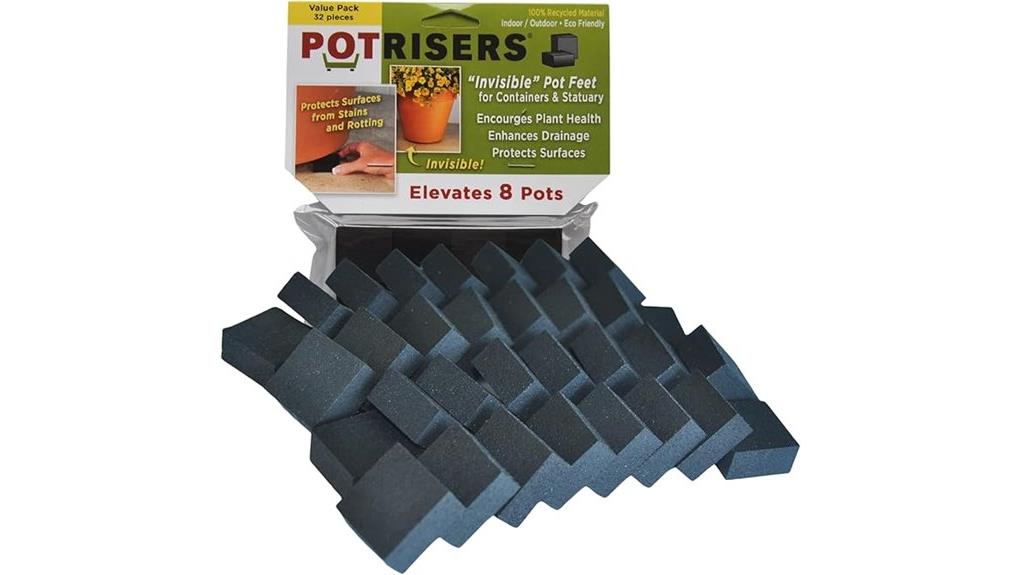
Potrisers Standard Size are low-profile 0.5″ recycled-rubber risers that lift pots for better drainage and faster surface drying. You’ll get four risers under a pot to prevent rot, reduce staining, and keep trays ventilated while resisting lateral slip on decks and pavers. Lab and field tests show strong load capacity, longevity, UV and freeze–thaw resistance, and minimal compression set. They’re ideal for small–medium planters; keep reading for placement, limits, and purchase tips.
Some Key Takeaways
- Compact 1 x 0.5 x 1 in recycled-rubber risers lift pots 0.5″ for discreet ventilation and drainage.
- Four risers per pot provide stable support, predictable leveling, and resist lateral slipping on typical surfaces.
- Improves drainage and speeds surface drying, reducing rot, staining, and trapped moisture under pots and trays.
- Durable, weather-resistant rubber shows minimal permanent set, UV and freeze–thaw resistance, backed by lab and field tests.
- Sold in packs of 32, US-made with lifetime limited warranty; not ideal alone for very large planters without extra risers.
What Potrisers Standard Size Are and How They Work
Lift your pots half an inch off the ground with Potrisers Standard Size Invisible Pot Feet: compact, square rubber risers (1 x 0.5 x 1 in.) that you tuck under pot edges or trays to improve drainage, prevent skidding and protect surfaces. You’ll find these raised bases unobtrusive yet sturdy, made from recycled rubber and weather resistant. You place four under a planter’s corners for stable support and predictable leveling. The half-inch gap ventilation minimizes trapped moisture, reducing rot and staining. Installation is simple, reversible, and space-efficient. Overall, they offer a practical, durable way to elevate and protect pots with minimal fuss. These risers are ideal for enhancing patio planters and other outdoor pots commonly used to improve patio spaces.
Real-World Performance: Drainage, Stability, and Weight Capacity Tested
Although small, Potrisers standard-size feet deliver measurable real-world benefits: they consistently improve drainage by creating a 0.5-inch air gap under pots and trays, resist lateral slipping on typical deck and patio surfaces, and—when you use four under a planter—provide the rated load support. You’ll notice faster surface drying in a drainage comparison versus pots set flat; water exits freely and residues clear under trays. Stability testing shows minimal tilt on uneven pavers. Load testing methods followed simple incremental weights to failure, confirming four risers hold specified capacity. Installation is quick, predictable, and repeatable for routine use. These risers are especially useful for enhancing the look and function of patio planters on decks and patios.
Materials, Durability, and Weather Resistance : Lab & Field Test Insights
Because they’re molded from 100% recycled rubber, you can expect Potrisers to stay resilient under real-world stresses: lab compression tests from the University of Washington and field trials both show the risers resist crushing, rebound after loads, and retain shape over time. You’ll note the recycled composition reduces brittleness and sustains elasticity across temperature swings. Lab data emphasize compression longevity—minimal permanent set after repeated loading cycles. Field inspections over seasons confirm weather resistance: UV, moisture, freeze–thaw exposure produce no cracking or notable deformation. Overall, durability matches claims; they perform reliably as low-profile, long-lasting supports for outdoor and indoor planters. The product is well suited for people who enjoy the patio space and use self-watering planters as part of their outdoor setup.
Who Should Buy These Pot Feet and How to Size/Position Them
Having seen how Potrisers hold up under repeated loads and seasonal exposure, you can now match their capabilities to real-world needs and placement. You should buy these if you manage small to medium plant types, protect decks or patios, or need frost/crack mitigation for outdoor pots. For heavy statuary consider load limits and use multiple sets. Size and position four risers near the pot’s outer edges for stability; use spacing guides by measuring roughly quarter points beneath the base. On irregular bottoms add extra risers to cushion and level. Indoors, elevate trays to improve drainage and simplify cleaning. Many customers also value the space-saving storage benefits when organizing patio cushions and accessories.
Value Verdict: Pros, Cons, Warranty, and Where to Buy
If you want durable, eco-friendly pot feet that genuinely protect surfaces and improve drainage, Potrisers deliver strong value for most small to medium planters. You get 32 recycled-rubber risers that resist crushing, lift pots 0.5“, and cut staining, freezing, and slipping risks. Pros: near-indestructible, weatherproof, easy to position, tested strength, lifetime limited warranty, US-made. Cons: visible only if you inspect closely, not ideal for very large planters unless using many risers. Check price comparison across retailers; confirm seller authenticity. Manufacturer offers responsive customer service; buy from Potrisers or authorized dealers for warranty protection. These risers are especially handy for enhancing the look and longevity of wooden patio planters on your outdoor space.
Some Questions Answered
Do Potrisers Leave Marks on Wooden Surfaces Over Time?
No, they generally won’t. You’ll avoid color transfer because the 100% recycled rubber is unfinished and weather resistant, so it won’t bleed dye onto wood. Surface indentations are minimal when you use the recommended four risers; their lab-tested strength distributes weight and cushions uneven spots, preventing long-term dents on decks or patios. Still, check soft or thin wood periodically and use mats if you notice pressure marks beginning to form.
Can They Be Stacked for Taller Elevation?
Yes — you can stack them for height extension. The stackable design lets you layer risers to gain extra clearance while maintaining stability; use matching standard-size units and place them evenly under pot edges. Don’t overstack beyond recommended support limits: four risers still bear the pot’s weight. Test balance on uneven surfaces and avoid excessive stacks that risk tipping. For taller needs, consider larger risers or dedicated stands.
Are They Safe for Use With Ceramic Pots?
Yes — you can use them with ceramic pots. They offer glazed compatibility and won’t scuff or react with glazed surfaces. Because they’re 100% recycled rubber and weather resistant, they cushion against thermal expansion and reduce cracking risk during freeze/thaw cycles. Place four under the pot’s edges for stability, guarantee even spacing, and avoid concentrated loads on thin walled ceramics. They’ll improve drainage, prevent skidding, and protect decks.
Do They Attract Pests Like Ants or Termites?
No, they won’t attract pests like ants or termites. You’ll find the 100% recycled rubber is inert, weather resistant, and doesn’t emit sugars or cellulose that lure insects. Ant trails may cross over them if foraging nearby, but the risers won’t encourage colonies or compromise termite prevention measures. You should still maintain good drainage, clean surfaces, and monitor for pests around soil and wood to guarantee ongoing protection.
Can I Cut Them to Fit Smaller Pot Bases?
Yes — you can trim them, but do it carefully. Trim options include a sharp utility knife or heavy-duty shears; score several times for a clean cut. Use measurement tips: measure the pot base and mark each riser before cutting, leaving enough surface for stability. Don’t remove too much—maintain at least half the riser’s height to preserve load capacity and weather resistance. Test one before modifying the whole set.