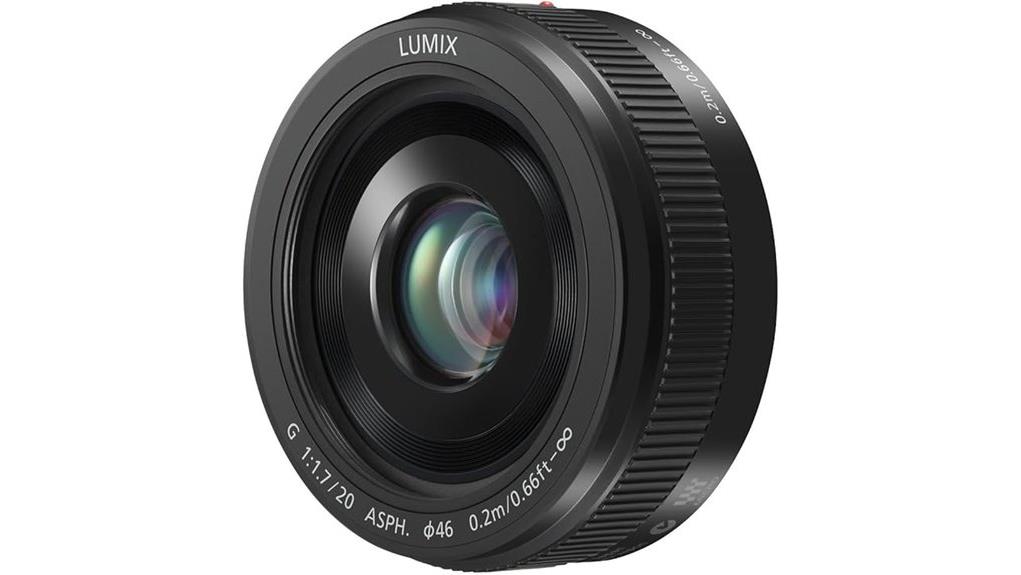
You’ll find the Panasonic LUMIX G II 20mm f/1.7 is a compact, 87 g Micro Four Thirds prime that gives fast f/1.7 low‑light capability and near‑normal 40mm equivalent framing. You’ll get punchy center sharpness wide open, peak acuity near f/4, smooth seven‑blade bokeh with mild onion‑ringing, and noticeable vignetting at f/1.7. Autofocus is micromotor‑driven and mostly responsive, with close‑focus to 0.2 m. Keep going to see detailed comparisons, handling notes, and buying advice.
Some Key Takeaways
- Compact 20mm f/1.7 (40mm equiv.) prime ideal for street, travel, and everyday shooting on Micro Four Thirds.
- Fast f/1.7 aperture delivers strong low-light performance and good subject separation with smooth seven-blade bokeh.
- Punchy center sharpness at f/1.7, peak detail around f/4, with modest edge falloff and mild onion-ring bokeh texture.
- Lightweight (87 g), easy to balance, but all-plastic build, no weather sealing, and no optical stabilization.
- Autofocus is generally quick via micromotor with occasional low-contrast hunting; close-focus 0.2 m (0.13x) useful for portraits.
Why the 20mm F1.7 Matters: Who This Lens Is For
Because it combines a compact, lightweight build with a fast f/1.7 aperture, the Panasonic 20mm is a practical, high-quality everyday prime for Micro Four Thirds users who want a near‑normal field of view (40mm equivalent) with strong low‑light and shallow‑depth control. You’ll appreciate its portability if you shoot run-and-gun street, travel, or documentary work where weight and discretion matter. It’s well suited to portraits at modest distances, offering useful portrait potential without telecentric compression. You can also exploit creative filters and in-camera processing for stylized looks. Autofocus responsiveness and close-focus utility make it a versatile, efficient tool. The lens is an excellent match for enthusiasts shopping in our store for essential Micro Four Thirds gear.
How It Performs on Image Quality: Sharpness, Bokeh, and Vignetting
Moving from who this lens suits to how it renders, you’ll find the 20mm F1.7 delivers punchy center sharpness wide open with only modest falloff toward the edges. You’ll note in a sharpness comparison against similar primes that centers are usable at f/1.7, midframe tightens by f/2.8, and peak acuity appears around f/4. Bokeh rendition is smooth for short telecentric distances, with seven-blade highlights that round nicely but show mild onion-ring texture. Vignetting measurement reveals noticeable corner darkening at f/1.7, largely gone by f/4. Edge performance improves stopping down; chromatic aberration remains well controlled. This lens is a great fit for photographers who enjoy close-up work and often use macro lenses to capture fine detail.
Handling and Autofocus: Size, Build, Focus Speed, and Close-Focus Behavior
Handle the 20mm F1.7 with confidence: it’s tiny and light (87 g) so it won’t upset your camera’s balance, and the all-plastic construction feels serviceable though not rugged—no weather sealing. You get compact handling that makes it ideal for grab-and-go setups; the smooth manual aperture ring is minimal but functional. Autofocus uses a micromotor and performs acceptably with contrast-detect systems—generally quick, sometimes exhibiting slight focus hunting in low-contrast or dim scenes. Close-focus to 0.2 m yields usable 0.13x magnification for near portraits and detail shots, though working distance is modest. Overall handling is efficient and predictable. It’s a great match for mirrorless users looking for compact handling and portability.
Real-World Use Cases: Street, Low-Light, Video, and Travel Examples
When you need a compact, fast prime for everyday shooting, the Panasonic 20mm F1.7 excels across street, low‑light, video, and travel scenarios thanks to its small size, bright aperture, and predictable handling. You’ll shoot street scenes confidently: 40mm-equivalent framing feels natural, focus is quick, and 0.2m close-focus lets you isolate subjects. In low-light you’ll favor f/1.7 for night portraits with subject separation and usable shutter speeds. For video, the lens is quiet enough for handheld interviews and delivers minimal focus breathing. Travel benefits from 87g weight, 46mm filters, and reliable contrast-AF on Lumix bodies. Lightweight tripod options can further enhance travel shooting when you need steady long exposures or stable video with compact support.
Should You Buy It? Price, Alternatives, Warranty, and Final Verdict
Figuring out whether to buy the Panasonic 20mm F1.7 comes down to value for your shooting needs: it's a compact, fast prime that delivers excellent street and low‑light performance on Micro Four Thirds bodies, but you should weigh its lack of optical stabilization and weather sealing against its lightweight handling, affordable price point, and straightforward alternatives from Olympus and Sigma. For your buying decision, compare price comparisons against Olympus 17mm and Sigma 30mm options; evaluate warranty terms (manufacturer 1‑year plus many sellers' 30‑day returns). If you prioritize size, speed, and cost, buy it; otherwise choose an alternative lenses. This lens is a good fit for photographers focused on prime lenses who value simplicity and image quality.
Some Questions Answered
Does This Lens Come With a Hood or Case Included?
No, it doesn't—boxed lens packaging typically includes caps and a simple pouch, not a dedicated hood or hard case. You’ll want to verify accessory compatibility if you need a hood or protective case: the lens has a 46 mm filter thread for screw-on hoods and standard 46 mm filters, and its compact 87 g body fits many third-party pouches. Consider buying a screw-in hood or small padded case separately for better protection.
Is the Lens Compatible With Full-Frame Panasonic Bodies?
No — you can’t use this Micro Four Thirds lens natively on full-frame Panasonic bodies. It’s designed for the MFT mount, so it projects a smaller image circle suited for crop adaptation; on a full-frame camera you’d get severe vignetting or need a crop-mode, losing resolution. You can adapt with third-party mount adapters, but you’ll still be limited to crop adaptation or heavy cropping, so it’s not ideal for true full-frame use.
Can I Use This Lens for Portrait Headshots Effectively?
Yes — you can use it for portrait headshots, but expect limitations. You’ll get shallow depth at f/1.7 for subject separation, yet the 20mm (40mm equivalent) gives only mild close up compression compared to longer lenses, so facial proportions stay natural but can show slight wide-angle distortion if you're too close. Focus is fast enough for controlled shots, but no stabilizer and limited magnification mean careful technique and framing are required.
Does the Lens Support Manual Focus Override?
Yes — you can use manual focus override, but it's limited. The lens has a mechanical focus ring that lets you switch to manual focus and fine-tune, though there's no full-time electronic clutch. The focus ring feel is light and a bit geared for quick turns, not precision cinema pullers. You'll get usable manual control for stills and casual video, but expect some play and less tactile refinement than higher-end lenses.
What Is the Exact Weight and Dimensions for Travel Packing?
The exact weight is 87 grams; compact weight for travel. Dimensions are small and pocketable: roughly 57 mm diameter and about 25 mm length (body only, cap attached adds a few mm). You’ll find these pocketable dimensions make it easy to slip into a small bag or jacket pocket. Evaluatively, its compact weight and pocketable dimensions offer excellent portability without sacrificing standard-prime handling or build confidence.