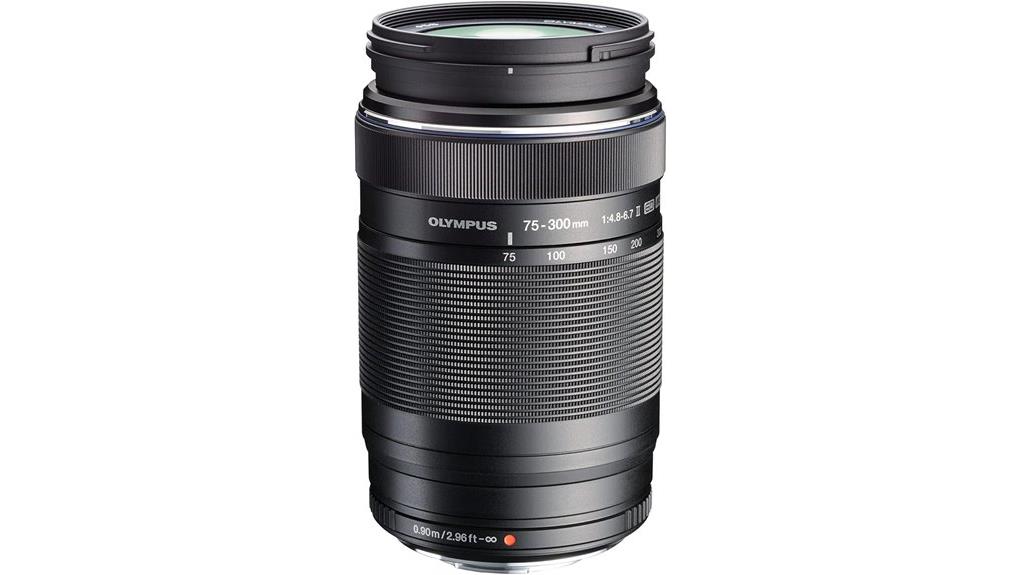
You’ll get a compact, lightweight 75–300mm (150–600mm equiv.) telezoom that’s built for budget-conscious Micro Four Thirds shooters who want long reach without bulk. It’s sharp centrally at 75–200mm stopped down, uses super-ED/ED/HR elements and ZERO coating, and offers MSC AF good for static and slow subjects. Expect slow apertures, edge softness at 300mm, modest stabilization, and no weather sealing. If you want more on handling, performance trade-offs and alternatives, keep going.
Some Key Takeaways
- Lightweight 75–300mm (150–600mm equiv.) telezoom offering affordable long reach for Micro Four Thirds users.
- Good center sharpness 75–200mm wide-open; softness at 300mm and extreme apertures.
- Slow f/4.8–6.7 aperture limits low-light and fast-action performance.
- MSC autofocus is reliable for static and slow subjects but hunts in dim conditions.
- Best value for casual birding, travel, and learning composition when portability and budget matter.
Quick Verdict: Who This 75–300mm Is Best For
Who needs this 75–300mm? You do if you're a beginner birding enthusiast seeking an affordable reach. This Olympus M.Zuiko serves Micro Four Thirds shooters who prioritize lightweight, compact handling over pro-grade glass. It's a pragmatic budget telephoto: long focal range (150–600mm equiv.) and modest magnification let you frame distant subjects without breaking your kit budget. Expect competent, contrasty results in good light; don't expect fast apertures or weather sealing. Use it for casual wildlife, travel, and learning composition and tracking. If you want high-speed low-light performance or professional durability, look higher. It's a great match for photographers focused on mirrorless systems and essential accessories like lightweight lenses to keep kits portable.
What the Lens Offers: Key Specs and Build Highlights
Although this Olympus 75–300mm prioritizes reach and portability over pro-grade features, it gives Micro Four Thirds shooters a compact, technically capable telephoto: a 75–300mm (150–600mm equivalent) zoom with an f/4.8–6.7 aperture range, 18 elements in 13 groups including super-ED, ED and HR elements, and ZERO coating to control flare and contrast. You get telephoto reach in a light 423 g package with compact construction, a seven-blade diaphragm and 0.18× magnification. Close focusing is modest (0.9–1.5 m) but useful for nature work. Build favors portability over weather sealing; controls are minimal and functional. This makes it an attractive option for wildlife and sports photographers seeking long reach without carrying heavy gear.
Real-World Performance: Sharpness, AF, Stabilization, and Handling
When you put the Olympus 75–300mm into real use, its strengths and limits become clear: center sharpness is good from 75–200mm wide-open, but contrast and edge resolution fall off noticeably at 300mm and toward the extremes of the aperture range. In sharpness testing you’ll find best results stopped to f/8–11 mid-range; chromatic aberration and softness at edges demand correction. The MSC AF delivers reliable focus consistency for static and slowly moving subjects but hunts in low light. Stabilization behavior is modest—digital correction helps but won’t match in-body systems. Handling comfort is excellent: light, balanced, and pocketable for extended use. For photographers building their kit, consider essential lens gear that complements this lens for better results.
Use Cases and Sample Scenarios: Wildlife, Travel, and Outdoors
Because it packs a 150–600mm equivalent reach into a light, pocketable body, this Olympus 75–300mm becomes a practical choice for wildlife, travel, and outdoor shooting where weight and reach matter more than ultimate edge sharpness. You’ll use it for distant birds, mammals, and staged wildlife portraits at moderate apertures; MSC AF gets you responsive framing, though fine detail softens at extremes. For travel landscapes, you’ll exploit telephoto compression to isolate subjects and compress scenes. Handheld hiking and roadside wildlife benefit from low weight and digital stabilization, but plan for limited low-light speed and occasional vignette with thick filters. Consider pairing it with a waterproof camera bag to keep your gear dry during outdoor excursions.
Buy or Skip? Value, Alternatives, and Final Recommendation
If you need long reach on a strict weight and budget limit, the Olympus 75–300mm delivers credible telephoto reach in a compact, affordable package. You’ll get 150–600mm equivalent coverage, light 423 g handling, and MSC autofocus suitable for outdoor subjects, but expect slow apertures, limited low-light utility, and vignette with thick filters. Buy if you prioritize portability and low cost; skip if you need fast glass, weather sealing, or top-tier sharpness. Consider budget alternatives like used Panasonic telezooms or slower primes for similar reach. Resale value is modest but steady—reasonable if you plan to upgrade later. For travel photographers prioritizing weight, pairing this lens with a lightweight tripod can make handheld reach more usable on long outings.
Some Questions Answered
Is This Lens Weather-Sealed or Splashproof?
No — it’s not weather-sealed and lacks splash protection. You shouldn’t expect dust or moisture resistance with this lens. Technically, the construction isn’t rated for sealing, so you’ll need to avoid wet conditions or use protective measures (rain cover, sealed camera body). For outdoor or nature work, plan for contingencies: keep cloths, plastic covers, and dry storage. Warranty doesn’t cover water damage, so be cautious in adverse weather.
Can I Use Teleconverters With This Lens?
You can physically mount some Micro Four Thirds teleconverters, but teleconverter compatibility is limited and not officially supported for this consumer zoom. You'll likely see notable image degradation: reduced sharpness, contrast, and effective autofocus performance, especially given the lens's slow f/4.8–6.7 aperture. If you try teleconverters, expect increased vignetting and focus hunting; test carefully for acceptable results and avoid stacking filters or using long exposures without stabilization.
What Filters Sizes Fit the Front Element?
The front element takes 58 mm filters, so you’ll buy 58 mm filters and compatible Lens cap options. You’ll get correct threading for standard screw-on 58 mm filters (UV, ND, polarizer). Note that stacking multiple or thick filters may vignette at wide settings and the lens hood or barrel can obstruct flash. Use slim-profile filters to minimize vignetting, and choose a snug 58 mm lens cap option to protect the front element during transport.
Is There a Manual Focus Clutch or Switch?
No, there’s no manual focus clutch or switch; you’ll use the MSC autofocus and manual override via the focus ring. The focus throw is short, tuned for quick AF corrections rather than precise manual work. You can grab the ring to fine-tune focus, but expect limited travel and tactile feedback. For deliberate manual focusing or macro-like precision you’ll find the throw restrictive compared with dedicated MF lenses.
Does the Lens Support In-Camera Lens Corrections?
Yes — you’ll get in camera corrections for this lens on compatible Micro Four Thirds bodies. The camera applies profile-based corrections (vignetting, distortion) and reduces chromatic aberration automatically when lens data is recognized. Results vary by body and firmware; aggressive correction can slightly alter edge sharpness. If you need precise control, you can disable in camera corrections and apply tailored profiles in RAW converters for finer chromatic aberration removal and distortion control.