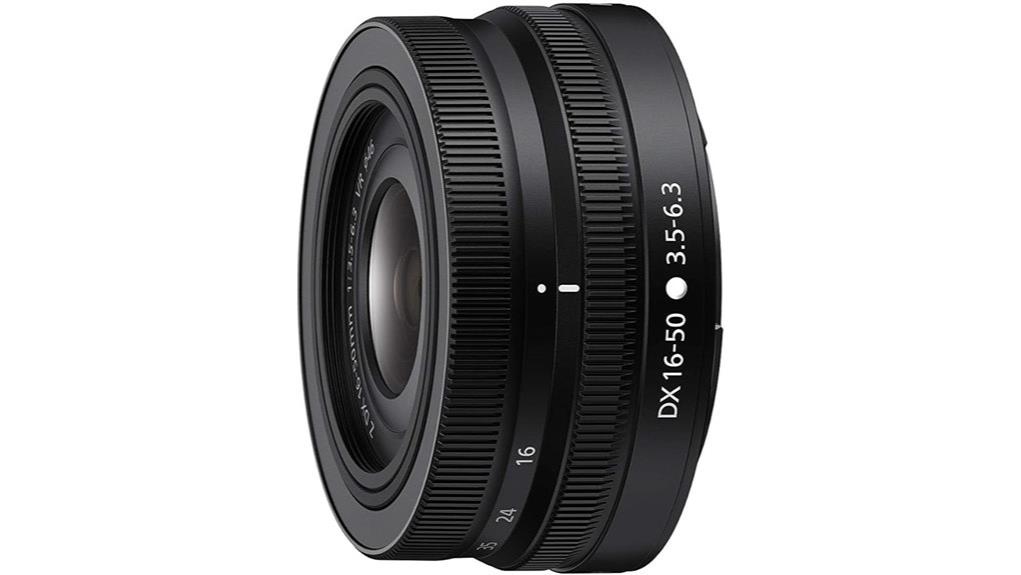
You’ll find the NIKKOR Z DX 16–50mm VR a pocketable, DX‑specific standard zoom that trades ultimate resolving power for portability and reliable stabilization. It covers 24–75mm equiv., offers about 4.5 stops of VR and close‑focus down to ~0.20–0.30 m, delivers crisp centers with mild corner softness at extremes, and autofocus is generally quick and quiet on Z DX bodies. It’s ideal for travel and everyday use; continue for a fuller assessment of strengths, limits and alternatives.
Some Key Takeaways
- Compact, pocketable DX zoom (16–50mm; 24–75mm equiv.) ideal for travel and everyday shooting.
- Built-in VR offers about 4.5 stops stabilization for steady handheld shots.
- Crisp center sharpness most apertures, but mild corner softness wide-open and at focal extremes.
- Quick, quiet autofocus on Z DX bodies, with occasional hunting on low-contrast subjects.
- Lightweight, retractable design with assignable control ring, but not fully weather-sealed or pro-grade.
Verdict and Who This Lens Is Best For
While it won’t replace pro-grade glass, the Nikon NIKKOR Z DX 16–50mm VR delivers a compact, versatile standard zoom that’s ideal for DX Z-series users who prioritize portability and everyday performance. You’ll appreciate its small footprint, built-in VR and useful focal spread for general shooting. Optics balance sharpness and weight; you’ll accept mild edge softness at extremes in exchange for convenience. If you need an affordable everyday,travel companion that handles landscapes, street, and snapshots with steady results, this lens fits. Professional assignments demanding ultimate resolving power or constant aperture won’t find this lens sufficient. Perfect Tripods recommends pairing compact lenses like this with a lightweight compact tripod for improved stability and portability.
Key Specs That Matter: Focal Range, VR, and Close‑Focus Distances
Because it covers 16–50mm (24–75mm full‑frame equivalent), this zoom gives you a true walkaround range for DX Z bodies—wide enough for landscapes and interiors, short‑tele for portraits and detail. The built‑in VR delivers up to ~4.5 stops of stabilization, so you can handhold slower shutter speeds confidently. Close‑focus distances (0.20–0.30 m across focal lengths) let you frame tight detail and near‑macro-ish subjects without extension. Optical design balances size and correction; expect controlled chromatic aberration though extreme ultra wide scenes may show edge colour shift. Portrait bokeh is acceptable for the class. Note: no weather sealing specified. This makes it a practical choice for everyday shooters looking for compact, versatile optics with portrait-oriented performance.
Real‑World Performance: Sharpness, Autofocus, and Stabilization
When you inspect sharpness across the 16–50mm range, the lens delivers crisp center resolution at most apertures but shows mild corner falloff and softness wide-open, especially near 16mm. You’ll find edge contrast improves noticeably by f/5.6, yielding usable corners for prints. Autofocus is generally quick and quiet on DX Z bodies; you rarely see focus hunting in normal light, though low-contrast subjects can induce brief dithering. VR provides steady handheld shots up to several stops; Nikon’s 4.5-stop claim feels realistic. Bokeh rendition is busy at longer focal lengths. High ISO performance depends on camera body more than the optic. This makes the 16–50mm a practical choice for everyday zoom use by enthusiasts.
Handling and Design: Size, Control Ring, and Build for DX Z Users
Although compactness often sacrifices controls, the Z DX 16–50mm balances pocketable size with usable ergonomics: it's the smallest DX interchangeable zoom Nikon makes, yet its assignable control ring feels positive and crisply damped for exposure or focus adjustments. You’ll appreciate the compact footprint on a Z DX body—handling stays balanced and the lens retracts for pocketability benefits without excess bulk. The tactile ring gives precise input and is programmable in camera menus. Build quality is lightweight but competent; don’t expect full metal robustness or extensive weather sealing. For travel and daily carry, the design prioritizes portability and practical control. This lens is a great fit for mirrorless camera enthusiasts looking for essential, travel-friendly gear.
Buy or Skip? Pricing, Alternatives, and Final Recommendation
Now that you know how it handles and what to expect from the build, let’s look at whether the Z DX 16–50mm VR is worth buying. You’ll pay a premium for compactness, reliable VR (up to ~4.5 stops), and an assignable control ring; factor in budget considerations if you need faster optics or weather sealing. Optically it’s competent for general use but soft at extremes. Consider third‑party alternatives only if you prioritize cost over seamless Z‑mount integration; adapters add compromise. Recommendation: buy if you value size, stabilization, and DX design; skip if you need pro‑level sharpness or low‑light speed. For transporting and protecting your gear, consider using Pelican cases to keep your kit safe and organized.
Some Questions Answered
Does This Lens Accept Filters and What Sizes Fit?
Yes — you can fit filters, but the lens uses a recessed front element so standard screw-on filters need a threaded adapter for secure mounting. You’ll get UV protection with a properly seated filter; serviceable protective filters work well. Consider step up rings if you prefer larger common sizes. Filter compatibility depends on the adapter thread size; evaluate vignetting and weight tradeoffs when using adapters or step up rings on this compact DX zoom.
Is the Lens Weather‑Sealed or Moisture Resistant?
No — the lens doesn’t have full weather protection; it’s not rated as weather‑sealed. You should treat it as moisture‑sensitive and avoid heavy rain or dusty conditions. In technical terms, sealing tests by Nikon aren’t specified for this DX kit zoom, so it lacks manufacturer‑guaranteed ingress protection. If you need reliability in adverse conditions, you’ll want a dedicated weather‑sealed lens or use protective measures like a rain cover or careful handling during shoots.
Can It Be Used on Full‑Frame Z Cameras Without Issues?
Yes — you can mount it on full‑frame Z cameras with an FTZ adapter, but you’ll need to use adapter use and camera settings to manage results. You’ll encounter significant image vignetting and cropped DX‑mode capture unless you shoot in DX crop; full‑frame coverage isn’t provided. Optically you’ll be fine for short focal lengths, but expect reduced resolution per pixel and limited peripheral sharpness when forcing full‑frame capture without cropping.
Does It Support In‑Camera Lens Corrections for Distortion?
Yes — you’ll get in‑camera corrections; the camera applies distortion profiles for this DX 16–50mm lens. Your Z‑series body detects the lens and automatically uses embedded distortion profiles to correct barrel and pincushion artifacts, plus chromatic aberration and vignetting where supported. You can disable corrections if you prefer raw lens output, but leaving them on yields more rectilinear results and reduces postprocessing for routine wide‑angle to standard shooting.
Is There a Compatible Lens Hood Included or Available?
No, a dedicated lens hood isn't included, and Nikon doesn't list an official hood for that collapsible kit lens; you'll need third‑party hoods if you want one. You can attach compatible third‑party hoods designed for the 16–50mm profile, though some require a bayonet adapter or specific mounting to avoid vignetting when collapsed. Evaluate hood length and compatibility; shorter petal hoods work best to preserve framing and autofocus performance.