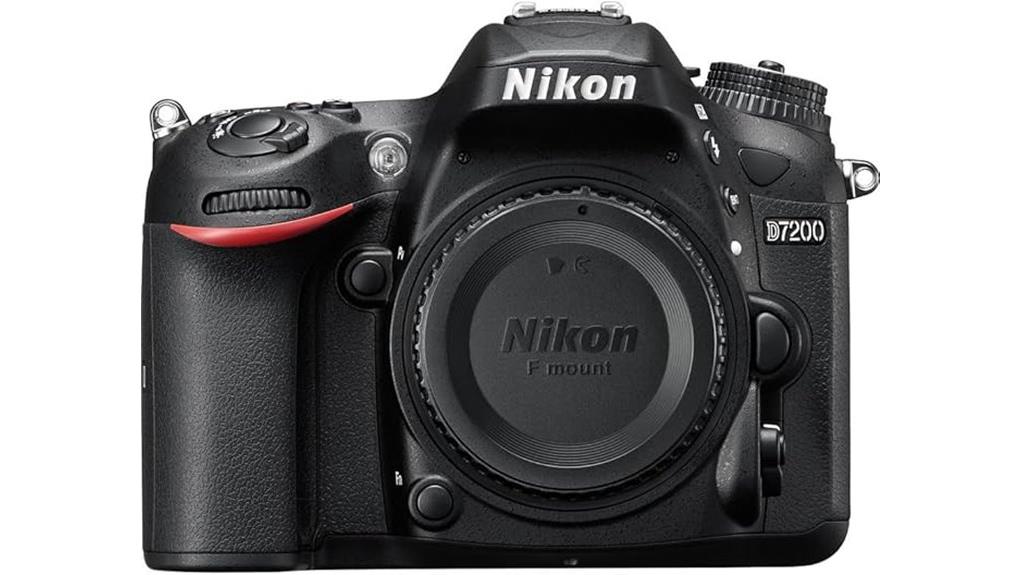
You’ll find the Nikon D7200 offers a balanced blend of 24.2MP DX resolution, robust low‑light performance and a fast EXPEED4 pipeline, with the optical low‑pass filter removed for sharper detail. Its 51‑point phase‑detect AF and 6 fps continuous shooting handle most enthusiast sports and wildlife needs, while the durable F‑mount body and reliable AF contacts support extensive lens options. Built‑in Wi‑Fi/NFC and tethering streamline workflow; read on for full details and tradeoffs.
Some Key Takeaways
- 24.2MP DX sensor with EXPEED 4 delivers sharp detail and strong color fidelity, especially up to ISO 1600.
- 51-point AF system and 6 fps continuous shooting provide reliable focus and modest burst performance for enthusiasts.
- Robust DX body, metal mount, and ergonomic grip ensure durable handling for run-and-gun and heavier lenses.
- Low-light usability extends to ISO 6400–12800 depending on output, with effective noise reduction preserving microcontrast.
- Built-in Wi‑Fi/NFC, tethered USB RAW support, and broad F-mount lens compatibility suit versatile workflows.
Verdict and Who the Nikon D7200 Body Is Best For
While the D7200 doesn't carry the newest sensor technologies, it delivers a balanced combination of resolution, speed, and low-light performance that makes it a strong choice for enthusiast photographers who need a durable, high-performance DX body. You’ll find its 51-point AF and 6 fps shooting suit portrait enthusiasts needing reliable focus tracking and modest burst rates. Video shooters benefit from EXPEED 4 processing, clean handling and robust build for run-and-gun work, plus Wi‑Fi/NFC for quick transfers. Its F‑mount compatibility and AF contacts support extensive lens options, so you can prioritize system flexibility and sustained operational reliability. It also pairs well with accessories aimed at mirrorless and DSLR users, such as essential gear that enhance shooting versatility.
Image Quality and Low‑Light Performance (24.2MP Sensor, No OLPF, ISO Range)
Because Nikon removed the optical low-pass filter and paired a 24.2MP DX CMOS sensor with the EXPEED 4 processor, you get sharper fine detail and improved resolving power across common focal lengths. You’ll resolve more high frequency detail, particularly in textures and foliage, without the slight blurring an OLPF introduces. The EXPEED 4 yields efficient noise reduction, preserving microcontrast so edges stay defined at mid ISOs. Color fidelity remains strong, with accurate hues and smooth tonality out to ISO 1600. At higher sensitivities noise rises predictably; usable results extend to ISO 6400–12800 depending on output needs and noise tolerance. The site caters to enthusiasts and camera fans looking for gear and accessories for digital photography, making it easy to find compatible lenses and peripherals for the D7200 camera accessories.
Autofocus, Burst Shooting, and Real‑World Performance (51‑Point AF, 6 Fps)
Sharper resolving power and cleaner high-ISO handling make image capture more demanding of a responsive AF system and sustained burst performance, so examine how the D7200's 51-point AF and 6 fps shooting hold up in real use. You’ll find the 51-point module uses phase detection across a dense central array, delivering rapid focus acquisition with compatible lenses. In single and continuous AF modes the camera sustains 6 fps reliably until buffer limits; tracking performance is competent for sports and wildlife at moderate speeds but can lose small, erratically moving subjects. Overall, you get predictable, fast autofocus and usable burst capability for most applications. For those building a kit, pairing the body with essential accessories can help you get the most from its autofocus and burst features.
Handling, Lens Compatibility, and Physical Features (F‑Mount, AF Coupling, Controls)
Although the D7200 keeps a traditional DSLR layout, its F‑mount, AF coupling and control layout make lens changes and manual operation straightforward for most users. You’ll find an ergonomic grip that secures larger lenses and balances the body; mount durability is robust, with solid metal construction and reliable AF contacts for electronic communication. The button layout groups exposure, AF and ISO controls within thumb and index reach, so you’ll change settings without shifting your stance. Optical viewfinder coverage is generous, offering clear framing and focus confirmation. Overall handling favors deliberate, tactile operation and wide compatibility with F‑mount glass. For photographers who use tripods frequently, choosing the right tripod head can further improve stability and ease of composition with the D7200 by matching the camera’s balance and controls to a compatible tripod head.
Connectivity, Workflow, Price Check, and Alternatives to Consider
When you pair the D7200 with its built‑in Wi‑Fi and NFC, transferring images and initiating remote control becomes fast and straightforward, letting you preview shots on a phone or tablet and trigger the shutter without extra adapters. You’ll integrate the D7200 into a wireless workflow for quick culling, basic edits, and upload. Tethered RAW capture via USB remains for studio work; EXPEED 4 output and buffer speed support efficient transfers. Check current market pricing—used bodies vary widely; factor battery health and shutter count. Consider aftermarket accessories like grips, remotes, and card readers; compare mirrorless alternatives for futureproofing. Many photographers also use wireless camera remotes to streamline shooting in diverse environments.
Some Questions Answered
Does the D7200 Record 4K Video or Only 1080P?
No, it records only 1080p; it doesn’t support 4K recording. You’ll get Full HD video with multiple Frame rates (including 60/50/30/25/24 fps depending on region and settings). You’ll benefit from the 24.2 MP DX sensor and EXPEED 4 processing for high-quality 1080p output, good low-light performance up to ISO 25,600, and reliable AF during recording, but true 4K recording isn’t available.
What Battery Model Does the D7200 Use and Its Approximate Lifespan?
The D7200 uses the EN‑EL15 battery; EN EL is the common shorthand. You’ll get about 1,110 shots per CIPA battery life under typical conditions; real-world battery life varies with settings and usage. Expect cycle durability of several hundred full charge cycles before capacity noticeably declines; lithium‑ion chemistry lets you recharge often but monitor capacity loss. Replace after substantial capacity drop to maintain reliable shooting and consistent battery life.
Is the Camera Weather-Sealed for Rain and Dust Resistance?
Yes — the camera features weather sealing that offers dust resistance and splash protection for professional use. You’ll get sealed buttons, dials, and a reinforced body-to-battery/memory card door interface that reduces ingress. It’s not fully waterproof, so you shouldn’t immerse it or expose it to heavy, sustained rain without additional protection. Use lens seals and care in harsh environments to maintain long-term reliability and sensor cleanliness.
Can the D7200 Use Autofocus With Older Non-Af-S Lenses?
Yes — you can use autofocus with older non-AF-S lenses only if the lens has a mechanical coupling for the camera’s AF motor. You’ll need to enable autofocus in the body, and the in-body motor will drive the lens’ focus via the mechanical coupling. You can still perform manual focus override with any lens; switch to M or use manual focus ring. AF performance may be slower and noisier than with AF-S lenses.
Does the Camera Support Intervalometer or Built‑In Time‑Lapse Shooting?
Yes — you get a built‑in time‑lapse (internal intervalometer) function in the camera’s shooting menu, so you can program intervals, frame counts and exposure smoothing without extra gear. You can also use external triggers via the accessory terminal or remote release port for more complex schedules or bulb ramps. The camera supports flexible interval timing, auto exposure control between shots, and manual or automatic exposure modes for time‑lapse sequences.