You’ll get an astonishing 24–3000mm (125x) reach in a pocketable body, so you can frame distant birds, wildlife, and sports without hauling big glass. It favors portability and extreme telephoto power over low‑light finesse and pro ergonomics, but Dual Detect VR, phase‑detect AF and 4K video keep long‑reach stills and clips usable. Expect noise and occasional AF hesitation at extreme zooms, plus modest battery life—keep spares. Continue for a full breakdown of performance, handling, and value.
Some Key Takeaways
- 125x zoom covers 24–3000mm equivalent, letting you frame distant wildlife and sports without heavy cropping.
- Dual Detect VR and stabilization modes enable surprisingly steady handheld shots at extreme telephoto ranges.
- 4K video and fast continuous shooting help capture distant action, though sensor size limits fine detail at full zoom.
- Phase‑detect AF with 153 points locks quickly on contrasted subjects but can hesitate with erratic wildlife.
- Compact, travel‑friendly body with modest battery life; accessory bundle adds strong out‑of‑box value.
Who the Nikon COOLPIX P1100 Is Best For
While it isn’t for everyone, the P1100 suits photographers who need extreme reach without hauling a full telephoto rig: birders, wildlife enthusiasts, and travelers who want a single, compact camera that covers 24–3000mm (125x) and shoots 4K video. You’ll appreciate its reach if you’re an enthusiast travelers photographer who prioritizes versatility over ultimate sensor performance. You’ll use it for longreach birding, distant wildlife, and travel scenes where changing lenses isn’t practical. It’s ideal when portability, broad focal coverage, and stabilized handheld shooting matter more than low‑light finesse or pro‑grade ergonomics and replaceable batteries. Expand your phone photography with wide-angle lenses to complement the P1100 for scenes where a broader perspective is desirable.
Quick Specs Snapshot: What the 125x Super Zoom Actually Means
If you’re coming from the previous section on who the P1100 suits, the next question is what that 125x Super Zoom actually gives you in practical terms. You get 24–3000mm equivalent optical reach, letting you frame distant subjects without relying on aggressive digital cropping. That enormous range increases focal compression at long telephoto settings, flattening backgrounds and isolating subjects—useful for tight compositional control. The camera supports Dynamic Fine digital zoom to 6000mm equivalent, but know that expands reliance on digital cropping and reduces detail. Expect pronounced perspective exaggeration shifts between wide and super-tele positions; framing and stabilization become critical for usable results. For wildlife and sports shooters, the long reach and focal compression are particularly valuable for achieving subject isolation and tight framing with telephoto lenses.
Real‑World Image and Video Performance (Wildlife, Sports, Long‑Distance)
Because the P1100 pairs a massive 24–3000mm optical reach with Dual Detect VR and a fast continuous mode, you’ll be able to capture distant wildlife and fast-moving sports action more effectively than most compacts — provided you manage stabilization, framing, and ISO carefully. You’ll find 4K video useful for extracting stills and for long-distance subjects, though sensor size limits ultimate detail at extreme zoom. Use the vari-angle LCD and viewfinder to nail composition; enable telemetry overlay for focal length and exposure readouts during recording. Subject isolation improves at longer reaches, but expect tradeoffs in noise and sharpness. For best long-term performance, consider routine sensor care to maintain image quality and reduce dust spots.
Autofocus, Stabilization, and Low‑Light Handling Tested
Having covered how the P1100 performs on distant subjects and motion, let’s look at how its autofocus, stabilization, and low‑light handling work together in real shooting conditions. You’ll find phase-detection AF with 153 points locks quickly on contrasted subjects; autofocus tracking follows predictable movement but can hesitate on erratic wildlife. Dual Detect Optical Vibration Reduction and selectable stabilization modes steady extreme telephoto shots, letting you handhold longer at 3000mm equivalent. In low light, boosted ISO to 1600–3200 keeps usable detail but raises noise; combine steady support, the VR system, and conservative shutter choices to maximize sharpness without pushing ISO to 6400. For best results when shooting handheld with long lenses, consider pairing the camera with a gimbal stabilizer to reduce fatigue and improve framing gimbal stabilizers.
Ergonomics, Battery Life, Accessories, and Bundle Value
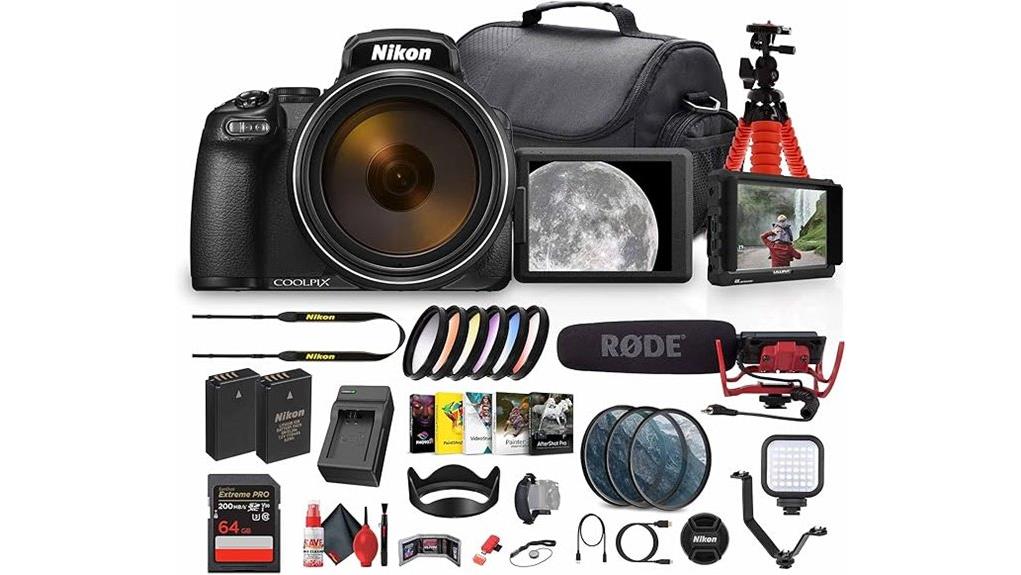
While the P1100’s compact body aims for grab-and-go convenience, its hefty listed weight and deep grip change how you’ll actually handle it—expect a camera that feels closer to a small DSLR when you mount the long zoom or add accessories. You’ll appreciate grip comfort during long tracking sessions, though smaller hands may fatigue. Battery life with the EN-EL20a is modest for 4K work; bring spares or use the external charger included in some bundles. The generous accessory bundle adds real value: external mic, monitor, filters, light, tripod, bag, and multiple charging options make it shoot-ready out of the box. For transporting this kit and keeping your gear protected and organized, consider a dedicated camera shoulder bag.
Strengths and Limitations: When to Choose the P1100 vs Alternatives
If you need extreme reach and straightforward 4K capture for wildlife or long-distance subjects, the P1100 delivers a unique mix of features that make it worth choosing—its 125x optical zoom, Dual Detect stabilization, 4K UHD output with clean HDMI, and all-inclusive accessory bundle let you get sharp telephoto stills and usable video without swapping lenses. You’ll appreciate zoom usability and accessory value, but accept optical limitations at longest focal lengths and sensor tradeoffs in low light and dynamic range. Compare alternatives for better low-light performance, smaller form factors, or interchangeable lenses; use alternative comparisons to match priorities. For those pairing long lenses with motion-control for smooth cinematic moves, consider integrating the camera with motorized camera sliders to maximize dynamic telephoto shots.
Final Verdict and Buying Recommendation (Who Should Buy, Who Should Skip)
The P1100’s strengths — massive 125x optical reach, Dual Detect stabilization, clean 4K output and a all-inclusive accessory bundle — make it a clear choice for photographers and videographers who prioritize long-distance reach and out-of-the-box usability. If you need reach for wildlife, sports or surveillance and value included accessories, buy it. Check the buyer’s checklist: acceptable sensor size, handling for long lenses, battery spares, and tripod mounting. Skip it if you demand low-light performance, pocketable size, or weather sealing. Consider resale potential—niche superzooms hold value among enthusiasts, but mainstream demand is limited. Enthusiasts of mirrorless systems will appreciate how this package complements other essential gear for long-reach shooting.
Some Questions Answered
Does the P1100 Support In-Camera Focus Stacking or Panorama Stitching?
No — the P1100 doesn’t offer in camera stacking or panorama stitching. You’ll need to shoot multiple frames manually and use desktop or mobile software to merge focus-stacked or panoramic images. Use RAW for best detail, a steady tripod, and consistent exposure/overlap. For focus stacking, bracket focal planes; for panoramas, maintain level framing and 30–50% overlap. The clean HDMI and vari-angle LCD help with composition and tethered monitoring.
Can the Camera Record Clean 4K Footage Longer Than 29 Minutes?
No — you can’t record clean 4K continuously beyond about 29 minutes. The camera limits clip length, and prolonged 4K recording often triggers battery overheating and heat throttling that cut sessions short. You’ll need to plan for segmented takes, swap batteries or use an external power source, and monitor temperature. For longer uninterrupted captures, use an external recorder via clean HDMI and watch for heat-related performance drops.
Is the Battery Compatible With Other Nikon EN-EL20 Variants?
Yes — the EN-EL20a battery included is compatible with other Nikon EN-EL20 variants (EN-EL20, EN-EL20a). You should check firmware notes and contacts, but they’re functionally interchangeable. For Battery compatibility, use genuine Nikon cells to guarantee correct voltage and firmware communication; Third party batteries can work but may cause shorter runtimes, slower charging, or warning messages. Test any third-party pack before critical shoots and keep a spare genuine battery.
Can the P1100 Tether to a Computer for Live Capture or Control?
Yes — you can tether the P1100 to a computer via USB tethering for Live view and remote capture. You’ll get Live view on compatible Control software and can trigger a Remote shutter from the PC, though functionality depends on the software’s Nikon support. Use Nikon’s or third‑party apps that recognize the camera’s USB interface; for smoother workflow, use clean HDMI to an external recorder/monitor if your software lacks full tethered control.
Are Firmware Updates User-Installable via SD Card or USB?
Yes — you can perform firmware installation yourself. The update process uses SD installation: download Nikon’s firmware file, copy it to the card root (formatted in-camera), insert the SD, then run Firmware Update from the menu. A usb method isn’t typically supported for direct flashing; USB is mainly for tethering or file transfer. Follow Nikon’s instructions precisely, keep battery charged, and don’t interrupt the update to avoid bricking.