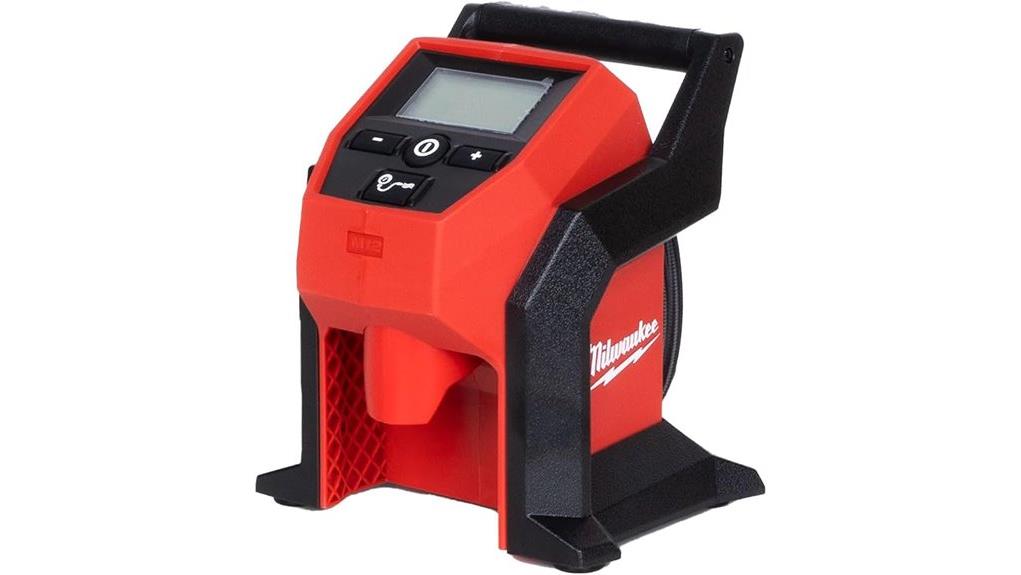

If you want a fast, cordless inflator, the Milwaukee 2475-20 M12 Compact delivers 0–120 PSI with a quick car-tire top-off to about 28–35 PSI in under a minute. You’ll get strong airflow (roughly 0.88 CFM near 0 PSI, down to ~0.63 CFM at 35 PSI) and ±3% gauge accuracy for tighter targets. Expect a 50% duty cycle, so pause between longer jobs, and plan battery charging for consistency. Keep going for more practical setup tips.
Some Key Takeaways
- Delivers fast tire topping, commonly reaching 28–35 PSI in under one minute with strong sustained airflow.
- Uses a high-efficiency pump and motor, with airflow roughly 0.88 CFM at 0 PSI dropping to 0.63 CFM at 35 PSI.
- Features a gauge with about ±3% accuracy, so readings can vary slightly from true pressure.
- Cordless portability is great for quick car fills, but plan battery charge for repeated sessions compared to corded models.
- Designed for a ~50% duty cycle to help prevent overheating during extended use like filling multiple car or truck tires.
Milwaukee 2475-20 Specs That Matter for Fast Inflating
To inflate faster without guesswork, you’ll want to start with the Milwaukee 2475-20’s core specs. You get 0–120 PSI pressure capability, so you match target ranges without overthinking. At 28–35 PSI, it tops off a car tire in under a minute, and it still sustains high output with a high-efficiency pump and motor. For evidence-based control, you rely on ±3% gauge accuracy plus compatible gauges via the included gauge setup. Cordless operation means your battery runtime matters: plan around the 50% duty cycle and choose M12 batteries that fit your workload.
How Fast Can the Milwaukee 2475-20 Fill Car and Truck Tires?
Milwaukee’s 2475-20 doesn’t just promise 0–120 PSI—it backs that range with real-world fill times, so you spend less time waiting around at the curb. For car tire topping, you typically hit 28–35 PSI in under 1 minute, which matches the inflator’s high-efficiency airflow. For truck tire filling, expect under 4 minutes to reach 30–45 PSI. These results align with its rated output, dropping from 0.88 CFM at 0 PSI to 0.63 CFM at 35 PSI. With ±3% gauge accuracy, you inflate confidently—fast, consistent, and ready to roll. For buyers comparing practical tools and gift ideas, this kind of performance makes a useful present for drivers and contractors alike.
Milwaukee 2475-20 Vs Corded Inflators: Noise, Portability, and Runtime
If you’re comparing the Milwaukee 2475-20 to corded inflators, the biggest practical differences show up in how you move the tool, how long you can run it, and how much noise you’ll tolerate at the point of use. With cordless design, you get clear portability tradeoffs: you stop fighting cords and still reach roadside valves. Expect measurable battery runtime limits, so do charging planning before a full weekend run. Noise reduction also matters in garages and shared driveways. Corded units stay continuous, but you trade freedom for outlet dependence. In practice, you’ll fill tires fast, then recharge between sessions.
Setup, Hose Length, and Gauge Accuracy Tips for 0–120 PSI Results
Dial in your results start with proper configuration: connect the Milwaukee 2475-20 to a valve securely, make sure the included hose can extend without bends (26 inches gives you limited slack), and rely on the built-in gauge recognizing its ±3% accuracy—meaning your setpoint at 100 PSI may read roughly 97–103 PSI. Apply setup best practice by holding the inflator steady, preventing kinks that add line resistance and skew readings. For confidence, follow gauge calibration tips: verify with a known reference gauge at 50 and 100 PSI, then adjust your target accordingly for repeatable 0–120 PSI outcomes. For anyone shopping for transit level gifts, this kind of practical tool advice can help you choose useful presents for family, friends, coworkers, and contractors.
Duty Cycle and Reliability: What to Expect From the Milwaukee 2475-20
You’ll get reliable operation in typical shop and roadside use because the Milwaukee 2475-20 is rated for a 50% duty cycle, meaning it’s designed to run, then rest to prevent overheating during extended inflation sessions. In practice, that matters when you top off multiple tires or fill a larger truck setup in one go. If you honor the duty cycle limits, you reduce heat buildup, maintain stable output, and support reliability under strain. That rest period also protects motor longevity, since the compact pump and motor stay within thermal expectations. Follow recommended intervals, and you’ll feel confident every session. It also makes the unit a practical choice for gift giving solutions when you want a useful tool for a family member, friend, coworker, or contractor.
Some Questions Answered
Can It Inflate Bicycle Tires and Sports Balls Safely?
Yes—you can inflate bicycle tires and sports balls safely. You’ll match the ball pressure safety needs by setting the proper PSI, then verify with a separate gauge since accuracy is ±3%. The inflator supports 0–120 PSI, so low-pressure bike setups and ball ranges work well. For temperature control, avoid long continuous runs; the 50% duty cycle helps prevent overheating during top-offs. Always use the right nozzle.
What Accessories or Nozzles Come Included With the Milwaukee 2475-20?
You get multiple Nozzle types for common inflation tasks: a universal valve clip for quick connections, a needle-style nozzle for sports balls, and a tapered cone for inflating smaller ports like air mattresses. You also get a storage bag to keep nozzles and adapters organized on the jobsite and at home. This setup helps you switch fittings fast without guesswork or leaks.
Does It Automatically Shut off at the Set Pressure?
Yes—when you set the target PSI, the inflator’s Automatic pressure control monitors the gauge and stops inflation when it hits your setpoint. It also uses safety shutoff limits to prevent over-pressurizing, so you don’t have to babysit the tool. In practice, this keeps your fills consistent across quick top-offs and longer tire sessions, giving you confidence you’ll get the pressure you asked for.
How Loud Is the Inflator During Operation?
You’ll notice moderate noise level during operation—loud enough to draw attention in a garage, but not unbearable for short fills. In practice, expect it to sit in the “shop compressor hum” range rather than a quiet tool profile. Battery power draw stays efficient while you reach 28–35 PSI and up toward 120 PSI, so the motor doesn’t scream continuously. Wear hearing protection if you run back-to-back tires.
Will It Handle Inflating Multiple Tires Back-To-Back Without Overheating?
Yes—you can run it back-to-back with confidence. The 2475-20 supports a 50% duty cycle, so you shouldn’t expect nonstop continuous operation at high pressure. For practical use, alternate between tires and give brief cooldowns to protect overheating performance. If you need proof, do continuous duty testing on your target tire sizes and pressures; you’ll quickly see whether heat buildup stays within safe limits for your workload.