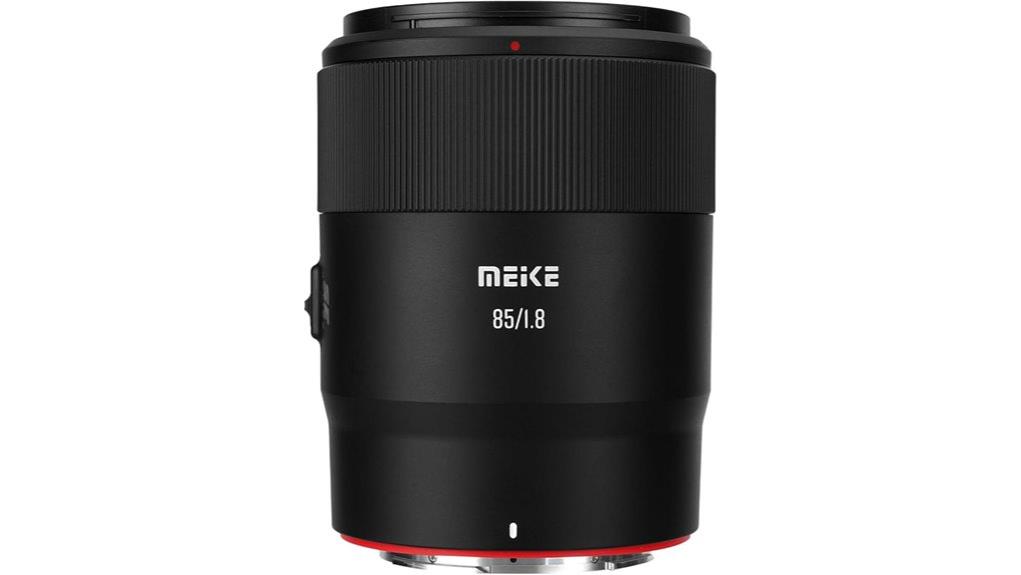
You’ll get a compact 85mm f/1.8 portrait lens for Nikon Z that’s tuned for high microcontrast, creamy bokeh and tight headshots on APS-C bodies. Its 11-blade diaphragm and 11-element/7-group optics hold center sharpness from f/1.8 to f/5.6 while minimizing coma and distortion. STM autofocus is quiet and reliable for stills and video, though slower in low light than native Z glass. Controls, coatings and firmware port add polish — keep going to see test results.
Some Key Takeaways
- Solid portrait optic: 85mm f/1.8 delivers creamy background separation and high microcontrast for detailed face rendering.
- Optical performance: consistent center-to-edge sharpness from f/1.8–f/5.6 with minimal distortion and controlled aberrations.
- Bokeh and diaphragm: 11-blade rounded aperture produces smooth highlights with minimal onion rings.
- AF and handling: STM autofocus is quiet and reliable for stills; manual focus ring is damped and tactile.
- Value proposition: competitively priced versus native Z lenses, lacking weather sealing and stabilization but strong for budget portraitists.
What the Meike 85mm F1.8 SE Mark II Is and Who It’s For
Although it’s built as a straightforward 85mm prime, the Meike 85mm F1.8 SE Mark II targets photographers who need high-resolution portrait optics in a compact, modern package. You’ll get an 85mm focal length with an f/1.8 aperture, 11-blade diaphragm, and 11 elements in 7 groups tuned for sharp rendering and controlled aberrations. It’s optimized for Nikon Z mounts and APS-C users see a 127.5mm equivalent, making it useful as a budget telephoto for tight headshots. If you’re exploring entry level portraiture or seeking a lightweight, mechanically precise lens with STM AF, this is a practical, value-focused choice. It’s well suited for the audience of our site, which focuses on essential gear for mirrorless camera enthusiasts.
How It Performs on Nikon Z Bodies: Sharpness, Bokeh, and AF Behavior
Moving from its design goals to real-world use on Nikon Z bodies, the Meike 85mm F1.8 SE Mark II delivers predictable, high-resolution results that reward careful technique. You’ll see center-to-edge sharpness consistency from f/1.8 to f/5.6 on full-frame Z cameras, with microcontrast revealing fine texture useful for portraits. Bokeh renders smoothly thanks to the 11-blade diaphragm and rounded aperture, producing soft highlight rolls with minimal onion rings. STM-driven autofocus behavior is quiet and measured; on Z6/Z7 series you’ll notice reliable subject acquisition and steady tracking in good light. Low-light AF speed trails native Z lenses but maintains autofocus reliability for stills. It also pairs well with many tripod head options to help stabilize and refine your portrait workflow.
Build, Handling, and Real-World Usability (Controls, Coatings, Firmware)
When you pick up the Meike 85mm F1.8 SE Mark II, its compact metal-and-polymer construction feels purposeful and balanced on Z-series bodies, with a matte finish that reduces reflections and a snug bayonet mount that seats cleanly without play. You’ll notice a textured finish on the focus ring offering tactile indexing; manual focus is linear and damped, responsive to subtle inputs. Multi-coated elements resist flare; front/rear fingerprint- and oil-resistant coatings ease cleaning. STM autofocus is quiet and smooth, EXIF passes reliably, and firmware updates use the Micro Type-C port. Menu integration with Nikon bodies is straightforward and stable. It’s an excellent option for photographers using lens adapters to expand their system compatibility with third-party lenses.
Image Quality Tests: Low Light, Portraits, Close Focus, and Distortion
While testing the Meike 85mm F1.8 SE Mark II across low-light, portrait, close-focus, and distortion scenarios, you’ll quickly see how its optical design translates into real-world images: the f/1.8 maximum aperture gathers ample light for usable shutter speeds and shallow depth of field, the 11-blade diaphragm renders smooth highlights, and the 11-element/7-group layout holds detail toward the frame center even wide open. You’ll get clean, usable low light files at higher ISOs with minimal coma. Portraits show pleasing bokeh with well-controlled chromatic aberration centrally; edges soften and micro-CA increases. Close focus (0.65 m) is competent, while geometric distortion stays negligible. For outdoor shooting, adding a polarizing filter can further improve color saturation and sky contrast.
Value and Verdict: Price, Alternatives, and Who Should Buy
Having seen how the Meike 85mm F1.8 SE Mark II performs in low light, portraits and close-focus work, you can now judge how those imaging strengths map to value. You’ll weigh sharp center resolution, 11-blade bokeh, and 0.65 m close-focus against the lens's price. In a price comparison with native Z 85mm options, Meike undercuts while offering STM autofocus, firmware upgradability, and fingerprint-resistant glass. Buyer profiles: budget-conscious portraitists wanting creamy background separation; hybrid shooters on Z5/Z6 bodies; and videographers valuing silent focus. Skip it if you need stabilization, weather sealing, or absolute edge-to-edge clinical sharpness. It's a compelling choice for many DSLR and mirrorless users who prioritize affordable, well-built portrait lenses.
Some Questions Answered
Does It Support In-Camera Lens Correction Profiles on Nikon Z Bodies?
Yes — you’ll get in-camera lens correction on Nikon Z bodies when firmware compatibility is present. The lens transmits EXIF and supports electronic aperture, so Z cameras can apply distortion, vignetting and chromatic aberration profiles automatically once the body recognizes the lens. Expect normal autofocus behavior during correction; profiles don’t slow STM focusing. If a body lacks a matching profile, update the lens firmware via Type‑C and the camera firmware to enable corrections.
Can the Lens Be Adapted for Canon or Sony Mounts With an Adapter?
Yes — you can use a mount adapter to fit the lens to Canon or Sony bodies, but flange compatibility determines success. You’ll need an adapter that matches Nikon Z to your target mount; on Sony E you’ll preserve infinity easily due to short flange distance, while Canon EF/EF‑R may require electronic adapter for aperture/AF. Expect possible limitations in AF speed, electronic aperture response, and no optical stabilization; check adapter electronics compatibility.
Is There a Dedicated Lens Hood Included in the Box?
No, the box contents don’t include a dedicated lens hood. You’ll get the lens, caps, paperwork and packaging, but hood compatibility is listed separately — the lens accepts a detachable petal-style hood sized for the 85mm SE Mark II. Physically check the bayonet mount and inner diameter to confirm fit if you buy third-party hoods. Consider a hood with matching bayonet alignment and proper shading for portrait framing and stray-light control.
What Is the Warranty Duration and International Coverage Details?
You get a manufacturer warranty; duration varies by vendor and region, so check your purchase docs for the exact period. You can usually transfer warranty transferability only with original proof of purchase and vendor approval. For international repairs, Meike supports EXIF-enabled diagnostics and firmware updates via Micro Type-C; international repairs depend on regional service centers and may incur fees if outside covered territory. Keep receipts and serial number for claims.
Are There Third-Party Filters Specifically Sized for This Lens?
Yes — you’ll find broad filter availability for this lens because it uses standard front threads; check thread compatibility by confirming the lens’s filter diameter (typically printed on the barrel). Third-party brands (Hoya, B+W, Tiffen, NiSi, H&Y) make circular UV, CPL, ND and specialty filters sized to match that thread. Visually inspect thread pitch and slim profile filters to avoid vignetting on full-frame sensors at wide apertures.