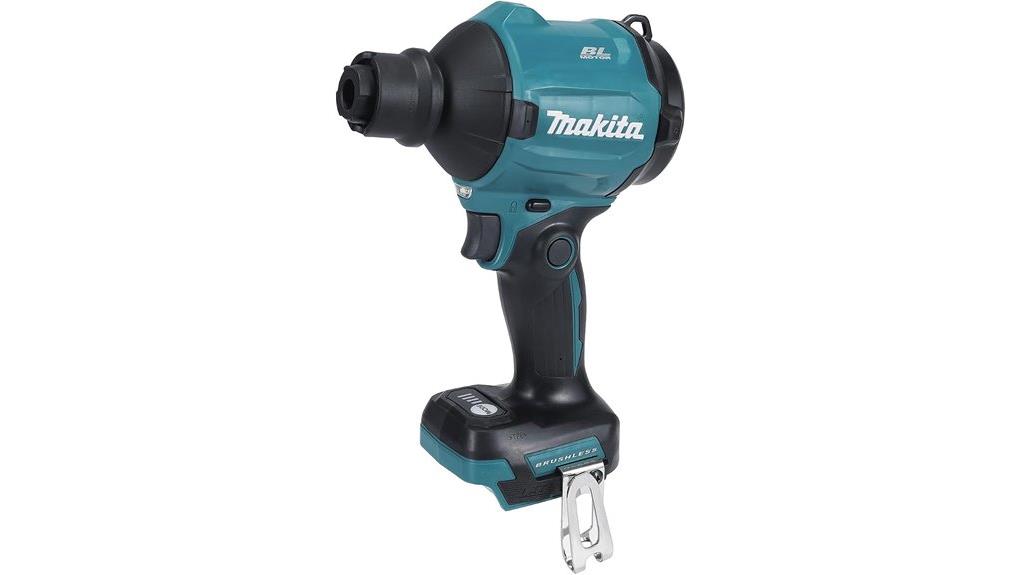

If you want fast, controlled 18V cordless debris clearing in tight spots, the Makita DAS180Z is a strong pick. You get four air-volume stages, a one-touch nozzle swap, and an LED/lock-on trigger to keep airflow focused. Mode selection lets you trade speed for runtime—Mode 4 is best for quick cleanups, while Mode 1 can run about 55 minutes on a BL1860B. With proper filter/vacuum use, you’ll manage fine dust more safely, and there’s more to know.
Some Key Takeaways
- Cordless 18V dust blower excels at quick, controlled air movement in tight spaces for repeatable debris clearing.
- Features four air-volume modes with mode-based airflow control for faster cleanup (Mode 3–4) or longer runtime (Mode 1–2).
- One-touch nozzle swaps let you change airflow quickly to match fine dust versus bulk debris needs.
- Runtime with BL1860B varies by mode: 55 min (Mode 1) down to 15 min (Mode 4).
- Designed with dust/fine-particle handling in mind, including vacuum/filter use to help maintain consistent performance.
Makita DAS180Z Review: What It’s Best At
If you want a cordless blower that keeps things moving in tight spots without fuss, the Makita DAS180Z shines at quick, controlled air movement thanks to its 4-stage air volume and toolless one-touch nozzle swaps. You’ll appreciate this model as the best for jobs that demand fast response and quick cleanup, especially when you’re clearing dust from narrow spaces or OA equipment. The filter helps prevent debris ingestion, so performance stays consistent. Use the LED and lock-on trigger to keep your focus steady while you blow out tools, air filters, or prep areas. It also supports inflation and deflation tasks, too. It can also be a thoughtful choice for gift giving solutions when someone needs a practical tool for home or work.
How to Choose the Right Mode on the Makita DAS180Z Blower
Choosing the right mode on the Makita DAS180Z starts with matching airflow to the job—because higher air volume gives you faster clearing, while lower volume gives you longer runtime. You’ll make better, repeatable results by selecting airflow presets by demand, not guesswork. For quick debris removal in narrow spaces, start with Mode 4 or Mode 3, relying on understanding mode specific output for speed. For extended cleanups, switch to Mode 2 or Mode 1 to stretch runtime—up to 55 minutes on Mode 1 with a fully charged BL1860B. Pick your mode, lock in, and belong to the efficient crew. For gift-ready cyclone dust collectors, this kind of practical performance can make a thoughtful choice for both home users and professionals.
How the Makita DAS180Z Nozzle and Airflow Control Work
The DAS180Z makes it easy to match airflow to the task because its nozzle design works with a four-stage air-volume controller. You select a mode, then the airflow stage behavior shifts output to suit fine dust or faster clearing. You get stable control because the nozzle directs stream focus at close range while the controller scales volume without guesswork. Need quick shifts? Use the Nozzle quick change to swap positions fast, keeping your work moving. You’ll feel confident in tight spaces, because the airflow stays responsive to your chosen stage for consistent results.
Using the DAS180Z Vacuum/Filter to Handle Dust Safely
Using the DAS180Z vacuum/filter setup, you can handle dust more safely because the tool helps prevent debris from being sucked back into the motor while you work. You get stronger confidence when you switch to vacuum mode and let the filter trap fine particles before they circulate. That’s practical dust filter handling that supports cleaner airflow and consistent performance in tight spaces. For peace of mind, follow safety vacuum tips: keep the intake clear, check the filter for clogs, and empty it promptly when suction drops. You’ll stay comfortable, work faster, and protect your blower for the long haul. If you’re shopping for dust extractor gear that makes cleanup easier, this kind of tool can be a practical gift for any handy person.
Makita DAS180Z Battery Runtime With BL1860B (Mode 1–4)
Real-world runtime depends on how hard you push the DAS180Z, and once you’ve settled into safe vacuum/filter handling, you’ll want to match the airflow level to the job. With a fully charged Makita BL1860B, you get clear, predictable battery runtime planning. In Mode 1 it runs 55 minutes, Mode 2 delivers 30, Mode 3 gives 20, and Mode 4 lasts 15. This matters for your user usage scenarios—quick dusting of OA equipment, repeated narrow-space cleanups, and longer filter or tool clean cycles. Pick lower modes when you can; save high power for stubborn debris. For gift shoppers, the DAS180Z fits well with cordless tool sets for practical, everyday use.
Some Questions Answered
Does the DAS180Z Include a Battery or Charger?
No—you get the Makita DAS180Z dust blower without a battery or charger. You’ll need to supply an 18V LXT Li-ion battery and compatible charger, so cordless runtime management becomes your responsibility. If you plan for dust control techniques, use the 4 air-volume stages to match debris load while extending runtime. For best results, choose a compatible BL1860B-style battery, since the kit itself doesn’t include power or charging gear.
Is It Compatible With Makita G-Series 18V Batteries?
No, you can’t use G‑Series 18V batteries with the DAS180Z. It’s designed for Makita 18V LXT batteries, so G‑Series won’t fit or run reliably. If you want strong Airflow performance comparisons, stick to compatible LXT packs and follow battery efficiency tips: fully charge before use, avoid running higher modes longer than needed, and let the tool cool between bursts so you keep consistent output. You’ll feel the difference quickly.
Can I Use the Blower for Vehicle Interior Dust and Debris?
Yes—you can use it for vehicle interior dust and debris. Its 4-stage air volume lets you dial airflow to loosen dust from vehicle upholstery and work around tight trims. For effective dust control, aim the nozzle at creases and vents, then sweep debris out. It also handles fine debris better than many vacuums when you maintain a steady distance and use the LED light for visibility. You’ll feel more in control cleaning faster.
How Do I Clean the Intake Filter and Vacuum Hose Safely?
To clean the intake filter and vacuum hose safely, power down and unplug the battery, then remove the filter and Use gentle rinsing. Avoid harsh chemicals. Rinse until debris clears, check filter seals for tight fit, and ensure proper drying before reassembly. For the hose, inspect hose clogs and clear with soft airflow or a cloth, then prevent air leaks by reseating parts. Finally, store dry components safely and follow manual guidelines.
What’s the Noise Level at Each Air-Volume Mode?
You don’t get reliable noise level specs per mode from the available documentation. Noise measurement conditions vary, so you’ll see different readings in real world usage comparison—especially on hard surfaces, with different debris types, and at distance. If you want confidence, check third-party decibel tests for Mode 1–4 or measure yourself at a fixed distance and height using a smartphone SPL app.