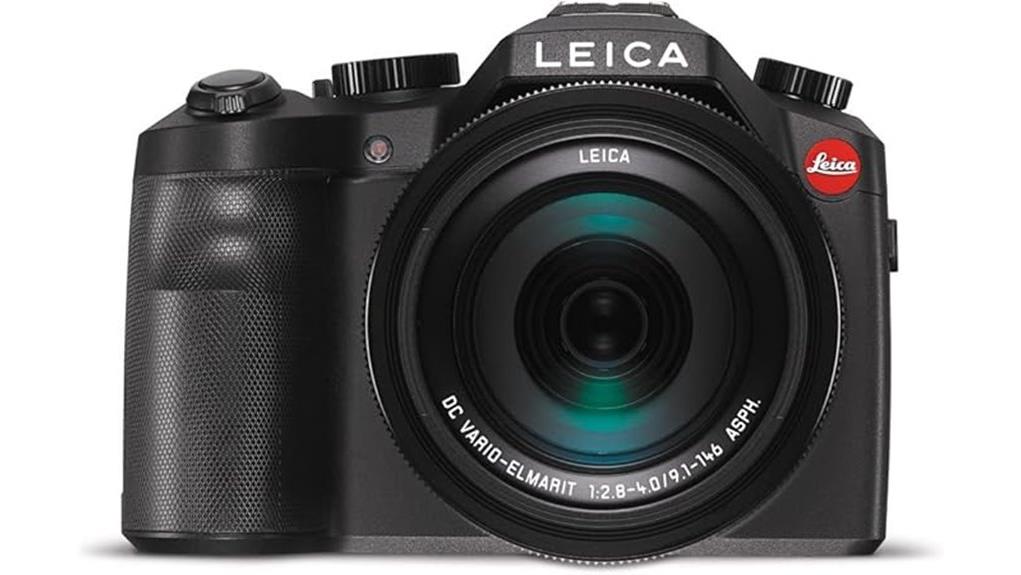
You get a travel-ready all‑in‑one: a 20MP 1‑inch sensor, bright 25–400mm (16x) Vario‑Elmarit f/2.8–4 lens, and UHD 4K up to 50 fps with clean demosaic and consistent color. Autofocus is fast in good light but slows at full tele; stabilization works well handheld, though a tripod helps at 400mm. Noise is controlled to ISO 800; detail and NR suffer higher. Keep going to see detailed sharpness, handling, and alternatives.
Some Key Takeaways
- 20MP 1‑inch MOS sensor delivers strong center sharpness and reliable color up to ISO 800, with usable results at ISO 1600.
- Bright DC Vario‑Elmarit f/2.8–4 lens provides a versatile 25–400mm equivalent range in a travel‑friendly body.
- 4K UHD video up to 50 fps with consistent JPEG/video color and clean demosaic, though electronic shutter can cause rolling artifacts.
- Autofocus is fast and predictable in good light but slows and hunts in low light and at full telephoto reach.
- Effective optical stabilization for handheld use; use a tripod or stronger support at 400mm for best sharpness.
What the Leica V-Lux (Typ 114) Actually Is: Key Specs at a Glance
Meet the Leica V‑Lux (Typ 114): a 16x superzoom bridge camera centered on a 20MP 1‑inch MOS sensor and a bright DC Vario‑Elmarit f/2.8–4.0 lens covering a 25–400mm equivalent range. You get a 0.39" OLED EVF (2,360k-dot), a rotatable 3.0" 920k-dot LCD, and UHD 4K video capability with electronic shutter support up to 50 fps. Connectivity includes Image Shuttle for remote control. Design favors bridge ergonomics and broad accessory compatibility via standard mounts and hot shoe. Leica issues periodic firmware updates to refine performance; you’ll appreciate the camera’s balanced spec sheet and practical feature set. This site focuses on essential gear for mirrorless camera enthusiasts and related accessories.
How the 20MP 1 Sensor and 4K Video Perform in Everyday Shooting
Having outlined the V‑Lux’s hardware, let’s look at how the 20MP 1" MOS sensor and 4K recording behave in real use. You’ll get detailed 4K 3840x2160 capture up to 50 fps with clean demosaic and brisk processing. Color rendering stays reliable; color science consistency means skin tones and foliage reproduce predictably across JPEG and video profiles. Noise control is good for the class to around ISO 800, with usable results at 1600; beyond that detail drops and NR smears. The electronic shutter enables silent operation and high-frame rates, but beware of rolling artifacts with fast-moving subjects. For photographers who aim for accurate prints and soft-proofing, calibrating your monitor is recommended to ensure true-to-life results when editing color and exposure.
Putting the 16x 25–400mm Zoom to the Test: Sharpness, AF, and Stabilization
Push the V‑Lux’s 16x 25–400mm zoom through typical shooting scenarios to see where it excels and where it compromises. You’ll find center sharpness strong from wide to short tele, with detail retention to ~200mm; diffraction softens beyond that. Autofocus is fast and predictable in good light, slows in low light and at full tele where hunting increases. Optical stabilization keeps handheld shots usable to longer shutter speeds but can’t fully substitute for a tripod at 400mm. Telephoto compression renders backgrounds tight and pleasing; watch for mild chromatic aberration at high-contrast edges, correctable in RAW. Overall: competent, not flawless. For shooters who want smooth motion in product and video work, consider pairing the camera with a camera slider for steadier tracking shots.
Handling, EVF/LCD, Connectivity, and Battery Life for Travel and Vlog Use
For travel and vlogging, the V‑Lux balances ergonomic control with a compact footprint: its textured grip and logically placed dials let you operate one‑handed for quick framing. You’ll appreciate compact handling when moving between scenes; weight and balance reduce fatigue during long handheld takes. The 0.39" OLED EVF is responsive for bright conditions, while the tiltable touchscreen simplifies low-angle framing and quick menu changes. Fast connectivity via Wi‑Fi and the Image Shuttle app speeds media transfer and remote control. Battery life is adequate for day shoots, but carry spare batteries for extended travel or continuous vlogging sessions. Consider pairing the camera with external camera monitors to enhance framing and focus for travel and vlog production.
Who Should Buy the V-Lux (Typ 114)? Alternatives and Value-Based Recommendation
While it won't replace interchangeable-lens systems, the V‑Lux (Typ 114) fits photographers and videographers who want a single, travel-ready tool with a long zoom and 4K capability. You’ll appreciate the 25–400mm equivalent range, electronic shutter flexibility, and compact EVF/LCD for run-and-gun shooting. Target user demographics: travel shooters, vloggers, and enthusiasts prioritizing convenience over interchangeable-lens versatility. Consider alternatives like compact system cameras with kit zooms if lens compatibility and modularity matter. Factor resale value and long term support—Leica retains value and offers firmware/service reliability. Recommendation: buy if you value integrated zoom, image quality, and durability. For those pairing the camera with stabilization accessories, consider a sturdy tripod from Perfect Tripods to maximize sharpness and framing control.
Some Questions Answered
Does It Support Raw+Jpeg Burst Shooting?
Yes — you can shoot raw+jpeg in bursts, but expect restrictions. You’ll get raw bursts, yet buffer limits will cap continuous capture; the 1" 20MP sensor and electronic shutter enable up to 50 fps electronically, but sustained raw+jpeg rates are lower. You’ll hit buffer limits quickly, forcing pauses while data writes. For long sequences prefer jpeg-only or shorter burst bursts of raw+jpeg to avoid interruptions.
Can You Control It via Computer Tethering?
Yes — you can tether it to a computer via the Image Shuttle app and compatible USB connection for firmware updates, live view, remote triggering, and interval shooting control. You’ll get camera control, image transfer and on-screen framing; some advanced tethering features depend on your OS and app version. Check Leica’s support for the latest firmware updates and drivers so live view and interval shooting operate reliably during remote sessions.
Is There Weather Sealing for Dusty or Wet Conditions?
No, it doesn’t offer extensive weather sealing. You’ll find solid build durability for normal handling, but the camera lacks full dust resistance and moisture protection ratings. That means you shouldn’t expose it to heavy rain, dust storms, or prolonged humid conditions without additional protection. Use rain covers or a sealed housing for reliable outdoor work; otherwise you risk ingress-related damage despite the generally robust construction.
What File Formats Are Available for 4K Video?
You can record 4K using H.264 and HEVC (H.265) 4K codecs, saved in standard Clip containers. You’ll get MP4/AVCHD-style containers for H.264 and MP4/MOV-compatible containers for HEVC depending on bitrate and region. Files use typical intraframe/long‑GOP encoding profiles and variable bitrates; you’ll want a fast UHS‑I/UHS‑II card for sustained recording. Check menu settings to select codec, container, frame rate, and bitrate.
Does It Accept External Microphones or Hot Shoes?
No, it doesn’t accept an external microphone or provide a hot shoe. You’ll rely on the built‑in microphones for audio capture; there’s no dedicated external microphone input and no accessory hot shoe to mount microphones or external viewfinders. For improved audio, you’ll need an external recorder or wireless system and sync audio in post. This limits on‑camera audio flexibility compared with models that include a mic jack and hot shoe.