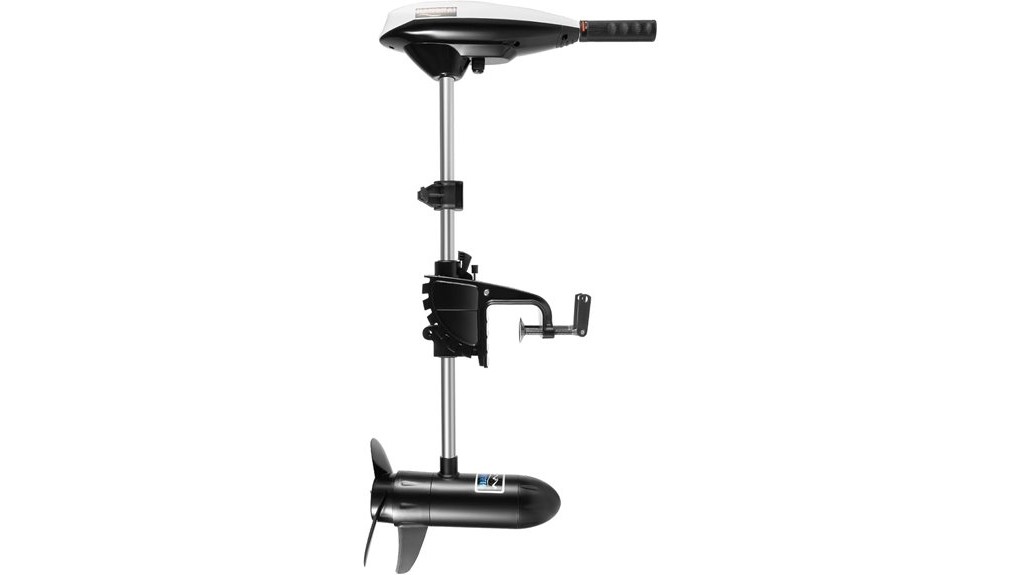
You’ll find the 65 lb 12V electric outboard gives quiet, low‑maintenance propulsion with predictable 3.7–5.0 mph performance ideal for small fishing boats, kayaks, and pedal‑drive craft. It delivers 65 lbs thrust from a 12V pure‑copper motor (660 W peak, ~1420 rpm) with a three‑blade prop, five forward/two reverse gears, and cruise control for steady transits. Mounting needs correct transom reinforcement and battery planning. Continue for detailed specs, installation tips, and real‑world tradeoffs. When considering 4 stroke outboard motor performance review options, it’s essential to evaluate fuel efficiency and noise levels, especially for nontaxable operations on tranquil waters. The latest models boast enhanced torque and improved handling, ensuring a smooth experience while navigating through various water conditions. These advancements make them increasingly popular among boating enthusiasts looking for reliable and efficient power sources.
Some Key Takeaways
- 65 lbs thrust 12V outboard delivers quiet, low-maintenance propulsion ideal for small-to-midsize boats and kayaks.
- Motor outputs 660 W peak, ~1420 rpm, with expected speeds of 3.72–4.97 mph depending on load and hull.
- Three-bladed prop and adjustable shaft/transom mount balance thrust and reduce cavitation when properly trimmed.
- Controls include a retractable tiller, five forward/two reverse gears, and cruise control for steady trolling.
- Pros: efficient thrust-to-weight and simple operation; cons: limited top speed, plastic parts may wear in saltwater, battery-dependent.
Quick Verdict and Who Should Consider the 65lbs 12V Electric Outboard Motor
Although it’s electric, the 65lbs 12V outboard delivers practical thrust and efficient operation for small-to-midsize craft, so you can expect reliable, quiet propulsion for fishing boats, kayaks, and other light vessels. You’ll find it suited to budget anglers and leisure cruisers who need low-noise, low-maintenance propulsion with measurable payload capability. You can mount it on transoms, adjust suspension and handle length, and use integrated cruise control for steady speed. You’ll appreciate pure copper motor efficiency and multi-gear control for tactical maneuvering. Choose it when you prioritize simplicity, predictable performance, and reduced operational cost over high-speed demands. It’s an excellent match for pedal-drive kayaks and other watercraft popular with adventurous water enthusiasts seeking versatile, low-maintenance gear.
Essential Specs Breakdown: Thrust, Power, Speed, Propeller, and Capacity
You’ll now look at the core numbers that define real-world performance: thrust, electrical power, top speed, propeller design, and payload capacity. You get 65 lbs thrust and a 660 W peak from a 12 V pure copper motor—suitable for displacement hulls and light planing. Expect 3.72–4.97 mi/h depending on load and conditions; battery range ties directly to battery capacity and operational rpm. The three-bladed prop balances thrust and efficiency; shaft length and transom mount determine immersion and cavitation risk. Carrying capacity is rated 1,322.7 lbs; match boat weight, payload, and battery mass for reliable performance. Check our selection of kayaks and GPS backup batteries for pairing motor performance with reliable power on the water.
On-Water Performance Test: Speed, Handling, Gears, and Cruise Control
Push the 65lb TANAUT into open water and you’ll immediately notice how measured thrust, gear range, and cruise control combine to shape real-world behavior. You accelerate to the specified 3.72–4.97 mi/h range depending on load; top speed is stable but affected by water resistance and hull form. Handling is predictable: the retractable tiller gives fine directional inputs, and trim adjustments control bow rise. The five forward and two reverse gears shift smoothly; gear durability felt solid under repeated shifts at varying RPM. Cruise control maintains set speed with minimal oscillation, reducing operator workload during extended transits. For paddlers and small-boat users, pairing this motor with VHF marine radios and proper safety gear enhances communication and trip safety.
Installation, Controls, and Real-World Usability for Fishing Boats and Kayaks
When mounting the 65lb TANAUT on a fishing boat or kayak, plan the transom attachment and center-of-gravity placement to preserve trim and steering response; the adjustable suspension bracket and transom-mount design let you set height and shaft angle to minimize cavitation and bow rise. You’ll fasten using reinforced bolts, verify transom thickness, and torque to spec. The retractable, length-adjustable control handle offers repeatable steering inputs and five-forward/two-reverse gearing for precise trolling. Monitor battery management to match draw, runtime, and recharge cycles. Inspect fasteners and finish regularly to prevent mount corrosion, and rout cables for strain relief and water intrusion prevention. Consider carrying essential launch and trail gear like kayak cart wheels to simplify transport between vehicle and water.
Pros, Cons, Warranty, and Final Buying Checklist
Although lightweight and quiet, the 65lb TANAUT electric outboard delivers solid thrust and efficient cruising for small to mid-size boats, offering five forward and two reverse gears, cruise control, an adjustable suspension bracket, and a pure-copper 660 W motor that reaches up to 1420 r/min—features that give you precise speed control and good load capacity (rated 1,322.7 lbs). Pros: efficient thrust-to-weight, low noise, adjustable mount, simple controls. Cons: limited top speed, plastic components may wear in saltwater, dependent on battery life. Warranty: 2-year manufacturer coverage. Final checklist: confirm battery capacity, mounting compatibility, propeller condition, and follow maintenance tips. This motor is especially suited for pedal kayak enthusiasts looking to supplement or replace manual propulsion on recreational water adventures.
Some Questions Answered
Does the Motor Support Trolling Battery Setups for Multi-Day Trips?
Yes — you can use trolling battery setups for multi-day trips if you choose deep cycle compatibility and proper capacity. You’ll want high‑capacity 12V deep‑cycle batteries and a battery management system (BMS) to prevent overdischarge and balance cells. Calculate amp‑hours vs expected draw (660W peak, typical cruise lower), factor reserve, and wire/gauge losses. With correct BMS and battery bank sizing, the motor will support extended trolling reliably. When choosing a propulsion system, pay attention to marine electric thruster specifications to ensure compatibility with your vessel’s power requirements. Opt for thrusters that offer efficient performance and have a proven track record in marine applications. This will not only enhance your boat’s maneuverability but also contribute to fuel efficiency during long journeys.
Can the Propeller Be Replaced With Aftermarket Blades?
Yes — you can replace the propeller with aftermarket blades if dimensions, shaft splines, and hub design match. Check aftermarket compatibility by measuring diameter, pitch, bore, and spline count; confirm hub type and rotation. Consider blade materials (plastic, aluminum, stainless) for strength, corrosion resistance, and noise. Match thrust and load ratings to avoid motor strain. If unsure, consult TANAUT or a qualified technician to verify fit and performance before installation.
Is the Unit Saltwater Corrosion-Resistant Without Extra Coatings?
No — you shouldn’t assume full saltwater durability without extra protection. The unit uses plastic components and likely has some anodized aluminum parts, but manufacturer specs don’t confirm thorough corrosion testing or integrated sacrificial anode protection. You’ll want to add marine-grade coatings, regular rinsing, and fit a sacrificial anode if mounting in saltwater. Inspect anodized aluminum for blemishes and perform periodic corrosion testing to verify long-term saltwater durability.
Does It Include Remote Steering or Only Tiller Control?
It includes only tiller control; remote steering isn’t provided. You’ll operate with the retractable, length-adjustable tiller control that directly actuates steering and throttle. The unit lacks electronic remote steering integration or a wireless helm interface, so you can’t expect remote steering functionality out of the box. If you need remote steering, you’ll have to fit an aftermarket remote kit or upgrade to a model offering dedicated remote steering compatibility and controls.
Are Spare Parts Readily Available From the Manufacturer?
Yes — you can get spare parts directly from TANAUT; manufacturer availability is generally good for common items (propellers, brackets, control handles). You should verify specific parts before purchase. Warranty coverage is two years, which may cover defects but not wear items; confirm exclusions. For technical replacements or rare components, you’ll likely need to contact the manufacturer or authorized dealers to confirm stock, lead times, and compatible part numbers.