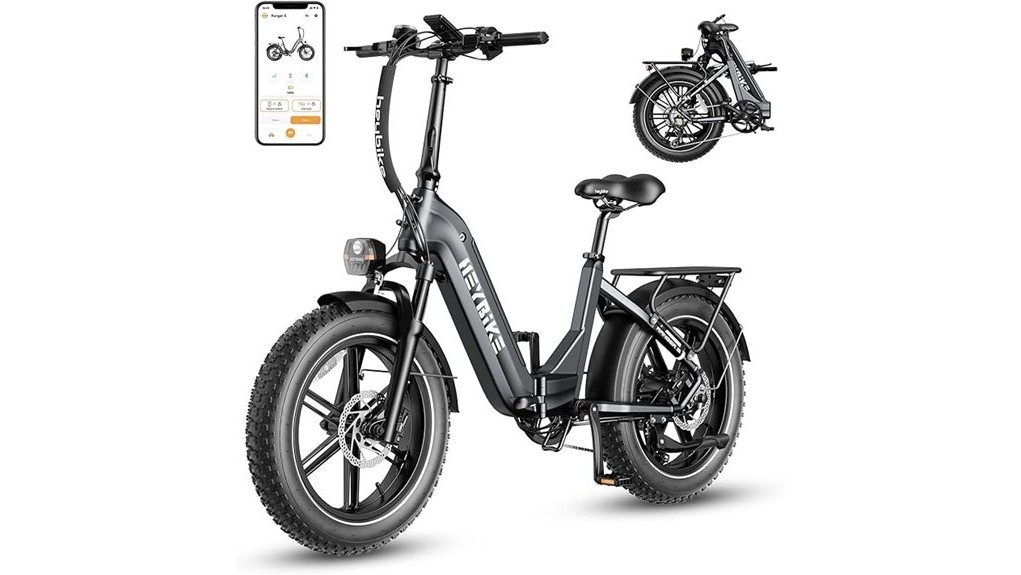
You’ll find the Heybike Ranger S is a compact, foldable 750 W e-bike that’s tuned for practical commuting and weekend cargo runs. It gives brisk acceleration, up to ~28 mph top speed, and confident hill-climb ability from a geared motor with controlled torque. A 48 V 720 Wh removable battery supports long days out, charging in about 3–4 hours. The frame, hydraulic fork, heavy-duty rear rack, lights, and app favor utility over minimalism — continue and you’ll get full specs and real-world notes.
Some Key Takeaways
- Powerful 750 W nominal (peak ~1,400–1,500 W) motor delivers brisk acceleration and up to ~28 mph top speed.
- 48 V 720 Wh removable battery supports about 55 miles in conservative riding, charge in ~3–4 hours.
- Foldable step-through frame and tuned hydraulic fork make mounting, storage, and urban comfort easy.
- Heavy-duty rear rack, automatic lights, and Heybike app add cargo utility, visibility, and connectivity.
- Best for commuters and weekend adventurers needing durability and range; not for ultra-light minimalist riders.
Quick Verdict: Who the Heybike Ranger S Is Best For
While the Ranger S packs a powerful 750 W nominal motor, long-range 720 Wh battery, and rugged rack for cargo, it’s best suited for commuters and weekend adventurers who need a compact, capable e-bike that can handle hills and heavy loads. You’ll appreciate its foldable, step-through frame for easy mounting and storage, useful if you’re a commuter senior or an urban camper moving between transit and campsites. Controls are straightforward, battery range supports full-day use, and the rack handles substantial payloads. It’s not for minimalists seeking ultra-light weight, but for practical users needing durability and utility. The Ranger S fits well within the market of adventure-ready step-through ebikes for outdoor riders, offering features that appeal to that community and practical outdoor use, especially for those interested in step-through ebikes.
How the Ranger S Performs: Motor, Speed, Climbing, and Suspension
The Ranger S backs up its practical design with serious propulsion: a 750 W nominal brushless geared motor (peaking around 1,400–1,500 W) delivers brisk acceleration and maintains speeds up to about 28 mph, while the 48 V, 720 Wh battery supports ranges up to ~55 miles under mixed conditions. You’ll notice controlled torque delivery from launch through midrange, enabling confident hill starts and steady pace on 30° inclines. The geared motor keeps cadence natural, reducing pedal lag. Hydraulic fork suspension and thoughtful suspension tuning absorb urban irregularities without excessive bobbing, preserving traction and rider confidence at speed. Consider upgrading components like controllers or sensors to optimize performance with smarter ebike motor controllers and tailor ride characteristics further.
Real-World Range and Battery: Charging, Riding Modes, and Expected Miles
Because battery performance hinges on riding style, terrain, and assist level, you should treat the Ranger S’s 48 V, 720 Wh pack as a flexible resource rather than a fixed-mileage promise. Expect up to ~55 miles under conservative pedaling and low assist; aggressive throttle, steep climbs, or high speeds cut range substantially. The removable battery charges in about 3–4 hours with the 4 A charger. Use lower PAS levels, pedal-assist rather than full throttle, and occasional regenerative braking where available to extend range and improve battery longevity. Monitor charge via the LCD and plan routes with margin for real-world variability. For riders who frequently explore trails and remote areas, consider keeping a replacement ebike battery available as a backup.
Daily Use and Features: Folding, Cargo Capacity, Controls, Lights, and App
Having considered how riding modes and charging affect range, you’ll also want to evaluate daily usability features that shape everyday comfort and convenience. You’ll appreciate folding convenience: the frame folds compactly for trunk or RV storage and the step-through helps quick mounts. Cargo versatility comes from a heavy-duty rear rack rated for substantial loads and secure attachment points for panniers or cargo straps. Controls are straightforward: an LCD shows speed, battery, PAS; a control pad toggles 4 modes and 5 speeds. Lighting is automatic with turn signals and brake-intensified taillight. The Heybike app adds anti-theft, firmware updates, and customizable settings. Many outdoor riders also value the Ranger’s compatibility with folding e-bike accessories for camping and travel gear.
Value Check: Price Considerations, Pros/Cons, and Comparable Alternatives
While price can feel like the decisive factor, you should weigh what the Heybike Ranger delivers against similarly equipped e-bikes to judge real value; its 750 W motor, 720 Wh battery, folding step‑through frame, heavy‑duty rack, hydraulic fork, integrated lighting and app features position it above entry-level commuters yet below premium cargo or high‑performance models, so compare total package—motor power, range, payload, suspension, and connectivity—rather than focusing on MSRP alone. You’ll want clear price transparency, documented resale value expectations, and available financing options. Pros: robust power, range, cargo capacity, app integration. Cons: weight, niche positioning. Check accessory compatibility and peer alternatives before buying. Gear up for epic outdoor rides on your adult eBike with the right accessories and preparation, especially if you value outdoor riding.
Some Questions Answered
Is Assembly or Professional Setup Required Out of the Box?
No, you won’t need professional setup for basic use, but you’ll perform an initial setup and tighten critical fasteners to specified torque specs for safety. You’ll unfold the frame, install handlebars/wheels, connect the removable 48 V battery and check brake/turn-signal function. Follow the manual’s torque specs for stem, axle and rack bolts, and calibrate the LCD and app. If you’re unsure, get a bike shop tune for peace of mind.
Can the Battery Be Charged While Installed on the Bike?
Yes — you can charge the battery while it’s installed on the bike. You’ll connect the charger to the external port and the onboard power management handles charging, monitoring cell balance, and safety cutoffs. Charging onboard is convenient for daily use and preserves security. Follow the manufacturer’s charger specs and 3–4 hour fast-charge guidance to maintain battery health; avoid prolonged charging beyond full capacity to reduce wear.
What Warranty and Customer Support Options Are Available?
You get a manufacturer warranty covering frame, motor, and battery defects for a stated period, and you can buy extended plans for longer coverage and accidental damage. You’ll access phone support for troubleshooting and warranty claims, plus online resources — manuals, firmware updates, and FAQs — for diagnostics and parts replacement. Keep purchase records and register the bike to validate coverage and speed claims processing.
Are Replacement Parts (Tires, Motor, Battery) Readily Available?
Yes — replacement tires, batteries, and motors are generally obtainable. You’ll find OEM and aftermarket compatibility for common tire sizes and batteries; motor replacements may require model matching. Parts sourcing is straightforward via the manufacturer, authorized dealers, and third‑party suppliers. You’ll want to verify connector types, voltage, and mounting specs before purchasing. Keep service manuals and part numbers handy to streamline ordering and guarantee proper fitment and performance.
Is the Bike Legal to Ride on Local Bike Paths and Roads?
Yes — it’s typically allowed if it meets local e-bike rules: the bike’s legal classification often aligns with Class 3 (750 W nominal, assist up to 28 MPH), which many jurisdictions restrict on multi-use paths. Check local ordinances for path accessibility; some allow Class 1–2 only, others permit Class 3 on roads but ban it on shared paths. You should verify state and municipal regulations before riding on specific bike paths.