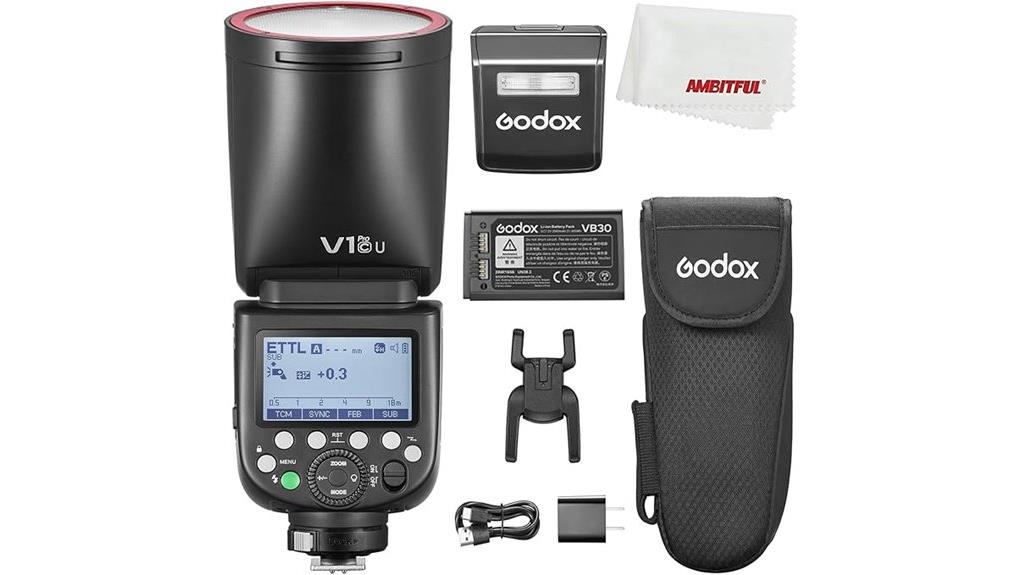
You’ll get a compact, pro-grade round-head TTL flash made for Canon that delivers reliable TTL, fast HSS to 1/8000s, and a GN equivalent of 76 Ws. It recycles in about 1.3s, yields roughly 500 full-power pops per charge, and offers 10-step LED modeling plus 2.4 GHz radio for multi-flash control. Build is robust though not weather-sealed, and the built-in battery limits hot-swaps — continue for detailed performance, quirks, and pairing tips.
Some Key Takeaways
- Canon-compatible round-head flash delivering reliable TTL and HSS up to 1/8000s with predictable power falloff.
- Guide number ~76 Ws, fast recycle (~1.3 s) and about 500 full-power shots per charge from VB30 battery.
- Built-in 2.4 GHz radio supports multi-flash group control and programmable RF for consistent off-camera setups.
- Round catchlights, 10-level LED modeling lamp, and included white reflectors improve soft shaping and previewing.
- Trade-offs: not weather-sealed and internal battery prevents hot-swapping, but offers compact, ergonomic, studio-grade performance.
What the Godox V1PRO‑C Is and Who It’s For
Think of the Godox V1Pro‑C as a professional-grade, round‑headed on‑camera flash engineered for Canon users who need reliable TTL, high‑speed sync, and fast recycling in demanding workflows. You’ll get a compact, consistent light source with round catchlights and programmable RF control for multi-flash rigs. Portrait photographers will appreciate skin-tone fidelity and modeling lamp preview; event photographers gain rapid TTL response across changing scenes. Run and gun shooters benefit from quick mode toggles and durable construction. Studio beginners can adopt it as a primary off-camera head via radio control. You’ll find the V1Pro‑C balances portability, control, and integration. It’s an excellent choice for photographers who work with speedlight gear and want seamless integration with other flash units.
Key Specs That Matter: Power, Battery, and Sync Performance
Having established where the V1Pro‑C fits in a workflow, let’s examine the numbers that determine on‑camera and off‑camera performance: guide number, recycle time, battery capacity and sync limits. You get a 76 Ws equivalent guide number—adequate for fill and short‑throw lighting. Recycle time averages ~1.3 s; expect ~500 full‑power flashes per charge and roughly 100 continuous full‑power shots, with listed battery lifespan around 2 hours under typical use. USB‑C charging is convenient. Sync performance supports HSS to 1/8000s; measured Sync latency is minimal for most triggers, but add marginal delay when routing through wireless groups. White reflectors can shape and soften the light for better portraits, so consider using a white photo reflector to control spill and broaden catchlights.
Real‑World Use: TTL, HSS, Modeling Light, and Wireless Multi‑Flash
Although the V1Pro‑C packs consumer‑friendly automation, you'll notice its real strengths when combining TTL accuracy, HSS headroom, the modeling lamp, and the 2.4 GHz wireless system in practical shoots. You’ll find TTL nuances in mixed lighting: exposure is generally reliable, but rapid compensation fine‑tuning is necessary for reflective subjects. HSS experiments show consistent output up to 1/8000s with predictable falloff; expect reduced effective power. Modeling tests prove valuable for shaping catchlights and previewing ratios with the 10‑level LED. Wireless workflows on 2.4 GHz handle multi‑flash arrays reliably, offering group control and rapid sync for dynamic setups. For those working outdoors, integrating these features with outdoor flash techniques improves subject separation and overall lighting control.
Design, Build, and Included Accessories (SU‑1, USB‑C, Battery)
Beyond its on‑camera performance, the V1Pro‑C's physical design and bundled accessories shape how you'll use those features in the field. You get a compact, round‑head unit with an upgraded head structure—manufacturer durability claims focus on long‑term consistent output. The package includes a detachable SU 1 sub‑flash for low‑angle fill or bounce, a USB‑C cable for in‑camera or bench charging, the VB30 Li‑ion battery, charger, stand and pouch. Fit and finish feel robust but it's not weather sealed. Battery capacity and USB‑C convenience streamline workflow; the detachable SU 1 adds flexible lighting without extra packs. The included stand and pouch make transporting and deploying the V1Pro‑C easy for photographers who also shop light stands for their gear.
Verdict: Strengths, Trade‑Offs, and Which Canon Shooters Should Buy
When you need a compact, TTL‑capable round‑head flash that balances power, speed and on‑board flexibility, the Godox V1Pro‑C delivers: its 76 Ws output, 1/8000s HSS, 2.4 GHz radio system and one‑click TTL/manual toggle give you pro‑level control in a small package, while the VB30 Li‑ion battery and USB‑C charging keep recycle times short and shooting sessions long. Strengths: consistent round catchlights, fast HSS, reliable radio, solid battery longevity and intuitive user ergonomics. Trade‑offs: non‑weatherproof body, built‑in battery limits hot‑swap workflows, modest guide number vs studio heads. Buy if you need portable TTL for Canon shooters. Many photographers also pair on‑camera flashes with RGB lighting setups to add creative color accents in portrait and product photography.
Some Questions Answered
Does the V1pro‑C Support Optical Slave Triggering?
No — it doesn’t offer traditional optical triggering as its primary wireless method. You’ll rely on 2.4 GHz RF optical triggering alternatives via the Godox system; optical triggering modes aren’t highlighted. The unit does support rear curtain sync in TTL and manual modes, so you can use rear curtain timing with RF or camera-based sync. If you need classic optical slave firing, you’ll need an external trigger or different model.
Can I Use Third‑Party Batteries With This Flash?
Yes — you can physically use third‑party batteries, but you should run compatibility checks first. Verify voltage, capacity, and connector fit; mismatches can disable charging or damage the flash. Expect variable results: some third‑party cells work fine, others degrade recycle time or fail safety cutoffs. Perform performance testing (recycle time, shot count, temperature, TTL reliability) before critical shoots. Prefer OEM or well‑reviewed batteries for consistent results.
Is Firmware Updatable via Usb‑C on the V1pro‑C?
Yes — you can update firmware via USB‑C on the V1Pro‑C. You’ll use the USB‑C cable to connect the flash to Godox’s updater tool, follow the update process in the app, and monitor progress. Verify bootloader status if prompted; if the device shows bootloader mode the tool will push the firmware updates safely. Don’t disconnect during flashing, and keep battery charged to avoid corruption.
Will the Round Head Accept Standard Bowens Modifiers?
No, the round head won't natively accept standard Bowens modifiers. The V1Pro-C uses a circular head, so you’ll need Bowens compatibility via Modifier adapters specifically made for the V1/V1Pro series. With a proper adapter ring you can mount Bowens-mount softboxes, reflectors, or beauty dishes. Verify adapter fit, heat tolerance, and locking security before use. Without the adapter, Bowens modifiers won’t attach or seat securely on the round head.
Does the Su‑1 Sub‑Flash Work Independently From the Main Unit?
Yes — the SU‑1 offers sub‑flash autonomy and can perform independent firing from the main V1Pro‑C unit. You’ll control it as a detachable fill source that communicates via the flash’s internal circuitry and RF system, letting you trigger it solo for localized fill or bounce. Functionality is limited compared with a full remote head: it’s optimized for close‑range, synchronized firing rather than full-power remote strobing.