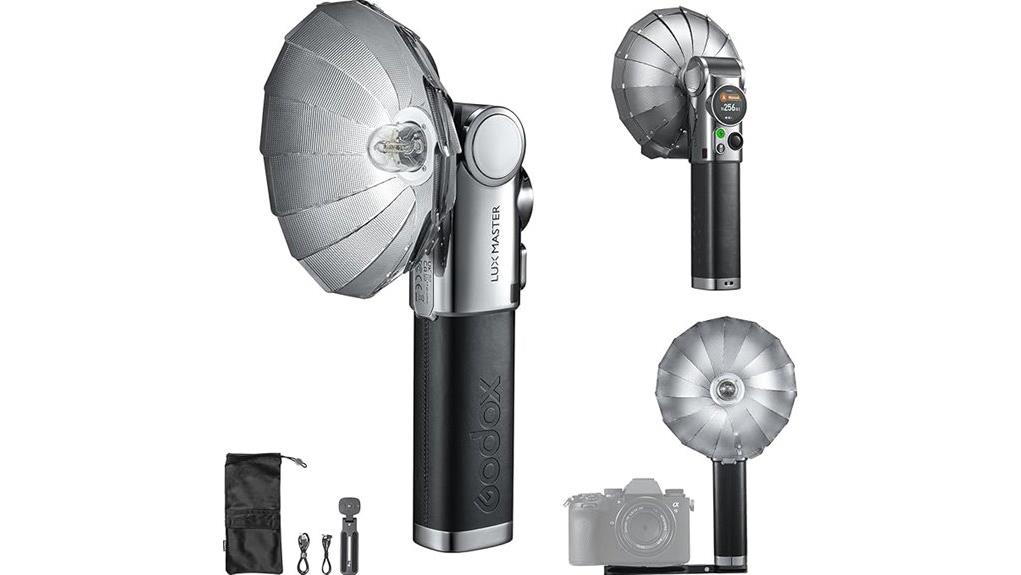
You’ll like the Lux Master Retro if you want Graflex‑style looks with modern TTL/HSS control and a compact GN25 punch for on‑camera and light off‑camera work. It’s tactile, tilts 0–90°, and gives predictable output with 0.1 EV steps, Bluetooth and 2.4 GHz X triggering, plus ~460 full‑power pops from a 7.2V/2980 mAh pack. Recycling is quick at mid power, slower at full. Color’s around 6000 K with slight warmth, and more details follow if you want them.
Some Key Takeaways
- Vintage Graflex-inspired design with brushed-black body and tactile controls pairs classic looks with modern usability.
- Compact 470 g unit with GN25 (ISO100) offers reliable on-camera and modest off-camera performance.
- TTL and HSS support with 0.1 EV steps, consistent output tracking, and 1/250s sync limit.
- 7.2V/2980mAh battery yields ~460 full-power pops, USB-C recharge in ~2 hours; mid-power recycling is fast.
- Built-in 2.4 GHz X system and Bluetooth enable multi-flash wireless control and tethered app adjustments.
Hands-On First Impressions and Retro Design Breakdown
On first handling the Godox Lux Master Retro, you’ll notice it leans into vintage cues without sacrificing modern ergonomics: the Graflex-inspired fan reflector and brushed-black body give it character while the 470 g weight and compact footprint keep it practical for on-camera use. You’ll appreciate vintage ergonomics in the grip and control layout; tactile materials feel deliberate, not toy-like. Silhouette accuracy to classic flashguns aids aesthetic shoots, while the removable fan reflector and supplied bracket show strong accessory compatibility. Buttons are responsive, the tilting head moves smoothly, and the overall build balances nostalgia with everyday usability. Its compact size and balanced weight make it particularly suitable for use with handheld gimbals during run-and-gun shoots.
Key Specs and On-Paper Features That Matter (GN25, TTL/HSS, Battery, Connectivity)
Because the Lux Master pairs retro styling with modern specs, its headline numbers matter: GN25 (ISO 100) puts it in the compact on-camera flash class, TTL and HSS give you flexible exposure control, and the built-in 7.2V/2980 mAh battery promises roughly 460 full-power pops per charge with USB-C recharge in about two hours. You’ll appreciate precise 0.1 EV steps, decent trigger range via the 2.4 GHz X system, and Bluetooth for tethered control. Check battery health over time and expect firmware updates to refine behavior. Note the 1/250s sync limitation—plan off-camera setups accordingly. This flash is a good match for photographers who use ring lights and portable lighting gear.
Real-World Performance: Output, Recycling, Tilt/Bounce, and Color Consistency
While the Lux Master’s GN25 output won’t dominate a studio, you’ll find its real-world punch reliable for run-and-gun work and modest off-camera setups. You’ll get consistent output consistency across most power settings; exposures track predictably with 0.1 EV steps. Recycling sits in the practical range—fast enough between mid and low power, slower at full but acceptable given the battery. The 0°–90° tilt enables usable bounce without awkward vignetting, and the detachable fan reflector shapes light cleanly. Color reads a neutral 6000 K with pleasant flash warmth; you may still want minor white-balance tweaks in mixed lighting. It’s a handy companion for photographers who also use field monitors to shape and preview light.
Workflow and Usability: Controls, Touchscreen, Wireless Triggering, and Mounting
Although the Lux Master borrows vintage looks, its workflow is modern and straightforward: the full-color touchscreen gives you swipe-and-tap control with 0.1 EV increments, and physical buttons provide quick access to TTL/HSS and mode swaps when you need tactile confirmation. You’ll appreciate touchscreen responsiveness—menus feel immediate, though tiny icons can be fiddly with gloves. Wireless triggering via the built-in 2.4 GHz X system and trigger compatibility (X3/XPro series) lets you integrate into multi-flash setups reliably. Mounting flexibility is excellent: the hot shoe and included flash bracket fit most bodies and stabilize the 470 g unit for handheld or bracketed shooting. It’s a great option for photographers who rely on wireless flash triggers to coordinate multiple strobes.
Who Should Buy the Lux Master Retro and How It Compares to Alternatives
If you want a compact flash that mixes vintage styling with modern control and reliable wireless, the Godox Lux Master Retro is a strong choice for hobbyists and hybrid shooters who value looks without sacrificing function. You’ll appreciate the 2.4 GHz X system, TTL/HSS, 0.1 EV steps, and 460 full-power flashes per charge. Choose it if you’re portrait photographers who care about bounce and color consistency, street shooters wanting discreet retro looks, product photographers needing precise output, or travel vloggers avoiding bulky kits. Alternatives like Godox V1 or Profoto A1 trade style, battery life, or ecosystem compatibility differently. We also sell a range of on-camera LED lights ideal for supplementing flash work and continuous lighting needs, including compact panels and bi-color options for balanced color temperature control with on-camera LED panels.
Some Questions Answered
Can I Use External Flash Modifiers With the Fan Reflector Attached?
Yes — you can use external flash modifiers with the fan reflector attached, but expect limited modifier compatibility and some accessory stacking trade-offs. The fan reflector mounts over the head, so low-profile softboxes, gels, or small diffusers fit reasonably; larger modifiers or deep softboxes will clash or block tilt. You’ll need quick-release or adaptable mounts and may remove the fan reflector for full-size modifiers to avoid vignetting, balance, or secure mounting issues.
Is the Built-In Battery User-Replaceable?
No — the built-in battery isn’t user-replaceable. You’ll need authorized service for battery replacement under the service policy; attempting DIY replacement will void warranty and risks damage. Technically it uses a 7.2V 2980mAh lithium-ion pack soldered/secured internally, optimized for up to ~460 full-power flashes. Contact Godox support or an approved repair center for battery replacement, warranty claims, or safety-certified disposal guidance.
Does the Flash Support Power Output Locking or Groups Memory?
No — it doesn’t offer dedicated power locking or persistent group memory. You can lock output by holding controls temporarily, but there’s no true power locking feature to prevent accidental changes across sessions. Group settings are selectable via the menu and 2.4 GHz system, yet they aren’t saved as long-term group memory after power cycles. For professional shoots you’ll need to reconfirm groups and outputs when restarting the unit.
Can the Unit Be Firmware-Updated via Bluetooth or USB-C?
Yes — you’ll get firmware access and an update workflow via USB‑C; Bluetooth pairing provides limited hardware interfacing but Godox typically pushes firmware updates through a wired USB‑C connection for reliability. You’ll connect the unit to your computer or mobile app, run the update utility, and follow prompts to transfer firmware. Don’t expect full firmware flashing over Bluetooth; use USB‑C for stable, verified updates and rollback support.
Is There a Recycle Indicator or Heat Protection During Rapid Bursts?
Yes — you get both a thermal indicator and a cooldown timer for rapid bursts. You’ll see a thermal indicator on the screen that warns when the unit’s getting hot, and an on-screen cooldown timer counts down required rest time after heavy use. That’s useful for protecting the flash and planning shoots. It won’t stop you completely, but it enforces safer burst limits to prevent overheating and prolong battery life.