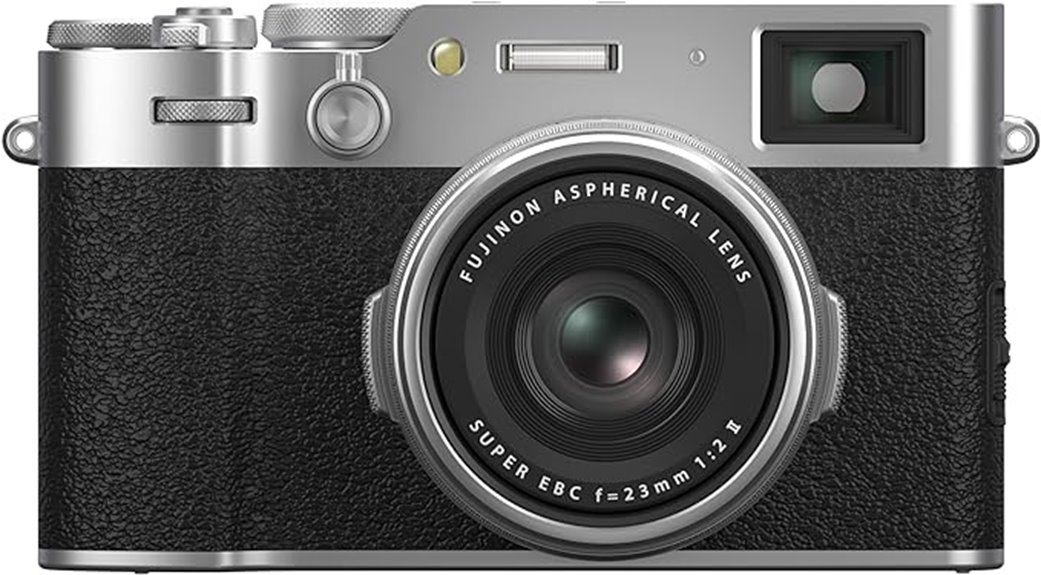
You’ll find the X100VI (Japan, Silver) gives you a compact rangefinder with a 40MP X‑Trans sensor, built‑in IBIS and a sharp fixed 23mm lens that lifts detail, color and dynamic range over prior models. JPEGs and film sims are excellent, and 6.2K/10‑bit H.265 video is surprisingly usable though workflow prefers proxies. Autofocus is quick in daylight but lags in low light, and the single lens trades versatility for simplicity — keep reading to get specifics and comparisons.
Some Key Takeaways
- 40MP X-Trans CMOS 5 HR sensor and X-Processor 5 Ultra deliver marked resolution, tonal improvement, and excellent color/skin rendering.
- Built-in IBIS (up to six stops) stabilizes handheld stills and smooths video, with slight micro-wobble on pans.
- Fixed 23mm lens and hybrid OVF/EVF suit street, travel, and documentary shooters preferring single-lens simplicity.
- 6.2K/30p H.265 10‑bit 4:2:2 video offers high-quality masters; use proxies for efficient editing and grading.
- Compact tactile rangefinder controls and strong daylight AF; low-light AF and grip may lag compared with full-frame rivals.
What the X100VI (Japan, Silver) Offers at a Glance
While you might expect a compact rangefinder to compromise on performance, the X100VI (Japan, Silver) delivers a surprising blend of cutting-edge imaging and practical usability. You’ll get a 40MP X-Trans sensor and X-Processor 5 Ultra, reliable IBIS up to six stops, and 6.2K video options without bulk. Its compact ergonomics and tactile dials make manual control immediate and satisfying, yet autofocus and subject recognition stay modern. Build and finish feel premium, though fixed-lens limitations remain for focal-length flexibility. If you value pocketable image quality and direct control, this model is hard to dismiss. This model appeals especially to mirrorless camera enthusiasts who seek dedicated accessories and gear.
How the 40MP X-Trans CMOS 5 HR Sensor Performs for Photos
Because Fujifilm paired the 40MP X-Trans CMOS 5 HR with the X-Processor 5 Ultra, you’ll see a marked leap in resolution and tonal nuance compared with previous X100 models. You get finely resolved images where detail rich textures—fabric weaves, foliage, skin microstructure—hold up even when you crop. Dynamic range feels expanded; shadows retain separation and highlights recover nicely without artificial crunch. Color depth rendering is impressive, producing nuanced skin tones and saturated hues that stay natural rather than pushed. Critically, noise control at base and moderate ISOs is excellent, though high-ISO grain becomes more apparent beyond ISO 6400. Regular sensor maintenance with sensor swabs helps keep those finely resolved images free of spots and artifacts.
Video, Stabilization, and Low-Light Results: 6.2K, IBIS, and H.265 Workflow
When you switch from stills to motion the X100VI delivers a surprising step up: 6.2K/30p H.265 10‑bit 4:2:2 capture gives you much more latitude for grading and reframing than past X100 models, and the X-Processor 5 Ultra keeps encoding efficient without obvious artifacts. You’ll appreciate a straightforward 6.2K workflow: edit proxies for responsiveness, then grade the 10‑bit masters. IBIS performs well for a fixed-lens compact, calming small shakes and extending usable shutter speeds; Stabilization testing shows up to several stops of benefit, though handheld panning can reveal subtle micro‑wobble. Low‑light footage holds color and detail, but noise rises past ISO 6400. For accessory users looking to add motion to their shoots, a compact camera slider can pair well with the X100VI for smooth, controlled moves and cinematic results with camera sliders.
Handling, Viewfinder, Autofocus, and Real-World Shooting Tests
Although compact in size, the X100VI feels deliberately engineered for tactile, confident shooting. You’ll appreciate the intuitive button layout and dedicated dials that keep controls under thumb without fumbling. Handling ergonomics are improved by a subtly sculpted grip, though larger hands may want more purchase. The hybrid viewfinder excels: viewfinder ergonomics deliver clear framing and quick eye alignment, blending OVF immediacy with EVF precision. Autofocus shows strong focus responsiveness in daylight and decent subject recognition in mixed scenes; low-light AF can hesitate compared with full-frame rivals. In real-world shooting it’s fast, precise, and rewarding for street and travel work. Our shop focuses on helping photographers find the right gear for everyday shooting, including thoughtfully designed camera shoulder bags.
Who Should Buy the X100VI (Japan, Silver) : Value, Alternatives, and Final Verdict
If you value a compact, tactile rangefinder-style camera that packs modern imaging tech, the X100VI (Japan, Silver) is hard to beat—its 40MP X-Trans sensor, X-Processor 5 Ultra, robust IBIS and hybrid viewfinder give you a unique blend of image quality and shooting immediacy that suits street, travel, and documentary work. You should buy it if you prioritize single-lens simplicity, superb JPEG/film simulations, and reliable AF in a discreet package. Buying considerations include price, fixed 23mm lens, and niche Japan-market extras. For competing options, consider full-frame compact hybrids or an interchangeable-lens Fujifilm X-series setup for greater versatility. This camera is a natural fit for readers of Gear Guide who enjoy curated digital camera products and expert buying advice.
Some Questions Answered
Is the Lens Fixed or Interchangeable?
The lens is fixed — you won’t swap it out. You’ll get a built-in lens with set focal length and manual aperture control that limits versatility compared with interchangeable systems. That said, its optimized optics and aperture control let you shape depth of field and bokeh precisely. You’ll rely on camera features, focal length choice and sensor performance for creative framing, rather than changing glass, so plan your shooting around that built-in perspective.
What Is the Native ISO Range?
The native ISO range is ISO 160–12,800, and you’ll find expanded ISO settings that extend down to ISO 80 and up to ISO 51,200. You’ll want to stick to native ISO when possible for best dynamic range and noise control; expanded ISO can help in extremes but often sacrifices image quality. Use IBIS and slower shutter speeds instead of cranking expanded ISO upward unless you absolutely must.
Does It Support External Microphone Input?
No, it doesn’t offer a dedicated external microphone input, so you’ll rely on the built-in mic or wireless solutions. That built-in mic risks wind noise in outdoor shoots, so you’ll want a windscreen or separate recorder. If you record audio externally, you’ll need to manually guarantee audio sync in post—clap or use timecode-capable devices. Overall, audio options are limited compared with cameras that include a mic jack.
Is There a Headphone Jack for Audio Monitoring?
No, there’s no dedicated headphone jack for headphone monitoring on this model. You’ll have to rely on visual meters and the camera’s internal monitoring, which can make evaluating real-time audio tricky. That limitation increases audio latency risk when using wireless solutions or relying on camera-recorded sound. If accurate live monitoring matters, you’ll want an external recorder or adapter with low-latency monitoring to guarantee reliable audio checks during shooting.
What Battery Life (CIPA) Does It Achieve?
You’ll get roughly 300 shots CIPA with the X100VI under typical use; actual battery longevity varies with EVF use, IBIS, and video. You’ll drain faster shooting 6.2K video or using continuous AF and stabilization. You can charge in-camera via USB-C or use an external USB-PD charger for faster top-ups; having a spare NP-W power pack or power bank is wise if you need extended shooting without breaks.