You'll like the Flashpoint XPLOR 600 Pro if you need a portable 600W monolight that balances power and mobility. It gives HSS to 1/8000s, short flash durations for motion-freezing, and fast recycling roughly 0.01–0.9s. Battery life is solid for location work but limited for long bursts. Color stays stable around ±75K, and built-in R2 wireless plus Bowens mount make modifiers easy. Keep going and you’ll find detailed test results and buying tips.
Some Key Takeaways
- Portable 600W monolight offering studio-level power on battery for location and hybrid shooters.
- Fast flash durations (~1/220 to 1/10,000s) and HSS to 1/8000s for motion-freezing control.
- Battery (28.8V/2600mAh) supports roughly 360 full-power pops but limits long continuous bursts.
- Color temperature stable (~±75K) with consistent skin tones and minimal post white-balance fixes.
- Built-in R2 2.4GHz TTL/HSS supports major camera brands and Bowens mount accepts common modifiers.
How the XPLOR 600 PRO Fits Your Kit: Who It’s For and Key Specs
Wondering if the XPLOR 600 PRO belongs in your kit? You’ll find it’s aimed at hybrid shooters who need a 600W monolight that balances power with lightweight portability. It’s compact, Bowens-mounted, and battery-powered, so you can move between studio and location without hauling AC gear. Portrait integration is straightforward: stable color temp, consistent output steps, and built-in R2 wireless make off-camera setups quick. It suits wedding, editorial, and portrait photographers who want versatile modifiers and fast sync options. It’s not for those wanting studio-only bulk or marginally cheaper, lower-spec flashes. It also pairs well with a range of video light panels for mixed lighting setups.
Practical Power and Speed Tests: Flash Duration, HSS, Recycling, and Battery Life
You’ve seen where the XPLOR 600 PRO fits in a kit; now let’s measure what it actually delivers when you push it. You’ll get flash durations from about 1/220 to 1/10,000s, letting you freeze fast motion or favor shorter flashes at low power. HSS works up to 1/8000s with predictable falloff. Recycling spans roughly 0.01–0.9s depending on output, and the supplied 28.8V/2600mAh battery yields up to ~360 full-power pops — practical battery longevity for location work. Watch for heat under extreme burst use; manage duty cycles to avoid strobe overheating. This makes the XPLOR 600 PRO a strong choice for photographers focused on speedlight gear and creative flash techniques.
Color Accuracy and Stability in Real Shoots: Stable Color Temperature Results (±75K)
When you rely on the XPLOR 600 PRO for mixed-light shoots, its Stable Color Temperature mode keeps results predictable, holding CCT variation to roughly ±75K across the power range. You’ll notice consistent skin tones and neutral highlights from full to low power, so your white balance adjustments are minimal and repeatable. In practical shoots the unit showed negligible color drift between bursts and during rapid power changes, reducing time spent color-matching in post. Measurements confirmed stability under varied battery and recycling conditions. If you prioritize reliable color fidelity in handheld or location work, this strobe delivers measured, usable consistency. This makes it a great choice for photographers who need to ensure their monitors are calibrated to present true-to-life colors.
Wireless, Mounting, and System Compatibility: R2, Range, and Camera Support
Having consistent color makes it easier to integrate the XPLOR 600 PRO into multi-light setups, and its built-in R2 2.4GHz system keeps control equally straightforward. You’ll appreciate reliable triggering across the quoted 328 range, with group/channel control and TTL/HSS support for Canon, Nikon, Sony, Fujifilm, Olympus, and Panasonic. Mounting is versatile: the Bowens mount accepts modifiers and common Mounting adapters for Bowens-to-modifier connections. For troubleshooting, R2 troubleshooting steps are simple—check channel/group, firmware, and line-of-sight interference. Overall, compatibility is strong; you’ll rarely need extra gear beyond adapters and routine wireless checks. This makes the XPLOR 600 PRO a great match for photographers using handheld gimbals who want consistent lighting in motion.
Final Verdict and Buying Advice: Real-World Pros, Cons, and Recommended Alternatives
Although it’s compact and feature-rich, the XPLOR 600 PRO is best for photographers who need high-speed performance and reliable color consistency without lugging studio mains, so you should weigh its strengths—fast HSS to 1/8000s, short flash durations, quick recycling, and stable ±75K color—against limits like battery runtime and modifier needs. You’ll appreciate pro-grade output, precise exposure control, and portable power for location work, but battery longevity and a limited accessory ecosystem can constrain long shoots or specialized modifiers. If you need more runtime or native modifiers, consider studio units or competing high-capacity battery heads as alternatives. For transporting and protecting this kind of gear, photographers often choose durable cases like Pelican cases designed specifically for equipment protection.
Some Questions Answered
Does It Come With a Protective Carrying Case for the Head and Accessories?
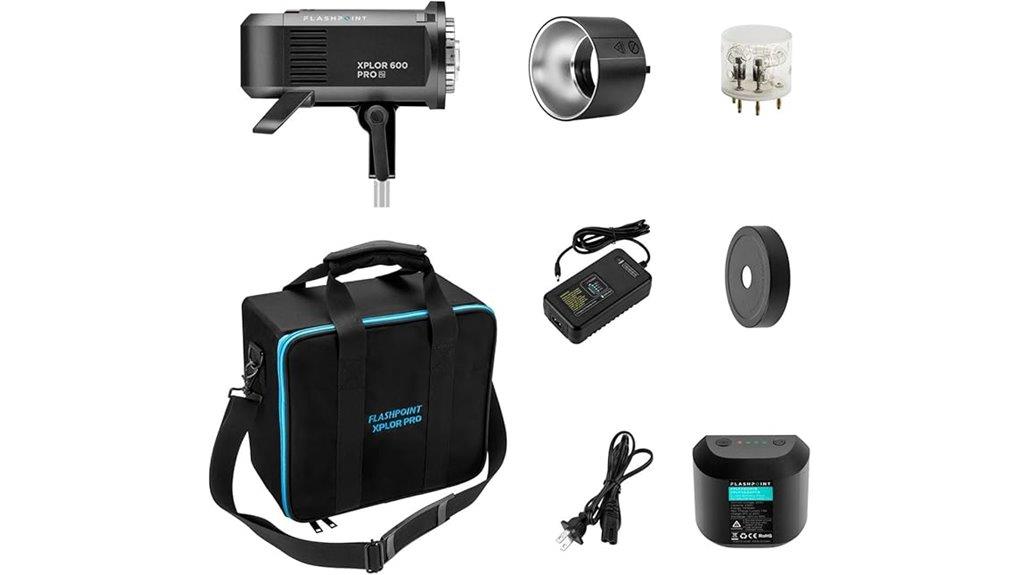
Yes — you get a protective case that includes accessory storage for the head and gear. You’ll find a compartment case designed to hold the monolight head, rechargeable battery, flashtube, reflector, charger and cords. It’s compact, protective and organized, so you won’t scramble for small items. You’ll appreciate the tailored fit and padded protection during transport, keeping components secure and accessible for shoots.
Can I Use Third-Party Bowens Modifiers Without Vignetting?
Yes, you can use third-party Bowens modifiers without vignetting if the mount adapter is properly fitted and the modifier’s size matches the strobe’s beam coverage. Check modifier diameter and depth—larger softboxes and parabolic reflectors minimize edge falloff. Use a secure mount adapter to avoid light leaks or misalignment. Test at various zoom/coverage settings and near-full power to confirm even illumination across the frame.
Is There a TTL-Capable Version or Firmware for TTL Support?
No — there isn’t a TTL-capable version built into the unit, nor official firmware availability to add TTL. You’ll need to rely on manual control and high-speed sync. Check trigger compatibility: the built-in R2 system supports many triggers but doesn’t provide TTL signals for Canon/Nikon/Sony et al. If TTL is essential, consider dedicated TTL-capable models or third-party triggers that explicitly list TTL support for your camera system.
What Is the Warranty Period and Authorized Service Process?
The warranty duration is typically one year from purchase, though it can vary by retailer or region, so check your receipt. For service procedure, you’ll contact the authorized dealer or Godox/Flashpoint support, provide proof of purchase and serial number, and follow their RMA instructions for shipping. They’ll evaluate, repair or replace, and return the unit. Keep all original packaging and document communications to streamline the process.
Are There User-Replaceable Parts Like the Flashtube or Fan?
Yes — the flashtube and fan are user replaceable parts, though they require care. You’ll follow a serviceability guide: power down, remove battery, open rear access screws, swap the flashtube or fan with OEM parts, then reseal. If you’re uncomfortable, use authorized service. Keep replacement parts, flashtube, and fan matched to the unit to preserve Stable Color Temperature Mode and safe operation; improper parts can damage the pack.