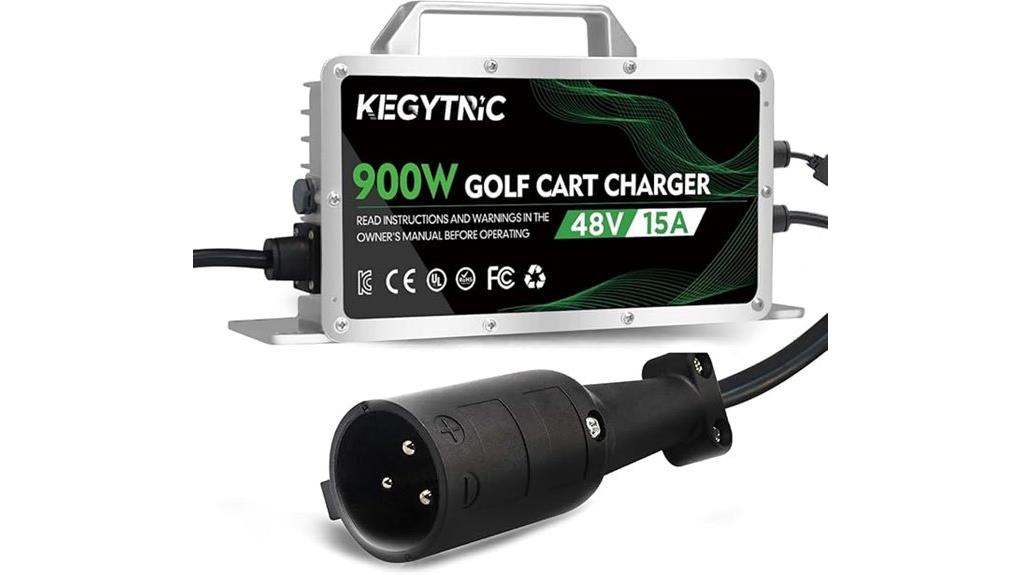
You’ll get a faster, smarter 48V 15A charger that fits most Club Car DS (1995–2010 with OBC bypass) and many Precedent models (2015+ plug‑and‑play), delivering up to 900W and a full charge in about 6–7 hours—roughly 20% quicker than standard units. It uses smart bulk/taper/trickle stages, temp sensors, fan cooling, IP67 housing, and heavy‑duty cables for durability. It’s ideal for regular users and fleets; continue for setup, bypass tips, and pros/cons.
Some Key Takeaways
- Delivers 48V at 15A (≈900W), charging a depleted pack in about 6–7 hours, roughly 20% faster than standard chargers.
- Built-in smart bulk/taper/trickle charging with auto-shutoff after 14 hours preserves battery life and prevents overcharging.
- Robust safety: temperature sensors, cooling fan, overcurrent/short/high-low-voltage protections, and auto-cutoff reduce thermal and fault risks.
- Durable IP67 aluminum housing, solid copper pins, heavy-duty cables, and 5.7 lb compact design suit outdoor and travel use.
- Compatible with most Club Car models (1995–2010 DS with OBC bypass, many 2004–2014 Precedents; 2015+ Precedent plug-and-play).
Which Club Car Models Is This 48V 15A Charger Compatible With?
Which Club Car models will this 48V 15A charger work with? You’ll find broad compatibility: 1995–2010 Club Car DS models can use it but require 1995 DS mods—an OBC bypass manual is included to guide that process. 2004–2014 Precedent (48V) units may also need the bypass depending on onboard computer configuration. 2015–Present Club Car Precedent (48V) are Precedent ready and work straight out of the box with the 3-pin round plug. The charger’s solid copper pins and clear model notes help you confirm fit quickly, minimizing downtime and installation guesswork. This charger is ideal for golfers who travel with their clubs and need reliable power for their carts hard-sided travel cases.
How Fast and Effectively Does the Charger Charge a 48V Battery?
Because this 48V 15A charger delivers up to 900W, you’ll typically get a full charge in about 6–7 hours for a depleted 48V golf cart battery pack, charging roughly 20% faster than a standard charger. You’ll notice fast charging during bulk phase, then automatic tapering to protect cells. The smart trickle mode holds full voltage while minimizing stress, and auto-shutoff after 14 hours prevents prolonged float. In practice you get quicker turnaround without sacrificing battery longevity, provided you follow recommended charging cycles. Overall the unit balances speed and care, delivering efficient fills with measures that preserve pack life. Many golfers appreciate pairing reliable chargers with protective gear like soft-sided travel cases to safeguard batteries and accessories when transporting clubs.
Safety, Protections, and Durability Features That Matter
When you’re charging your Club Car battery pack, the charger’s layered protections and rugged build work together to keep both you and the batteries safe: temperature sensors and a cooling fan cut power if things run hot, while overcurrent, short-circuit, high/low voltage, and overcharge protections stop dangerous faults before they escalate. You’ll appreciate the built-in temperature monitoring and auto-shutoff that limit thermal stress and reduce fire risk. The aluminum alloy case and IP67 waterproof housing resist corrosion and rain exposure, while heavy-duty cables and a compact, 5.7 lb package withstand daily handling and outdoor storage. Many golfers also value sun protection and skin-care measures during long rounds, so consider keeping sun protection essentials in your cart to reduce UV exposure while charging or maintaining gear.
Installation, OBC Bypass Option, and Real-World Setup Tips
If you’re installing the Club Car 48V 15A charger yourself, start by confirming compatibility with your cart model and whether the OBC (onboard charger) needs bypassing—2015‑present Precedent models work out of the box, while DS (1995–2010) and 2004–2014 Precedent usually require the included OBC bypass manual. Mount the unit where ventilation and placement considerations prevent heat soak; secure with vibration‑resistant hardware. Route the 16‑ft cable neatly for cable management and inspect the 3‑pin round connector regularly for connector maintenance. Check firmware updates where applicable, verify auto‑shutoff/trickle behavior, and test a full charge cycle before regular use. Also keep a basic set of essential tools on hand for mounting, wiring, and routine maintenance.
Should You Buy It? Use Cases, Pros vs Cons, and Final Buying Recommendation
Though you don’t have to be a technician to use it, the Club Car 48V 15A charger is a strong choice if you want faster, reliable charging for a Club Car golf cart—especially 2015‑present Precedents that work without modification. You’ll get ~20% faster charge, smart trickle and auto-shutoff for battery longevity, plus IP67 durability. Use cases: daily club/yard work, fleet charging, or occasional range extension for longer outings. Pros: fast, safe, portable, OBC bypass manual included. Cons: heavier than basic units, upfront cost vs basic chargers. Final verdict: buy if you value speed, protection, and long-term cost comparison. It’s particularly well suited for golfers who use their carts regularly and want to upgrade the top gear of their electric golf carts.
Some Questions Answered
Is This Charger Compatible With Non-Club Car 48V Batteries?
Yes — you can use it with non-Club Car 48V batteries if voltages and battery chemistry match and the connector dimensions fit. You’ll want to confirm your battery pack’s chemistry (lead‑acid vs lithium) because charging profiles differ; this charger uses a Club Car profile and smart trickle/auto‑shutoff that may not suit all chemistries. Check connector dimensions and pin type; if needed, adapt or use an appropriate adapter and monitor initial charges closely.
Can I Leave the Charger Plugged in Continuously Long-Term?
Yes — you can leave it plugged in long-term, but take precautions. The charger provides smart trickle charging, auto-shutoff after 14 hours, and thermal monitoring to protect cells. For peak battery maintenance, confirm the charger suits your battery chemistry and verify ventilation to avoid heat buildup. Periodically inspect connections and the cooling fan. If you see overheating, erratic charging, or corrosion, unplug and service the system promptly.
Does the Charger Work on 220V With an Adapter?
No — it’s designed for 110V input, so you can’t just use an adapter for 220V. Using a simple plug adapter without proper Voltage conversion creates safety risks and can damage the charger or batteries. If you need to run on 220V, use a certified step-down transformer or a converter rated for the charger’s input power plus margin. Have a qualified electrician verify installation to minimize risk and guarantee safe operation.
Are Replacement Cables or Plugs Available Separately?
Yes — replacement plugs and cables are available separately through the manufacturer and authorized dealers. You’ll get matching 3-pin round replacement plugs and heavy-duty rubber cables built to the same specs; cable lengths include the stock 16-foot extended option and shorter/longer alternatives on request. Check warranty/support first, since third-party parts can void coverage. Contact 24/7 support to confirm compatibility, order numbers, and lead times before purchasing.
What Warranty and Repair Process Is Included After Purchase?
You get a 60-month warranty length and 24/7 support; they’ll cover defects and offer guidance. If a repair’s needed, you’ll contact support, get troubleshooting, then ship instructions or local service referral. Typical repair turnaround is handled promptly by their team and aims to minimize downtime; exact repair turnaround depends on parts and location but they prioritize fast service and will keep you updated throughout the process.