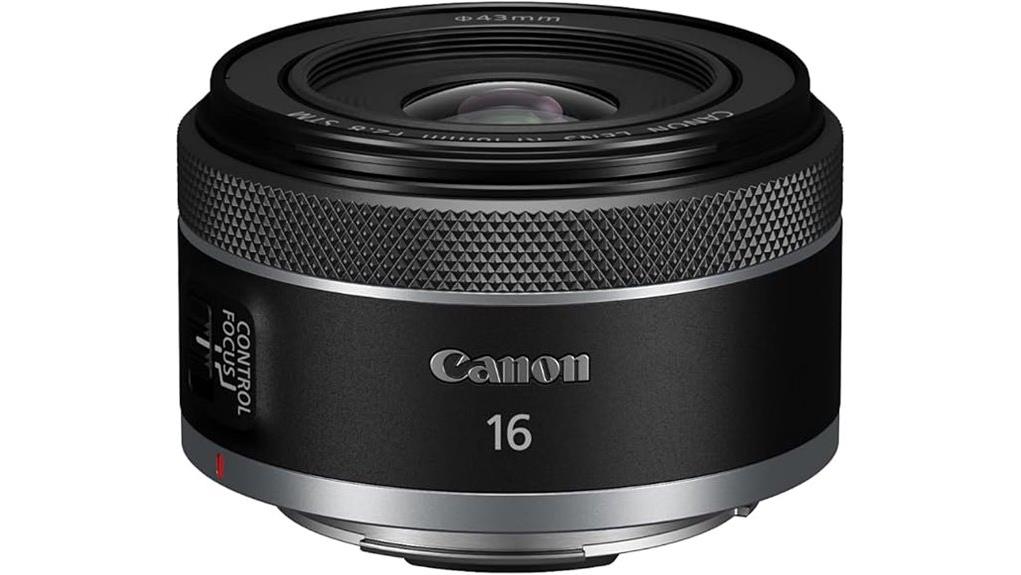
You’ll like the Canon RF16mm F2.8 STM if you want an ultra-wide, featherweight prime for travel, vlogging, and landscapes. It gives excellent center sharpness at f/2.8, corners clean up by f/5.6, and vignetting fades stopped down. The quiet gear-type STM focuses smoothly for video with minimal hunt, and the control ring helps quick adjustments. Expect barrel distortion correctable in RAW and modest coma for stars; keep going for detailed tests, comparisons, and accessory notes. When considering canon rf lens performance insights, you'll appreciate the level of detail it captures in both wide and tight frames. These lenses are designed to maximize compatibility with the latest mirrorless bodies, enhancing overall image quality. As you delve deeper, you'll find that factors such as lens characteristics and shooting techniques can significantly impact your results.
Some Key Takeaways
- Excellent center sharpness at f/2.8 with slight improvement when stopped down for high-resolution RF bodies.
- Corners are soft wide open but reach usable edge-to-edge sharpness by about f/5.6.
- Quiet, smooth gear-type STM autofocus ideal for vlogging and run-and-gun video with minimal hunting.
- Extremely lightweight (163 g) and compact, making it excellent for travel, street, and handheld video.
- Some barrel distortion and vignetting wide open are correctable in RAW; minor lateral CA and edge coma for stars.
Quick Verdict: Is the Canon RF16mm F2.8 STM Worth Buying?
While compact and affordable, the Canon RF16mm F2.8 STM delivers a sharp, ultra-wide perspective that makes it an excellent buy if you need a lightweight prime for landscapes, interiors, vlogging, or astrophotography. You’ll appreciate its 16mm field, f/2.8 speed, and 108° coverage on RF bodies—ideal as a budget ultrawide option. The 163 g body and STM motor give steady handheld framing and quiet AF for street vlogging or run-and-gun video. You won’t get weather sealing or premium build, but you’ll gain portability, reliable focusing, and useful close-focus performance, making it a practical, value-driven choice. Consider pairing it with a lightweight tripod for the best travel photography results.
Optical Performance and Image Quality: Sharpness, Distortion, Vignetting, and Coatings
Because this lens prioritizes portability and affordability, you should expect performance that’s strong in some areas and modest in others. You’ll find center sharpness excellent at f/2.8, improving slightly stopped down; corners soften wide open but become usable by f/5.6. Distortion is typical for ultra-wide glass—noticeable barrel curvature correctable in RAW with minimal quality loss. Vignetting is present at f/2.8, fading as you stop down. Chromatic aberration is well controlled in real scenes, with only minor lateral fringing at extreme edges. Color rendition is neutral and pleasing. Coatings deliver competent flare resistance and maintain good edge contrast across the frame. This balance of traits makes the lens a solid choice for photographers seeking portable wide-angle performance without a high price tag.
Autofocus, Handling, and Video Features: STM Motor, Focus Ring, Weight, and Usability for Vlogging
Having covered optical trade-offs, look next at how the lens behaves in real-world use: the RF16mm’s gear-type STM delivers quiet, smooth AF that keeps pace for run-and-gun video and most stills work, with minimal hunting on EOS R bodies. You’ll notice very low STM noise during continuous AF; it’s unobtrusive for onboard mic capture. The compact 163 g body and short profile improve Handling ergonomics—balance on small bodies is excellent, and the control ring gives direct adjustments without menus. Manual focus is responsive but not de-clicked; overall usability for vlogging is high, especially for handheld, walk-and-talk setups. This makes it a useful option for photographers looking for essential lens accessories and lens gear suited to compact setups.
Real-World Tests and Use Cases: Landscapes, Interiors, Astrophotography, and Webcam/Vlog Setups
When you put the RF16mm F2.8 STM on an EOS R body, its ultra-wide field, f/2.8 aperture and lightweight 163 g design make it immediately useful for landscapes, tight interiors, night skies and run‑and‑gun vlogging. You’ll capture expansive vistas with edge-to-edge detail at smaller apertures; center sharpness is strong wide open while corners improve by f/5.6. In cramped interiors you’ll frame scenes without distortion tricks. For astrophotography and street astrophotography the lens gathers enough light for starfields; expect mild coma at edges. For webcam/vlog setups it focuses quickly and delivers usable low light portraits with pleasing context. This makes the RF16mm a great choice for photographers exploring wide-angle lenses and seeking versatile performance across genres.
Final Buying Guide: Who Should Buy It, Alternatives, and Accessory Checklist
You’ve seen how the RF16mm F2.8 STM performs across landscapes, interiors, astrophotography and vlogging; now let's pinpoint who will get the most value and what to weigh before buying. You should buy this if you prioritize ultra‑wide reach, low weight (163 g), fast STM AF for video, and tight budget-to-performance. Consider budget alternatives if you need zoom flexibility or weather sealing. Check mount adapters only if using non‑RF bodies. Buy travel accessories (padded case, lens cloth) and confirm 43 mm filter options for ND/UV/glass protection. Alternatives: wider primes or compact RF zooms depending on workflow. Also consider compatibility with lens adapters when planning to pair this lens with non‑native camera systems.
Some Questions Answered
Can I Use Front Filters With the 43MM Filter Thread on This Lens?
Yes — you can use front filters with the 43mm thread, but watch vignetting on full-frame. You’ll get reliable results with slim adapters to keep the optical path clear; standard thick filters may darken corners at 16mm. For creative filters (ND, polarizers, star, soft) choose high-quality slim variants and stack minimally. You’ll maintain autofocus and close focus, but test combinations to confirm no edge shading or mechanical interference.
Is the Lens Weather-Sealed for Use in Light Rain or Dust?
No — it isn’t weather-sealed, so you shouldn’t expect reliable protection in light rain or dusty conditions. You’ll get no official weather resistance and sealing effectiveness is limited to basic construction only. If you’ll use it outdoors in questionable conditions, you’ll want external protection: a rain cover, plastic wrap, or avoid exposure. For consistent dust/rain work, choose a lens with dedicated weather sealing or camera body-weather resistance.
Does It Support In-Camera Lens Corrections on All EOS R Bodies?
Yes — you’ll get in camera corrections on compatible EOS R bodies that include lens correction profiles. Compatibility varies by model and firmware, so some earlier bodies or older firmware might not fully recognize the RF16mm F2.8 STM’s profile. You should update your camera firmware and check body compatibility lists to make certain automatic distortion, vignetting and chromatic aberration corrections apply. If unsupported, corrections can be applied in post using RAW software.
How Well Does It Perform With Extension Tubes or Close-Up Adapters?
You can use extension tubes and macro adapters, but expect limited close-up performance and working distance. With tubes you'll get higher magnification and can attempt focus stacking, yet corner sharpness and contrast drop and AF may hunt or fail. Macro adapters give better results for 1:1-like framing but vignette and distortion increase. For reliable macro work, you’ll want a dedicated macro optic; tubes/adapters are a compromise for occasional close-ups.
IS There a Version With Image Stabilization or Native IS Support?
No — there isn’t a version with optical stabilization or native stabilization built into this lens. You’ll rely on camera-body stabilization (IBIS) or digital stabilization for stills and video. That said, the RF16mm F2.8 STM’s lightweight, wide-angle design reduces handshake impact, and its STM autofocus suits smooth video. If you need native optical stabilization, you’ll want to contemplate different RF lenses that explicitly list optical stabilization in their specs.