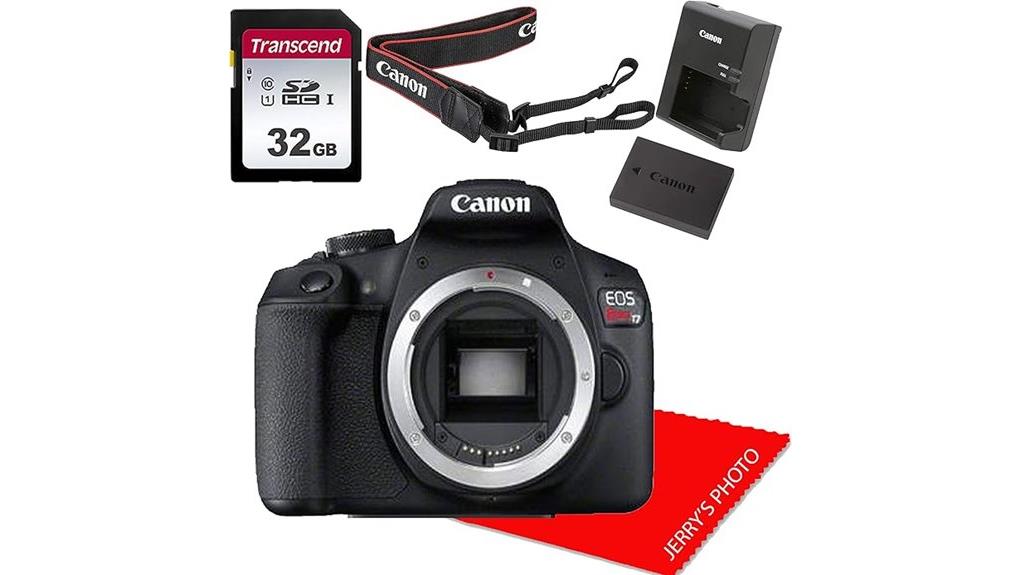
You’ll get a refurbished Canon EOS Rebel T7 body plus a 32GB card, battery, charger and accessories, giving you a 24.1MP APS‑C sensor with DIGIC 4+, 14‑bit RAW and decent base‑ISO detail. The 9‑point AF and 1080p30 video limit tracking and motion fidelity, and noise rises past ISO 1600, but color and microcontrast are reliable. Controls, LCD and Wi‑Fi are straightforward; warranty and shutter count checks are advised — continue for a full breakdown.
Some Key Takeaways
- Renewed Canon EOS 2000D/Rebel T7 kit offers solid 24.1MP APS‑C image quality and accurate colors for beginners at a budget price.
- 9‑point AF and DIGIC 4+ limit tracking, continuous shooting and low‑light performance compared with modern bodies.
- 1080p30 video is usable for casual clips but shows rolling shutter and modest bitrate.
- Bundle includes battery, charger, Transcend 32GB Class‑10 card and 90‑day Renewed warranty — inspect shutter count and condition.
- Good handling, clear 3.0" LCD and Wi‑Fi pairing; plan for spare battery and external card reader for workflow efficiency.
Canon EOS Rebel T7 Bundle at a Glance: What’s Included and Who It’s For
While the Rebel T7 bundle is offered as a renewed, pre-owned kit, it gives you a ready-to-shoot DSLR package: a Canon EOS 2000D (body only) that's been inspected and tested, a Transcend 32GB Class 10 SD card, battery and charger, neck strap, body and lens caps, plus a cleaning cloth—everything covered by a 90-day limited warranty and Amazon Renewed protection. You’ll get a compact, rugged body with Canon EF mount compatibility for a wide range of lenses and flashes. Gear setup favors accessory compatibility and straightforward connectivity, so you can adopt beginner workflows—capture, transfer, review—without technical friction. This makes it an accessible option for mirrorless camera enthusiasts exploring accessory compatibility.
Key Specs That Matter: Sensor, AF, ISO, and Video Performance
Now that you know what’s in the box and how the kit fits into typical workflows, let’s look under the hood at the bits that shape image quality and handling. You get a 24.1MP APS-C CMOS sensor and DIGIC 4+ processor delivering 14‑bit RAW, decent detail and color. A 9‑point phase‑detect AF (single cross center) limits tracking finesse; low light autofocus can hunt compared with newer systems. ISO 100–6400 (expandable) balances noise versus reach. Video is 1080p30 MP4 with modest video bitrate and visible rolling shutter in panned shots. No autofocus microadjustment on this body. This bundle also includes essential DSLR accessories for enthusiasts, like straps and lens options, to support essential gear for DSLR photographers.
Real-World Image Quality: Still Photos, Low Light, and Dynamic Range
Dig into raw files and you’ll see the T7’s 24.1MP APS‑C sensor delivers crisp, high‑frequency detail at base ISO with clean demarcation of fine textures and well‑controlled JPEG sharpening—RAW gives you more latitude to pull microcontrast without artifacting. You’ll notice accurate color rendition and natural skin tones straight from camera; tweak white balance in RAW for exacting results. Corner sharpness is acceptable on prime lenses but falls off with kit optics wide open. In low light the DIGIC 4+ handles noise predictably up to ISO 1600; expect increased grain and reduced shadow headroom beyond. Shutter lag is modest in single‑shot use. For photographers seeking improved critical sharpness, consider pairing the T7 with proper lens calibration to optimize focus performance.
Handling and Usability: Controls, LCD, Battery Life, and Build
Because Canon designed the T7 for straightforward operation, you'll find its controls intuitive and logically laid out. Button placement clusters primary dials and shutter ergonomically; tactile detents let you change settings without looking. The 3.0-inch 920k-dot LCD displays exposure data crisply, aiding histogram checks and focus confirmation, though it's fixed. Menu navigation is hierarchical and predictable; you can map frequently used functions quickly. Grip comfort is firm for extended handheld sessions; textured surfaces prevent slip. Viewfinder clarity is good for an entry APS-C, with clear focus points and accurate framing. Battery life comfortably covers a day's shoot with spare power advised. The bundle includes accessories tailored for enthusiast photographers to enhance everyday shooting.
Connectivity, Storage, and Recording Limits of the Renewed Bundle
While the T7's connectivity looks simple, it gives you practical wireless and wired options for image transfer and remote control: built-in Wi‑Fi with NFC lets you pair the camera to the Canon Camera Connect app for wireless remote shooting and image sharing, and a USB 2.0 port provides a direct tether for file transfer to computers or compatible devices. You’ll appreciate clear app integration for preview, transfer, and basic remote shutter control; wireless pairing is fast. Storage compatibility tops at 32GB Class 10 (≈10 MB/s write), limiting burst depth and video duration. Maximum bitrate for 1080p30 is modest, so plan clips accordingly. For reliable workflows, consider using an external memory card reader to speed transfers and manage multiple cards.
How the T7 Compares to Newer Entry-Level DSLRs and Mirrorless Cameras
Having covered how the T7 handles connectivity and storage, let’s look at how its core imaging and handling features stack up against newer entry-level DSLRs and mirrorless models. You’ll notice the 24.1MP APS-C sensor and DIGIC 4+ deliver good stills, but newer models use faster processors, higher ISO performance, and superior buffer/frames-per-second. The 9-point AF shows its age next to today's phase-detect-on-sensor and hybrid systems—autofocus evolution has moved to more points, better tracking, and eye-detection. Also weigh battery comparison: T7’s removable Li-ion performs well for DSLR shooting, yet mirrorless rivals often trade battery life for compactness. External camera monitors can further improve composition and focus accuracy, especially when using live-view monitoring on awkward angles.
Is the Renewed T7 Bundle Worth It? Price, Warranty, and Buying Advice
If you’re weighing the renewed Canon EOS Rebel T7 bundle, focus on practical trade-offs: the refurbishes save you money and include a 32GB Class 10 card, neck strap, battery/charger and a 90‑day warranty, but you’re buying an international, pre‑owned EOS 2000D with an older DIGIC 4+ pipeline, a 9‑point AF system and limited continuous shooting and ISO headroom compared with current entry‑level bodies. Inspect shutter count, sensor dust, and articulation marks; verify Amazon Renewed coverage and clarify warranty transferability. Use condition photos to support price negotiation. If you accept technical limits for lower cost, it’s a sensible stopgap. Keep your camera sensor pristine by learning safe cleaning techniques and using quality sensor swabs.
Some Questions Answered
Does the International Version Include a US Power Charger or Plug Adapter?
Yes — the international version typically ships with the camera body and a charger configured for the region’s plug types rather than a US power plug, so you’ll need to verify power compatibility. You’ll likely get the local plug on the supplied charger; use a certified plug adapter or replace the charger with a US-spec unit. Check the charger label for input voltage range (100–240V) and supported plug types before use.
Can the Camera's Shutter Count Be Checked Before Purchase?
Yes — you can often check shutter count pre purchase by asking the seller for a camera-generated image or RAW file so you can read its EXIF data. You’ll inspect shutter lifetime figures to estimate mechanical wear and confirm reported usage history. Use EXIF tools (e.g., Opanda, exiftool) to read “Shutter Count” or “Image Number.” If seller won’t provide files, consider requesting a live demo or walking away to avoid hidden wear.
Are Third-Party EF Lenses Fully Compatible With Autofocus?
Yes — many third-party EF lenses will autofocus on your camera, but compatibility varies. Check autofocus compatibility and lens communication: modern Sigma, Tamron, Tokina EF-mount lenses usually communicate fully, enabling AF, exposure metering and EXIF. Older or cheaper clones might lack electronic contacts or use slower AF motors, giving limited or no AF. Visually inspect mount contacts, verify AF motor type (USM/STM/HyperSonic) and test focus acquisition speed before buying.
Is the Included 32GB Card Pre-Formatted for the Camera?
No, the 32GB card isn’t guaranteed pre formatted; you should check and format it in-camera for peak file system and card compatibility. Power the T7, insert the Transcend Class 10 card, view the menu’s Format option, then format to guarantee proper allocation, directory structure, and maximum write performance. Formatting in-camera also prevents file system mismatches and reduces risk of write errors when recording 1080p video or high-resolution RAW stills.
Can Firmware Be Updated on the International Renewed Unit?
Yes — you can update firmware on the international renewed unit. You’ll check firmware compatibility on Canon’s support site, download the correct EOS 2000D/T7 file, copy it to a properly formatted SD card, insert it, and follow on-screen update steps. Region locking isn’t applied to Canon DSLR firmware, so updates won’t be region-restricted; just make sure battery is fully charged and back up settings and files before flashing to avoid corruption.