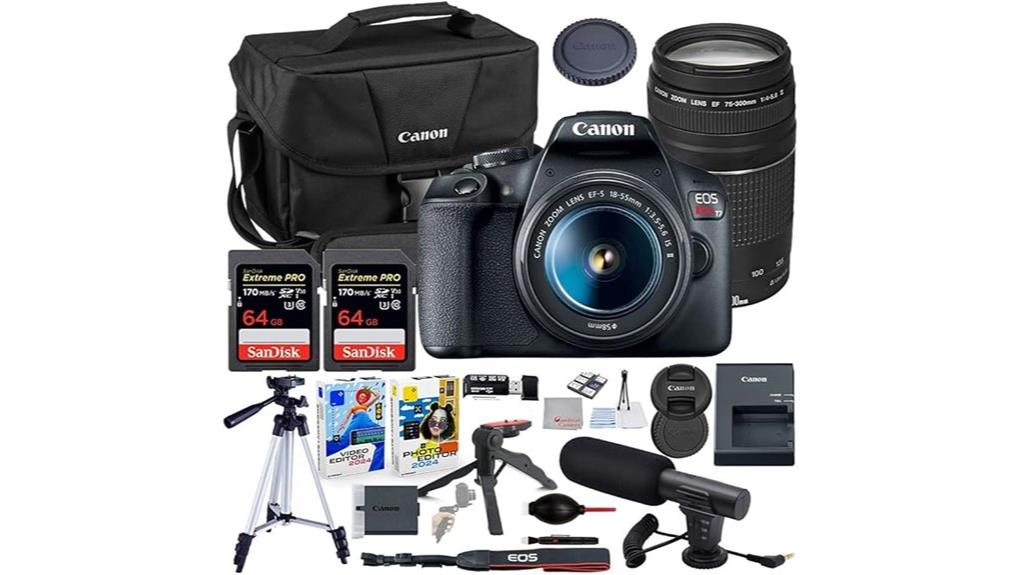
You’ll get a competent, budget-friendly starter DSLR with the Canon EOS Rebel T7 bundle, pairing a 24.1MP APS‑C body with an 18–55mm and 75–300mm lens plus batteries, dual 64GB cards and travel accessories. It’s ideal for beginners learning manual controls, travel, and casual video, but expect limited high‑ISO performance, basic 9‑point AF, 3 fps burst and 1080/30p video. If you want deeper gear tradeoffs and usage tips, keep going.
Some Key Takeaways
- Good beginner bundle: Rebel T7 with 18–55mm and 75–300mm suits learners wanting wide-to-tele flexibility and essential accessories.
- Image quality: 24.1MP APS-C and DIGIC 4+ deliver solid daylight detail but limited dynamic range and high‑ISO performance.
- Autofocus and speed: basic 9‑point AF, 3 fps continuous, and shallow buffer limit action, tracking, and fast shooting.
- Video: restricted to 1080/30p with possible rolling‑shutter during fast pans—adequate for casual clips, not advanced videography.
- Value check: great budget package with chargers, two 64GB cards, and accessories, but compare with newer used/refurbished APS‑C bodies.
Who This Canon EOS Rebel T7 Bundle Is Best For
Because it pairs an entry-level DSLR body with a wide-to-tele lens set and essential accessories, this Canon EOS Rebel T7 bundle is best for beginners and hobbyists who want a complete, affordable kit for learning photography and basic videography. You’ll get a 24.1 MP APS-C sensor, DIGIC 4+ processing, and basic AF system that suit beginner photographers learning exposure, composition, and manual controls. Battery life and accessories support travel shooting, so budget travelers can rely on included chargers, memory, and carry options. Performance is modest—3 fps and 1080/30p—yet adequate for instructional use and casual documentation. The bundle also includes several pieces of essential gear that DSLR enthusiasts often seek, like straps, memory cards, and protective cases.
What’s Included in the Rebel T7 Bundle (Lenses, Batteries, Accessories)
The bundle brings together everything you need to start shooting: the Canon EOS Rebel T7 body, two lenses (EF‑S 18‑55mm f/3.5‑5.6 IS II and EF 75‑300mm f/4‑5.6 III), a Canon LP‑E10 battery with LC‑E10 charger, and two SanDisk 64GB Extreme PRO UHS‑I SDXC cards. You also get strap, shoulder bag, caps, eyecup, tripods, microphone, blower, cloth, screen protectors, card reader and software. Lens compatibility covers Canon EF and EF‑S mounts; the 18‑55mm adds optical IS, the 75‑300mm uses a DC micro motor. Expect standard LP‑E10 battery performance; bring spares for extended shoots. This bundle is ideal for mirrorless camera enthusiasts transitioning from other systems who want essential accessories and lenses in one kit essential gear.
Key Camera Specs That Affect Photos and Video Quality
Although the Rebel T7 looks straightforward, several core specs directly shape image and video quality and determine how you'll shoot in real conditions. Its 24.1MP APS-C sensor and DIGIC 4+ processor deliver usable detail and moderate dynamic range, but highlight/headroom is limited compared with newer chips. ISO 100–6400 gives acceptable low light performance for casual use, though noise rises quickly. Video is Full HD 1080/30p with potential rolling shutter during fast pans. Autofocus is basic 9-point AF and 3 fps continuous shooting constrains action capture; buffer depth is shallow, so long bursts will stop sooner than pro bodies. Our tripod-focused shop makes it easy to match the T7 with the right support for sharper results using stable tripods.
How the 18–55mm and 75–300mm Lenses Perform in Real Use
Compare the two kit lenses by framing what you'll shoot: the EF-S 18–55mm IS handles everyday wide-to-short-tele work with decent sharpness at center and useful optical stabilization, while the EF 75–300mm covers long-reach telephoto needs but sacrifices contrast and AF speed. You’ll find the 18–55mm predictable for landscapes, portraits and run-and-gun travel; edges soften stopped down. The 75–300mm gives reach but shows lower microcontrast and slower DC motor response—expect autofocus quirks in low light and hunting at long distances. Bokeh comparison favors the 75–300mm for smoother background blur at similar framing when light permits. Choosing the right tripod head can improve stability and composition when using these lenses, especially with long telephoto shots using a solid tripod head.
Shooting Modes, Connectivity, and Ergonomics You’ll Actually Use
Having tested both lenses in the field, you’ll want shooting modes, connectivity, and handling that match real-world use rather than lab specs. The T7’s Scene Intelligent Auto, Portrait, Landscape, Sports and Movie modes let you switch quickly; Creative Filters and Creative Auto provide simple in-camera adjustments. Built-in Wi‑Fi with NFC and Canon Camera Connect enable remote control and file transfer to phones or tablets; USB 2.0 offers wired tethering. Ergonomics favor beginners—lightweight body, clear layout, tactile buttons—but serious shooters may add a battery grip for extended shoots. Controls are functional, not customizable; handling is predictable and straightforward. For photographers pairing the T7 with external displays, using an external camera monitor can improve framing and focus during shoots.
Real‑World Strengths and Limitations Compared to Modern Entry‑Level DSLRs
When you put the Rebel T7 next to modern entry‑level DSLRs, its 24.1 MP APS‑C sensor and straightforward handling still deliver solid image quality for everyday shooting, but limitations in processing, autofocus, and video become apparent—DIGIC 4+ yields respectable JPEGs at low ISOs yet lags in high‑ISO noise control and dynamic range compared with newer processors, the 9‑point AF (with a single cross‑type center) constrains tracking and focus coverage, and video tops out at 1080/30p without advanced codecs or higher frame rates. You’ll get reliable results in daylight and controlled scenes, but dynamic low light performance suffers: noise, reduced shadow detail, and slower buffer clear times limit burst shooting and extended sequences. The 3 fps continuous rate and buffer limitations hamper action work, while basic AF and no high‑frame video restrict versatility versus current entry models. Consider pairing the T7 with a lightweight travel tripod to improve stability and low‑light results for handheld‑limited situations, especially when shooting landscapes or long exposures with compact tripods.
Should You Buy This Rebel T7 Bundle or Look for Alternatives?
The Rebel T7 still delivers dependable images for everyday use, but given its older DIGIC 4+ processor, limited 9‑point AF, 3 fps burst, and 1080/30p ceiling, you should weigh whether the bundled savings justify those tradeoffs. If your needs are basic photography, included lenses and accessories make the bundle a strong value on a strict budget. Do a price comparison with newer used or refurbished APS‑C bodies (better AF, faster burst, 4K/video codecs) before buying. Consider how long you'll keep the camera and planned future upgrades: invest now only if you accept hardware limits or tight short‑term budgets. For outdoor shoots, pairing the kit with a heavy-duty tripod can greatly improve stability and framing control.
Some Questions Answered
Does This Bundle Include a Remote Shutter or Intervalometer?
No — the bundle doesn't include a remote shutter, and it doesn't list a dedicated intervalometer accessory. You can use the camera's built‑in Wi‑Fi/NFC with the Canon Camera Connect app to trigger remote shutter release wirelessly, and third‑party wired remote shutters or intervalometers compatible with the Canon EOS Rebel T7 (LP-E10 battery, E3-type remote standard or USB solutions) will work for intervalometer compatibility if you add them separately.
Are Lenses Compatible With Full‑Frame Canon Bodies?
No, the included EF‑S 18‑55mm and EF 75‑300mm are designed for APS‑C and won't fully suit full‑frame bodies without limitations. The EF 75‑300mm (EF) will mount natively on full‑frame Canon cameras with full coverage, while the EF‑S 18‑55mm will physically not fit on most full‑frame mounts. You can use mount adapters for some combinations, but expect cropping, vignetting, or reduced functionality when adapting EF‑S lenses to full‑frame bodies.
What Type of Microphone Is Included and Does It Improve Audio?
The bundle includes a basic on‑camera mic (likely a compact stereo model). It offers modest improvement over the T7’s internal mic by reducing handling noise and slightly better audio levels, but it’s not a professional shotgun. You’ll still get wind noise in breezy conditions and limited directional rejection. It likely lacks plug‑in power for condenser mics, so you’ll need an external powered mic or recorder for markedly better results.
Is There Any Lens Calibration or Warranty Extension Included?
No, the bundle doesn’t include lens calibration or a warranty extension. You’ll get the standard 1-year Canon limited manufacturer warranty only; no extended warranty or calibration service is provided in-package. If you need lens calibration, you’ll have to arrange third-party tuning or send lenses to Canon service. For warranty extension, contact Canon or the retailer to purchase an extended plan or protection plan separately before your standard warranty expires.
Can the Camera Charge via USB While in Use?
No, you can’t charge the camera via USB while shooting; the T7 doesn’t support battery passthrough. You’ll rely on the LP-E10 battery and the LC-E10 charger for charging, and USB only supports data transfer. For extended use you should plan power management: swap spare batteries, use an AC adapter kit or external power via a compatible dummy battery and AC adapter (sold separately) to avoid interruptions during longer shoots.