You’ll get a dependable entry-level DSLR with the Canon EOS Rebel T7 (2000D): a 24.1MP CMOS sensor and DIGIC 4+ processor deliver detailed stills and predictable color, while 1080p video and expandable EF/EF‑S lens support keep workflow simple. Controls are tactile and intuitive, Live View AF is usable but slower than phase-detect, and Wi‑Fi/NFC enables basic remote/file transfer. Battery life is moderate; bring spares. Keep going to see specific performance notes, kit items, and alternatives. the canon eos 2000d rebel t7 features a sturdy build that feels comfortable in hand, making it ideal for beginners exploring photography. Additionally, the camera’s built-in creative filters and scene modes encourage experimentation, allowing users to capture unique perspectives effortlessly. With its user-friendly interface, photographers can quickly navigate settings and focus on honing their craft.
Some Key Takeaways
- 24.1MP sensor with DIGIC 4+ delivers detailed stills and reliable color for beginners.
- 1080p video is usable for casual projects but lacks 4K and has slower Live View AF.
- Kit lenses (18–55mm and 50mm f/1.8) provide versatile everyday and low-light shooting options.
- Simple controls, clear menus, and built-in Wi‑Fi/NFC make learning and remote shooting straightforward.
- Good value for entry-level photographers; mirrorless alternatives offer faster AF and 4K video.
Quick Verdict: Is the Canon EOS Rebel T7 (2000D) Worth It for Beginners?
While it lacks the latest processing power, the Canon EOS Rebel T7 (2000D) still makes a solid entry-level kit if you want dependable image quality, straightforward controls, and expandable optics. You’ll get a 24.1MP sensor and DIGIC 4+ processor delivering detailed stills and 1080p video with predictable color rendering. Controls are logical, so you’ll learn exposure fundamentals without distraction. The system’s lens mount and accessory compatibility make an easy upgrade path; buying primes, flashes, or filters is budget friendly compared with higher-end systems. Overall, you’ll gain reliable performance and clear growth potential for learning photographers. This makes it a practical choice for anyone focused on mirrorless camera essentials when assembling their core gear.
What’s in the Kit and Why Each Piece Matters
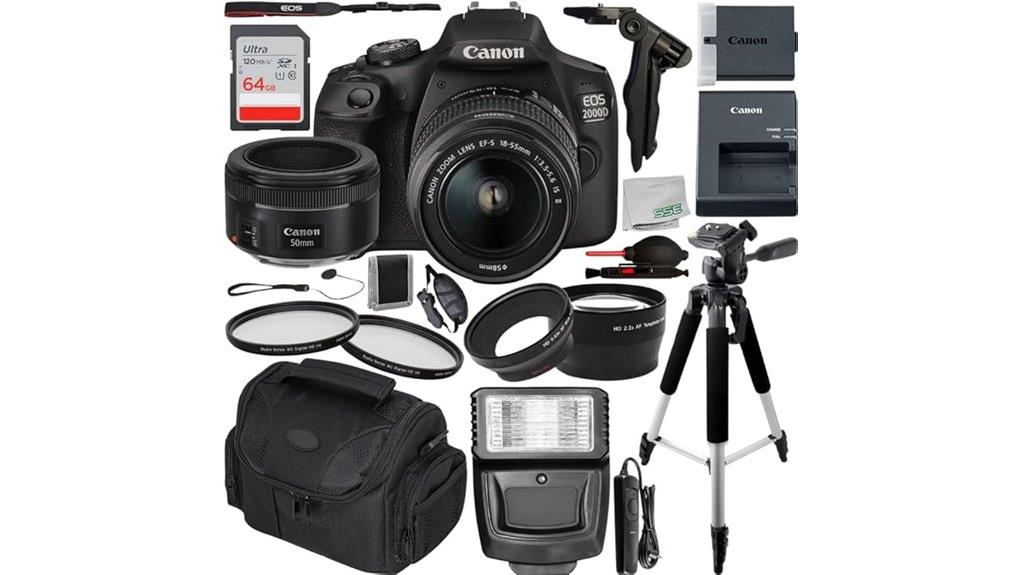
Open the kit and you get a complete, beginner-ready DSLR system designed to cover most shooting scenarios without immediate upgrades. You receive the 2000D body, 18–55mm zoom and 50mm f/1.8 STM prime, SanDisk 64GB card, tripod and mini tripod, external flash, filter kit with wide/tele attachments, padded case and extras. Each item maps to a workflow: zoom for versatility, prime for low-light/shallow DOF, filters for optical control, flash for fill light, tripods for stabilization, memory for capacity. The case enforces accessory organization; include lens care tools—blower, cloth, and cap—to protect optics and guarantee consistent results. Consider adding a camera bag insert to keep all the gear neatly organized and protected.
Image and Video Quality: Real-World Performance and Sample Scenarios
Because the 24.1MP CMOS sensor and DIGIC 4+ processor work together to prioritize detail and color fidelity, you'll get consistently sharp JPEGs and raw files that hold up well to moderate editing in Lightroom or similar software. In daylight landscapes you’ll observe accurate color reproduction and usable dynamic range across highlights and shadows; expose carefully to retain sky detail. The 50mm f/1.8 and external flash improve low light capability, reducing noise at moderate ISOs. For action freezing, AF and shutter response handle casual sports; continuous shooting is limited but effective for short bursts. Video: 1080p delivers clean footage suitable for basic color grading. Using a white balance card can further ensure accurate colors and streamline post-processing by providing a neutral reference white balance reference.
Usability, Connectivity, and Shooting Workflow With the T7
Image quality sets expectations, but how you capture and move those images matters just as much — the T7's physical controls, menu layout, and wireless features shape everyday workflow. You’ll use tactile dials and a clearly sectioned menu navigation system to set exposure, drive modes, and autofocus quickly. Live view gives accurate framing and focus confirmation for video or tripod work, though autofocus is slower than phase-detect. Built-in Wi‑Fi/NFC supports app pairing for remote shooting and file transfer; transfers are straightforward but not instantaneous. Expect moderate battery life under mixed use; carry spares for extended sessions or remote shoots. Consider keeping an extra dual battery charger on hand to minimize downtime during longer outings.
Who Should Buy the Rebel T7 (2000D) : Use Cases and Alternatives
While it doesn't target professionals, the Rebel T7 (2000D) suits photographers who need a reliable, entry-level DSLR that balances image quality, expandability, and straightforward workflow. You’ll find it ideal if you’re a budget traveler needing durable, travel-ready gear with Wi‑Fi transfer, an 18–55 kit plus 50mm prime, and a padded case. Street photographers will appreciate responsive handling, 24.1MP detail, and compact lenses for discrete shooting. It’s also good for learning exposure, flash use, and lens swaps. Consider mirrorless alternatives (EOS M series, Sony A6000) if you want faster AF, smaller bodies, or 4K video. Pair it with a purpose-built camera bag for better organization and protection on the move, like those featured for camera backpacks.
Some Questions Answered
Does the T7 Support Raw+Jpeg Continuous Shooting?
Yes — you can shoot RAW+JPEG in Burst mode. You’ll record both RAW and JPEG files simultaneously, but continuous shooting speed and buffer depth will be constrained by card write speed, file sizes, and the DIGIC 4+ processor. Expect reduced burst durations compared with JPEG-only shooting. Use the SanDisk Ultra 64GB card and limit image size/quality to maximize frames. Monitor buffer clearing and battery life during extended bursts to maintain performance.
Can the Camera Be Charged via USB Cable?
No — you can’t charge the battery via USB. The camera requires removing the LP‑E10 battery and charging it in the supplied external charger. For power, you’ll use the charger’s AC cable; cable types for data and remote control use are micro‑USB, but that port doesn’t support battery charging. For extended shoots, carry spare LP‑E10 batteries, a car adapter with external charger, or a compatible USB power bank that powers the external charger.
Is There In-Body Image Stabilization (IBIS)?
No, it doesn’t have in-body image stabilization (IBIS). The EOS Rebel T7 relies on sensor stabilization absence; stabilization must come from optically stabilized lenses or external supports. You’ll depend on gyro damping from tripods, gimbals, or lens-based IS for motion control. For low-light or handheld video, use the 50mm f/1.8 for faster aperture, an optically stabilized zoom, or external gyro-damped rigs to minimize blur and shake. the canon eos rebel t7 features overview highlights its beginner-friendly design and various shooting modes. This makes it an excellent choice for photographers looking to explore different creative options. Additionally, the camera's built-in Wi-Fi allows for easy sharing of images and remote shooting capabilities, enhancing the overall user experience. Canon EOS 2000D key features include a 24.1MP APS-C sensor that performs well in various lighting conditions. Additionally, its built-in Wi-Fi allows easy sharing and remote shooting via a smartphone. The camera also supports a range of interchangeable lenses, enhancing versatility for photographers of all skill levels.
What Battery Life Can I Expect per Charge?
You’ll typically get about 500–800 shots per charge under mixed use; continuous video reduces that to roughly 1.5–2 hours. Battery longevity depends on shooting habits, temperature and flash use. Expect gradual cycle degradation over hundreds of charge cycles, reducing capacity a few percent annually. To maximize lifespan, avoid full discharges, store partially charged in cool places, and replace after noticeable capacity loss or when shots-per-charge falls well below expected range.
Does It Support External Microphones for Video?
No — the camera doesn’t provide a dedicated external microphone or audio input port, so you can’t plug an external microphone directly into the body. You’ll need to record high-quality audio externally (portable recorder or camera-mounted recorder) and sync in post, or use a hot-shoe-mounted recorder that feeds audio separately. For improved audio capture, plan for external microphone solutions and workflow for syncing audio to video during editing.