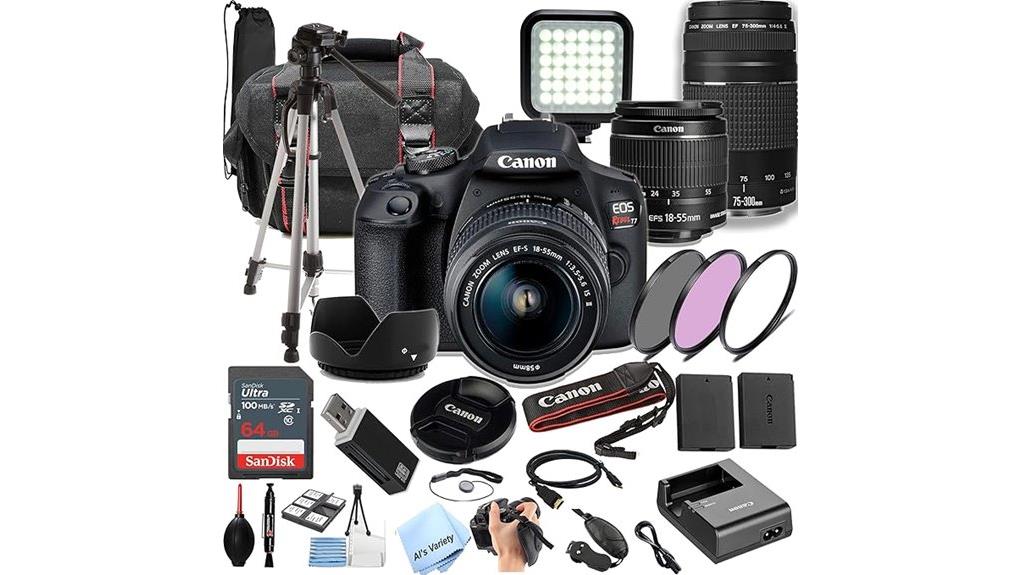
You’ll get a capable, budget-friendly DSLR that’s great for learning exposure and composition, thanks to a 24.1MP sensor and DIGIC 4+ processing. The 18–55mm IS lens gives sharper, stabilized everyday shots while the 75–300mm adds reach at the cost of edge softness and slower AF. Built-in Wi‑Fi and USB webcam support modern workflows, and the bundled accessories let you shoot right away. Keep going to see detailed comparisons, usability notes, and buying scenarios.
Some Key Takeaways
- 24.1MP sensor with DIGIC 4+ gives solid entry-level image quality for learning exposure and composition.
- Kit includes 18–55mm IS and 75–300mm tele for versatile everyday and long-reach shooting.
- 18–55mm outperforms the 75–300mm in sharpness, stabilization, and AF consistency.
- Built-in Wi‑Fi, USB webcam support, and included LED light suit streamers and fast transfers.
- Limitations: dated AF, modest continuous shooting, and basic build quality for advanced use.
Verdict: Is the Canon EOS Rebel T7 2-Lens Kit Worth Buying?
While the Rebel T7 isn’t the newest model, it still gives you a reliable entry-level DSLR experience: the 24.1MP sensor and DIGIC 4+ processor deliver solid image quality, the bundled 18–55mm with IS and the 75–300mm tele provide useful focal-range coverage, and built-in Wi‑Fi plus webcam support add modern convenience. You’ll find it a strong budget option for learning exposure, composition, and basic autofocus. Its controls fit a beginner workflow, and lenses offer an affordable upgrade path. Expect modest resale value but durable performance that justifies entry-level purchase decisions without overstating future trade-in returns. It’s a good match for enthusiasts focused on mirrorless camera accessories and lenses.
What You Get in the Box and Who Each Accessory Helps
Although the Rebel T7 kit centers on the camera body and two lenses, the box includes a compact ecosystem of accessories that make it ready to shoot right away and useful for a range of users. You get a 64 GB card, LED video light, carrying case, tripod, filters, grip and a 32-piece bundle that reduces immediate upgrade needs. Beginners benefit from bundled basics; vloggers gain constant lighting; travelers appreciate the case and battery life extension via spare grips. Check accessory compatibility, warranty terms for bundled items, and how included gear preserves resale value later. Consider also protecting memory cards with a sturdy memory card case to keep your investment safe.
Real-World Image, Low-Light, and Video Performance (18–55mm Vs 75–300mm)
When you compare the 18–55mm and 75–300mm lenses on the Rebel T7, you'll notice they target different strengths: the 18–55mm delivers sharper, more versatile everyday images with useful optical stabilization and better close-range contrast, while the 75–300mm extends reach for distant subjects but shows softer edges, slower AF response and more reliance on good light or a tripod. In practice, you’ll find the 18–55mm gives superior stabilization performance and more consistent autofocus accuracy for run-and-gun shooting, plus cleaner color rendition and wider exposure latitude. The 75–300mm works for telephoto needs but demands careful technique. Perfect Photography Tents often recommend controlled lighting and backgrounds when testing lenses to get the most consistent real-world comparisons with studio-style setups.
Usability, Connectivity, and Workflow: Shooting, Transfer, and Webcam Use
Get set up quickly: the Rebel T7's straightforward controls, clear LCD feedback and Scene Intelligent Auto make shooting simple for beginners, while its manual exposure options and 9-point AF let you work with more deliberate techniques. You'll appreciate the logical menu layout and simple live view interface for framing and video; changes are immediate and predictable. Built-in Wi‑Fi/NFC and USB webcam support speed transfers and streaming setup. Battery life is adequate for moderate sessions but carry a spare for extended shoots. File management is basic but effective—folders and thumbnails are clear, though tethered workflows are limited by older processing and transfer speeds. The kit is well-suited for hobbyists and enthusiast photographers seeking affordable DSLR gear with useful features.
Final Pros, Cons, and the Best Buying Scenarios (Hobbyist, Travel, Streaming)
Having covered how the T7 handles shooting, transfers, and webcam use, let’s evaluate what it does best and where it falls short so you can decide if it matches your needs. You’ll appreciate solid image quality, long battery life for casual shoots, and kit lenses that cover most scenes. Limitations include dated autofocus performance, modest continuous shooting, and basic build quality. For hobbyists it’s a low-cost, easy-to-use platform; travelers benefit from reliable batteries and the 18–55 IS lens; streamers gain from webcam utility and included accessories. Consider resale value low-to-moderate; upgrade later if you need faster AF or tougher construction. If you need gear protection and organized transport for shoots, consider pairing the kit with a camera bag designed for photographers.
Some Questions Answered
Can I Use Third-Party Lenses and Accessories With This Kit?
Yes — you can use third party lenses and a wide range of accessory compatibility with this kit. You’ll get EF and EF‑S lens mount support, so many reputable third party lenses autofocus and meter correctly, though AF speed may vary. Accessories like tripods, filters, cases, LED lights, and wireless remotes are broadly compatible. Always check mount/type compatibility and firmware notes to avoid functional or performance surprises.
How Long Does the Battery Typically Last per Charge?
You’ll get about 500 shots per charge under CIPA conditions, or around 2–4 hours of active use depending on shooting style. Battery longevity depends on power management: using Live View, Wi‑Fi, or continuous video cuts runtime sharply, while optical viewfinder shooting, image review restraint, and sleep settings extend it. Carry a spare battery and use power-saving modes to guarantee consistent performance during long shoots.
Is There Microphone Input for Improved Audio Recording?
No — the camera doesn’t have a dedicated microphone input, so you can’t plug an external mic directly into the body. You’ll need to use external mic solutions like a separate recorder synced in post or wireless systems, and you might need audio adapters to interface mics with recorders or USB capture. That said, using an external recorder or audio adapters gives you much better, controllable sound than the built-in mic.
Can the Camera Shoot Raw+Jpeg Simultaneously?
Yes — you can record RAW+JPEG (Dual Capture) on the camera. You'll get a high-quality RAW file for detailed editing plus a smaller JPEG for quick sharing. Use the image quality menu to select RAW+JPEG (often labeled RAW + L or RAW + JPEG). This Dual Capture approach preserves maximum tonal and exposure data while giving you convenient, ready-to-use images, useful for both post-processing flexibility and immediate delivery.
Does the Camera Support External Flash Triggering (TTL)?
No — the camera doesn’t offer built‑in TTL for external flashes via a hot shoe. You’ll get basic flash compatibility using standard Canon EX-series speedlites in manual and non‑TTL modes, and you can use optical wireless triggering with compatible Canon flashes as a controller/remote on certain units. For full TTL and advanced wireless triggering features, you’ll want a higher‑end Canon body or third‑party radio triggers that support TTL conversion and compatibility.