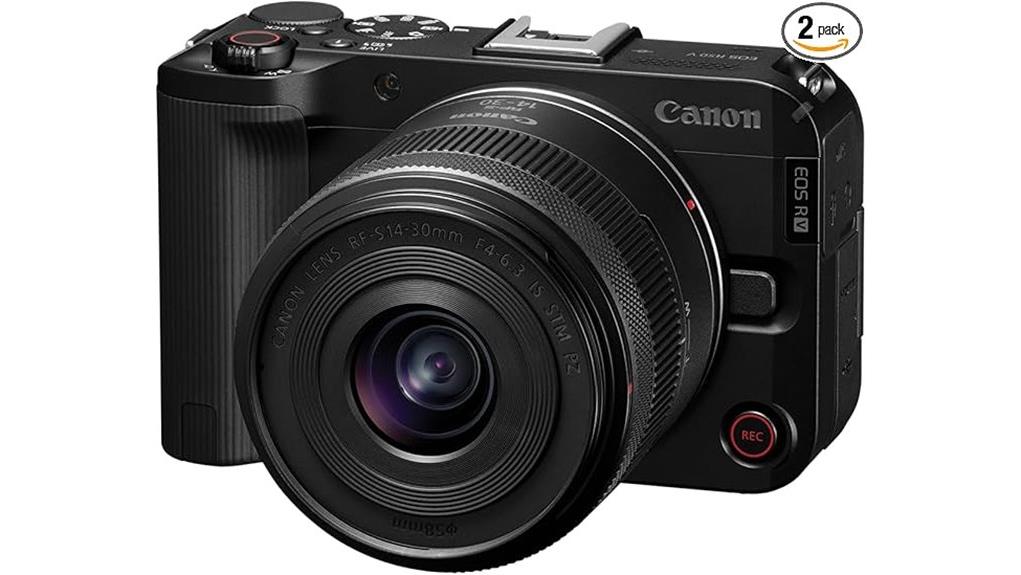
You’ll get a compact, video‑centric APS‑C kit that’s made for mobile creators who need run‑and‑gun agility. The R50 V’s 24.2MP sensor, DIGIC X, and Dual Pixel CMOS AF II deliver reliable stills and tracking, while the RF‑S14‑30mm PZ provides stabilized ultra‑wide coverage and smooth power‑zoom for handheld shooting. 4K up to 29.97p, V‑Log compatibility and 10‑bit capture suit hybrid work, though low‑light and reach are limited; keep reading for full tradeoffs and alternatives.
Some Key Takeaways
- Compact mirrorless kit optimized for mobile creators, offering a power-zoom RF‑S14‑30mm and vertical-video mount for run-and‑gun shooting.
- 24.2MP APS‑C sensor delivers detailed stills and faithful Canon color science, with RAW for extended editing headroom.
- Video: 4K up to 29.97p (cropped 59.94p), Full HD to 119.8p, plus V‑Log compatibility and optional 10‑bit internal capture.
- Dual Pixel CMOS AF II with 61 points provides reliable tracking for moderate motion; occasional hunting on very fast lateral subjects.
- Lightweight handling with articulating screen, dedicated Front Record, and limited battery life—spares recommended for longer shoots.
Does the EOS R50 V + RF‑S14‑30mm Suit Your Needs? Quick Verdict and Ideal Users
Wondering if the EOS R50 V with the RF‑S14‑30mm kit fits your workflow? You’ll find it targets mobile creators who need compact, video‑centric tooling. The lightweight body, power‑zoom lens, and vertical‑video mount streamline run‑and‑gun shooting. Battery ergonomics are adequate for short shoots; pack spares for extended sessions. Autofocus, DIGIC X processing, and lens IS suit hybrid stills/video tasks without heavy rigs. Accessory compatibility is focused: standard USB, Wi‑Fi/Bluetooth, and tripod options work, but professional audio and large gimbals may need adapters. Choose this kit if you prioritize portability, intuitive video controls, and efficient setup. It’s a great match for mirrorless camera enthusiasts who value compact systems and versatile kit options.
Real‑World Image and Video Performance: 24.2MP Stills, 4K/Full HD, and V‑Log Features
Evaluating real‑world output, the R50 V delivers clean 24.2MP stills and versatile video options that suit most creator workflows. You’ll get detailed APS‑C images with faithful hues thanks to Canon color science; JPEGs need minimal grading, RAW retains headroom for edits. Video modes cover 4K 29.97p and cropped 59.94p, plus Full HD up to 119.8p for slow motion. V‑Log-compatible recording expands dynamic range for grading, though noise rises in extreme shadows. Codec options include MP4 wrappers with 10‑bit internal capture, balancing file size and post flexibility. Overall, the output is practical and efficient for creators. Calibrating your monitor helps ensure those faithful hues and detail are accurately represented when editing, especially for photographers focused on true-to-life color.
Autofocus, Stabilization, and Low‑Light Usability: AF‑C Behavior, IS Limits, and Rolling Shutter
Having covered image and video output, let’s look at how the R50 V actually locks and steadies subjects in real shooting conditions. You’ll find Dual Pixel CMOS AF II delivers predictable AF-C behavior with 61 points and reliable AF tracking for moderate subject speed; occasional hunting appears in very fast lateral motion. The RF‑S14‑30mm lens IS helps handheld shooting but has clear stabilization limits—don’t expect gimbal‑level smoothing at long focal lengths or extreme motion. Rolling shutter is controlled at standard frame rates but becomes more noticeable in 4K 59.94p and fast pans. Low light performance is competent but limited by aperture and sensor size. Consider pairing the camera with quality L-brackets to improve handling and stability for handheld and tripod work.
Handling, Controls, and Vlogging Features: Vertical Mount, Front Record, Screen, and Battery Life
While the R50 V keeps controls familiar to EOS users, Canon's vlogger-focused tweaks—like the Vertical Video tripod mount and a dedicated Front Record button—make on-camera operation more efficient for single-operator workflows. You get a compact body with a usable vertical grip footprint for portrait orientation; rigging is straightforward on third-party vertical mounts. The articulating 3-inch screen supports framing and touch control, though resolution is modest. Button customization lets you map Front Record, AF, and exposure controls for quick access. Battery life is typical for a light mirrorless: adequate for short shoots, but you’ll want spares for extended vlogging sessions. Consider pairing the camera with an external monitor to improve framing and exposure accuracy, especially when using external camera monitors on shoots.
Buy or Skip? Value, Kit Lens Tradeoffs, Alternatives, and Who Should Choose This Camera
If you prioritize lightweight, vlogger-focused video features and want a renewed mirrorless body that balances modern AF and 4K capabilities with affordability, the R50 V is worth considering; its kit with the RF‑S14‑30mm PZ gives you a compact, stabilized ultra‑wide zoom and power‑zoom convenience for run‑and‑gun shooting, but you’ll compromise low‑light aperture speed and reach. You should buy it if you value portability, reliable Dual Pixel AF, and accessible 4K modes. Skip it if you need fast primes, long reach, or top-tier low‑light performance. Lens adaptability is decent; check market resale value for renewed units. Learn more about mastering zoom lens technique with zoom lens tips.
Some Questions Answered
Does the Rf‑S14‑30mm Lens Accept Filters or a Filter Adapter?
Yes — the RF‑S14‑30mm accepts filters only via a compatible filter adapter; it doesn’t have a standard front thread. You’ll attach a specific power‑zoom/filter adapter that interfaces with the lens and provides a threaded mount for screw‑in filters or a holder. Keep the supplied front cap when removing the adapter for protection. Verify adapter model compatibility before purchase to guarantee power‑zoom and optical stabilization remain functional.
Can the Camera Charge and Record Simultaneously via USB?
Yes — you can USB charging while recording, but with caveats. The camera supports USB charging and power pass through for extended shoots, enabling simultaneous recording in many cases. It’s not a true hot swapping batteries solution: battery removal during active recording can interrupt power. For uninterrupted capture you should use continuous external power via USB or an AC adapter and verify firmware and accessory compatibility before critical shoots.
Is There Headphone Output for Live Audio Monitoring?
No — you don’t get a built‑in headphone output for headphone monitoring. You’ll monitor live audio via an external recorder or camera-connected device that supports monitoring, or use wireless solutions; expect potential audio latency depending on the monitoring path and device buffering. If low latency is critical, route audio directly through a wired recorder/interface with dedicated monitoring and minimal buffering to reduce audio latency during live capture.
Are There Firmware Updates Planned to Improve Features or Stabilization?
Canon hasn’t published a detailed firmware roadmap, but you can expect occasional updates addressing performance and bug fixes. Canon typically issues firmware to refine autofocus and image processing, and they may deliver stabilization improvements via lens or body firmware when applicable. Check Canon’s official support site and product page for announcements and version histories. You’ll want to register your camera and enable notifications to receive update alerts promptly.
What Third‑Party Batteries or Grips Are Compatible?
You can use third‑party batteries and battery grips that specify compatibility with Canon LP‑E17‑equivalent cells and the R50 V’s battery bay/contacts. Look for reputable brands (e.g., Wasabi Power, Watson, RAVPower) offering NP‑style LP‑E17 replacements and dedicated grips designed for EOS R50 series or EOS M/RF‑mount mirrorless bodies. Verify voltage, capacity, OEM pinout, pass‑through charging, and warranty; avoid unmarked cells to reduce risk of damage or voided warranty.