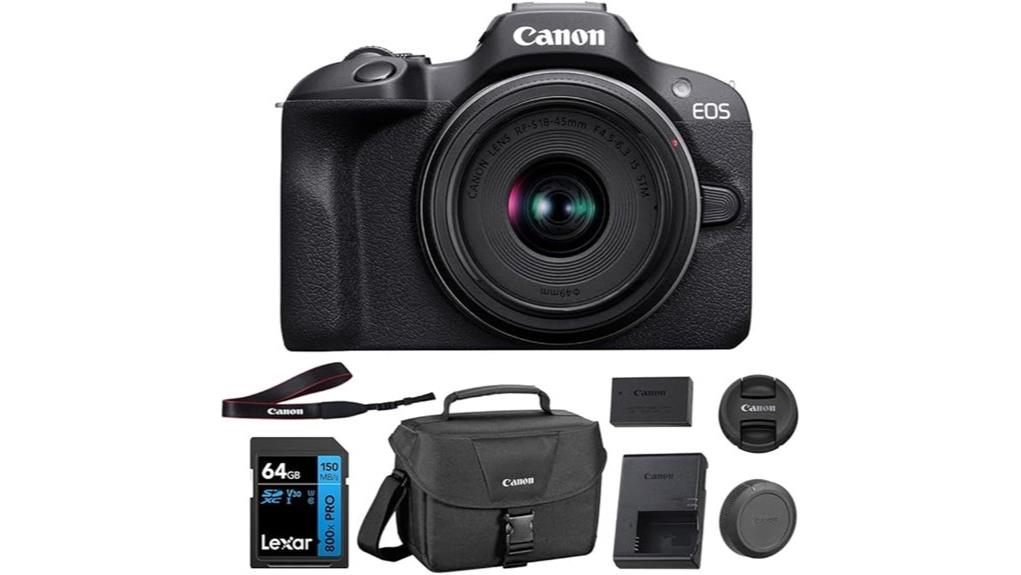
You’ll find the Canon EOS R100 a compact, entry-level APS‑C mirrorless that’s aimed at beginner vloggers and travel shooters who want simple operation and reliable Dual Pixel AF. It pairs a 24.1MP sensor and DIGIC 8 processing with an RF‑S 18–45mm kit lens, offers 4K/24p and 1080/120p, and uses body plus lens stabilization for handheld work. Image quality is clean with predictable noise at high ISO, and further details on performance and limits follow below.
Some Key Takeaways
- Lightweight, entry‑level APS‑C mirrorless ideal for beginner vloggers and travel photographers prioritizing portability and ease of use.
- 24.1MP sensor with DIGIC 8 offers clean stills, RAW/JPEG capture, and predictable noise performance in low light.
- Dual Pixel CMOS AF (up to 143 zones) gives fast face/eye/animal detection and reliable subject tracking for everyday use.
- Records 4K/24p plus 1080/120p slow motion; body+lens stabilization helps handheld footage but has practical cropping and heat limits.
- Bundled RF‑S 18–45mm IS kit delivers a compact starter setup, though faster or longer lenses improve low‑light and portrait results.
Quick Verdict: Who the Canon EOS R100 Is Best For
If you want a lightweight, entry-level mirrorless that handles everyday stills and 4K video without fuss, the Canon EOS R100 fits that role. You’ll find it suited to beginner vloggers and travel photographers who prioritize portability, straightforward menus, and reliable Dual Pixel AF. You can record 4K/24p, shoot 24.1MP stills, and rely on in-body plus lens stabilization for steadier hand-held results. Controls and connectivity keep workflows simple: touchscreen, Wi‑Fi, Bluetooth, and SD storage. It won’t satisfy advanced speed, low-light, or professional ergonomics, but it’s a pragmatic choice for casual creators. Consider pairing it with compact mirrorless accessories to maximize portability and shooting flexibility.
Key Specs at a Glance: Sensor, Lens, AF, Stabilization, and Video
Although compact, the EOS R100 packs a 24.1 MP APS-C CMOS sensor paired with a DIGIC 8 processor, delivering 3:2 stills at native 24.1 MP and RAW/JPEG capture (10‑bit RAW). You get an RF‑S 18–45mm F4.5–6.3 IS STM kit lens with 2.5× optical zoom and lens IS; body+lens dual stabilization aids handheld work. Dual Pixel CMOS AF covers up to 143 zones with face/eye, animal and vehicle detect, supporting 6.5 fps burst. Video tops at 4K/24p and 1080/120p. Menu layout is straightforward; ergonomics design favors portability. Color profiles and battery life meet entry‑level creator needs. For photographers who travel light but still want steady shots, pairing the R100 with a compact tripod head can improve framing and stability.
Real-World Stills and Autofocus Performance (Low Light, Portraits, Action)
When shooting in real-world conditions you'll find the EOS R100's Dual Pixel CMOS AF delivers reliable subject acquisition across portraits, low-light scenes, and moderate action, locking onto faces and eyes quickly and maintaining tracking across up to 143 AF zones. You’ll get clean 24.1MP stills with DIGIC 8 processing to ISO ranges usable in practical low light; noise rises predictably but detail holds. Portrait bokeh is dependent on the kit RF‑S 18–45mm’s modest apertures, so you’ll rely on framing not extreme background blur. Subject tracking is competent for casual sports; shutter lag and 6.5 fps cap intensive burst performance. The camera pairs well with enthusiast-friendly accessories and lenses designed for mirrorless systems, making it a solid choice for enthusiast photographers.
Video Workflow and Limitations: 4K, 1080p120, Stabilization, and Recording Practicalities
Because the EOS R100 records 4K at up to 24 fps and 1080p up to 120 fps, you’ll need to plan clips around its codec limits, stabilization behavior, and file-management constraints. You’ll adopt a 4K workflow that minimizes long continuous takes to avoid large files on UHS‑I cards and to respect processor heat and bitrate ceilings. For slow‑motion, use 1080p120 but expect crop or reduced dynamic range compared with 4K. Stabilization tradeoffs mean choosing lens IS plus mild electronic smoothing; aggressive electronic stabilization crops framing and raises processing load. Monitor battery, card capacity, and clip length for reliable recording. Consider using high-capacity UHS‑I cards to balance recording needs and budget.
Value Check and Alternatives: Price, Bundled Kit, and Better Choices for Specific Needs
Several kit deals position the EOS R100 as a strong entry-level mirrorless option, especially when bundled with the RF‑S 18–45mm IS and a 64 GB UHS‑I card and bag, which covers basic shooting and storage needs right out of the box. You’ll find the R100 competitively priced against similar APS‑C bodies; a focused price comparison shows value in starter kits versus body-only buys. If you need faster glass or reach, consider alternative lenses on RF and RF‑S mounts. For low‑light or advanced video work, opt for bodies with larger buffers, IBIS, or higher bit‑rate codecs. Many photographers also prefer a dedicated camera bag to protect gear and organize accessories.
Some Questions Answered
Does the R100 Support Third‑Party RF Lenses With Full Functionality?
Yes — you’ll get third‑party compatibility, but functionality can vary. Many RF and RF‑S lenses work mechanically and mount correctly, yet lens electronicization (AF, aperture control, IS, metadata) depends on the specific lens firmware and maker support. You’ll typically retain AF, aperture control and stabilization with well‑supported lenses, but some features (advanced AF modes, eye detect) may be limited. Test specific lens models or check manufacturer compatibility lists first.
Can the Camera Charge via USB While Shooting Video?
Yes — you can use USB power to run the camera, but the EOS R100 doesn’t support true battery pass through. You can power and charge the battery via USB-C while recording, yet the internal battery may not charge fully during continuous video capture and power interruptions can occur if draw is high. For reliable long recordings, use an external power adapter or dummy battery solution rated for sustained USB power delivery.
Is There In‑Camera Focus Bracketing or Stacking Support?
No — the camera doesn’t provide in‑camera focus stacking or dedicated focus bracketing automation. You’ll need to perform focus stacking manually by adjusting focus between shots or use external interval/stacking tools. The EOS R100 offers precise Dual Pixel AF and AF zone control to help you capture consistent frames, but true focus stacking and bracket automation aren’t built into the menu system, so post‑processing alignment and stacking are required.
What Is the Battery Life in Actual Stills and Video Shooting Hours?
You’ll get modest battery endurance: expect roughly 300–320 stills per charge under CIPA-like conditions, so plan for about 4–5 hours of active stills shooting spread over a day. Video runtime is shorter: shooting 4K or high‑frame 1080p you’ll see around 1.5–2 hours per charge; continuous Full HD at lower bitrates might reach ~2–2.5 hours. Bring spares for extended sessions or heavy AF/heat-limited recording.
Does the R100 Offer Intervalometer/Timelapse Without External Apps?
Yes — you can use built‑in interval shooting and timelapse modes without external apps. You’ll set interval shooting parameters (start time, interval, number of shots) in the camera menu to produce image sequences. The R100 can also generate in‑camera timelapses from those sequences or let you compile RAW/JPEG files externally. This provides automated capture for time‑lapse workflows without tethering or third‑party controllers.