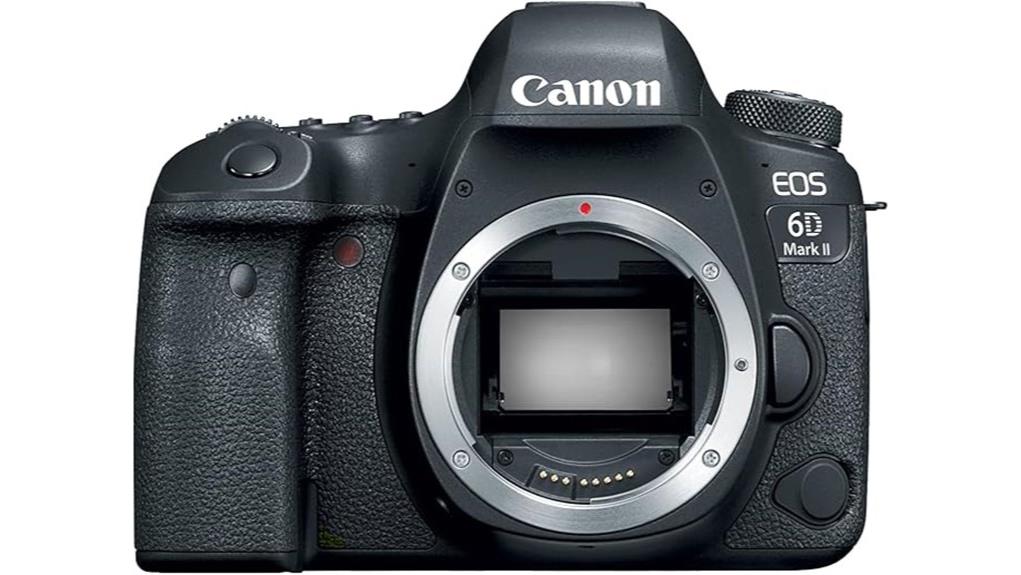
If you want full‑frame image quality, good low‑light performance, and familiar DSLR handling without pro prices, the Canon EOS 6D Mark II delivers a practical, well-rounded package. Its 26.2MP sensor and DIGIC 7 balance detail and noise, while 45 cross-type AF points and Dual Pixel live‑view AF are reliable for portraits and travel. You’ll get solid dynamic range at base ISO and usable results to ISO 6400, plus a vari-angle touchscreen and 1080p60 video. Keep going and you’ll learn specifics on strengths, limits, and workflow tips. The Canon EOS R6 Mark II specifications show an impressive upgrade with its 20 frames per second continuous shooting speed and improved autofocus capabilities. Photographers will appreciate the enhanced in-body image stabilization, making it easier to capture sharp images in challenging conditions. Additionally, the camera's robust weather-sealing ensures durability during outdoor shoots.
Some Key Takeaways
- 26.2MP full-frame sensor and DIGIC 7 deliver balanced resolution, good low-light performance, and responsive processing for portraits and travel photography.
- 45-point all cross-type AF plus Dual Pixel CMOS AF provide reliable phase-detect autofocus and smooth live-view/video focusing.
- Vari-angle touchscreen, deep grip, and built-in GPS/Wi‑Fi/Bluetooth improve handling, composition flexibility, and travel-ready connectivity.
- Strong base ISO dynamic range and usable results at ISO 3200–6400, though high-ISO shadow recovery shows visible noise above 6400.
- 1080p60 video with Dual Pixel AF is smooth but lacks 4K, uses MP4 codec, and has ~30-minute recording limits.
Who Should Buy the Canon EOS 6D Mark II and What Problems Does It Solve
If you shoot portraits, travel, or low-light scenes and want full-frame image quality without stepping up to pro-tier bodies, the Canon EOS 6D Mark II is a sensible choice because it pairs a 26.2 MP full-frame sensor and DIGIC 7 processing with reliable autofocus and useful connectivity. You’ll find its heritage appeal and straightforward controls comforting if you’re upgrading from enthusiast DSLRs. It solves common needs: improved low-light performance, GPS and wireless for travel robustness, and a vari-angle touchscreen for awkward angles. You won’t get top-tier burst or IBIS, but it balances image quality and usability well. For mirrorless camera enthusiasts looking to complement a Canon 6D Mark II setup, consider investing in essential accessories like spare batteries, lightweight tripods, and protective cases to enhance portability and shooting versatility with mirrorless gear.
Core Image and Autofocus Performance Explained (Sensor, DIGIC 7, 45-Point AF)
Having covered who benefits from the 6D Mark II, let’s examine how its 26.2 MP full-frame sensor, DIGIC 7 processor, and 45-point all cross-type AF work together to shape image quality and focusing reliability. You’ll find the sensor architecture balances resolution and pixel size for good detail and usable noise performance. DIGIC 7 speeds processing, enabling responsive buffer handling and improved color rendering. The 45-point all cross-type AF gives reliable phase-detect coverage for many compositions, while Dual Pixel CMOS AF aids live-view/video. This combination marks a practical step in autofocus evolution rather than a revolutionary leap. For photographers who care about consistent color across devices, proper color calibration of monitors and printers helps ensure the images you capture on the 6D Mark II look the same in print and on-screen.
Low-Light, ISO, and Dynamic Range: Real-World Shooting Expectations
Push the 6D Mark II into dim conditions and you'll see how its 26.2 MP full-frame sensor and DIGIC 7 processor trade detail for usable noise performance as ISO climbs. You can shoot night portraits at ISO 3200–6400 with acceptable grain and preserved tones, though fine detail softens. Dynamic range holds well at base ISO; shadow recovery from RAW pulls midtones without excessive color shifts but reveals noise quickly beyond ISO 6400. For low-light work expect good high-ISO usability for prints and web, but plan exposure carefully and prioritize clean RAW files over aggressive post-recovery. Using a white balance card in-camera or at capture helps ensure accurate color and simplifies RAW processing.
Handling, Ergonomics, and Touchscreen/Vari‑Angle Usability for Stills and Video
Balanced in hand and thoughtfully laid out, the 6D Mark II feels familiar to Canon shooters and comfortable for long sessions, with a deep grip, well-placed dials and a textured finish that keep the camera secure. You’ll appreciate the grip comfort during extended stills work; controls fall naturally under your fingers and the mode dial, rear dial and AF area selector are easy to reach. The vari-angle touchscreen adds compositional flexibility for low and high angles, and touchscreen responsiveness is generally good for navigating menus and touch AF. For run-and-gun shooting it’s practical, not revolutionary. Consider pairing the camera with a dedicated camera bag designed for photographers to protect and organize your gear on the go.
Video Capabilities and Limitations: 1080p60, Dual Pixel AF, and Recording Caps
Shooters will find the 6D Mark II capable for everyday video work thanks to Full HD 1080p at up to 60 fps and Canon’s Dual Pixel CMOS AF for smooth, reliable subject tracking in live view and handheld clips. You’ll get pleasing detail and steady continuous autofocus for run-and-gun shooting, and the vari-angle touchscreen helps framing. Be aware of 1080p limitations: no 4K, MP4-only codec, and a ~30-minute recording cap per clip. For longer takes, monitor battery and card speeds. Heat management is generally adequate, but prolonged recording can approach thermal thresholds, so plan breaks. Consider pairing the camera with an external monitor for better framing and exposure control, especially when using the vari-angle touchscreen.
Lens, Stabilization, Battery, and Connectivity Considerations for Different Workflows
When you plan shoots with the 6D Mark II, think about lenses, stabilization, batteries, and connectivity as a system rather than separate choices. You’ll rely on Canon EF glass for reach and sharpness; factor in lens maintenance to keep contacts and elements clean for reliable AF. Because the body lacks IBIS, prioritize optically stabilized L-series or third-party IS lenses for handheld work. Carry spare LP‑E6/LP‑E6N batteries and a charger for long days, and use fast SD cards for continuous bursts. For remote workflows, use built‑in Wi‑Fi/Bluetooth plus a secondary hotspot for connectivity redundancy to avoid downtime. Also consider a dedicated camera bag insert to organize and protect your kit during transport, especially when carrying multiple lenses and accessories like batteries and chargers camera bag insert.
Value Judgment: Who Still Benefits From the 6D Mark II Versus Modern Alternatives
Although it's no longer Canon's newest full‑frame DSLR, the 6D Mark II still makes sense for photographers who prioritize image quality, battery life, and a straightforward, familiar DSLR workflow over the latest autofocus bells and bezels. If you shoot landscapes, portraits, or travel and value reliable battery endurance, solid 26MP files, and Canon EF lens compatibility, it remains practical. Pros needing cutting‑edge AF, high‑res video, or IBIS will prefer modern mirrorless. Consider resale value and future proofing compatibility: resale may lag mirrorless, and ecosystem migration costs matter. Buy used to save, or choose newer bodies for longevity. Our Gear Guide also highlights accessories and lenses that complement Canon bodies, emphasizing practical options for enthusiasts and camera fans accessories and lenses.
Some Questions Answered
Does the 6D Mark II Support 4K Video Recording?
No, it doesn't record 4K; that's a 4K limitation you should note. You’ll get Full HD 1080p up to 60p instead. That lack of 4K keeps video files smaller and simplifies workflow, but you won't benefit from the resolution or flexible cropping in post. Also remember the Crop factor isn't relevant for 4K here because 4K capture isn't available; your framing stays based on the full-frame sensor for 1080p.
Can I Use EF-S Lenses With This Camera?
No, you can't directly mount EF-S lenses on this full-frame camera; they're not compatible without modification. The 6D Mark II uses the Canon EF mount, so EF-S glass will either not fit or will vignette heavily if adapted. You can use adapter options to physically attach some EF-S lenses, but you'll lose full-frame coverage and risk heavy crop, reduced image quality, or mechanical issues. Consider choosing EF or full-frame lenses instead.
Is There In-Body Image Stabilization (IBIS) on the 6D Mark II?
No, it doesn't have in-body image stabilization (IBIS). You’ll rely on lens stabilization (IS) for shake reduction, so choose lenses with IS for handheld low-light work. You can still use the sensor cleaning feature to keep image quality high, since sensor dust matters more without IBIS. Overall, the lack of IBIS is a trade-off you’ll accept if you prioritize full-frame DSLR ergonomics and compatibility with Canon EF lenses.
How Many Memory Cards Can the Camera Hold Simultaneously?
The camera holds one memory card at a time; it doesn't have dual slots, so your storage options are limited to a single SD/SDHC/SDXC card. That means you can't split files across two cards or use automatic overflow/backup to a second card in-camera. You'll want a high-capacity, fast UHS card for longer shooting or video; consider workflow backups and carrying spare cards to mitigate the single-slot constraint.
Does the Camera Include a Built-In Flash?
No, it doesn't include a built in flash. You get no pop up mechanism on the body, so you'll rely on external flashes via the hotshoe for fill or bounce lighting. That absence keeps the top plate cleaner and encourages using dedicated speedlites or balanced lighting, but it means you won't have the convenience of a quick onboard pop up for casual snaps. Consider a compact flash or off‑camera options instead.