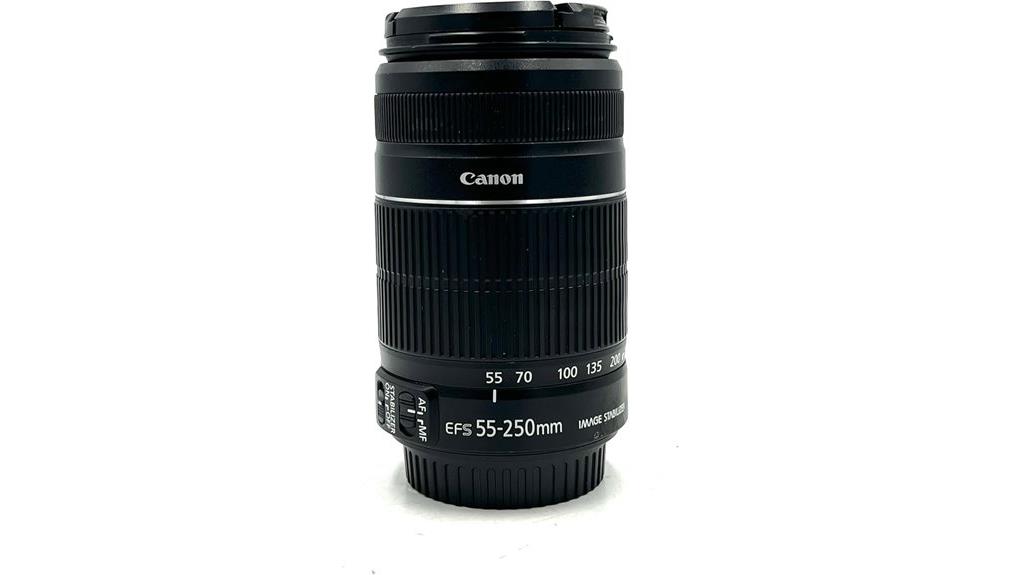
You’ll find the Canon EF-S 55–250mm f/4–5.6 IS II a compact, affordable telezoom for APS‑C shooters who want reach without weight. It gives 88–400mm equivalent, sharp centers, modest edge softness at 250mm wide open, and four stops of optical stabilization that lets you handhold slower shutter speeds. Autofocus is adequate for casual action but not pro sports. Low‑light performance is limited by the variable aperture, so plan ISO and support accordingly — keep going to see full strengths and tradeoffs.
Some Key Takeaways
- Lightweight, budget telephoto for APS-C Canon DSLRs offering 88–400mm equivalent reach in a compact 390 g package.
- Variable f/4–5.6 aperture limits low-light and shallow-DOF performance but keeps size and cost down.
- Sharp center detail and good contrast; edges soften at 250mm wide-open but improve by about one stop.
- Optical Image Stabilizer gives roughly four stops of shake reduction, enabling usable handheld shots at slower shutter speeds.
- DC motor autofocus is adequate for casual action but not ideal for professional sports tracking; RAW correction handles chromatic fringing.
What This Lens Is and Who It’s For
Think of the Canon EF-S 55-250mm f/4.0-5.6 IS II as a compact, budget-friendly telephoto zoom built specifically for APS-C Canon DSLRs—it's not compatible with full-frame bodies. You’ll find it’s a practical beginner telephoto that balances reach, weight (390 g), and cost, making targeted upgrades intuitive. Use it as a travel companion when you need extra reach without a bulky bag. You’ll appreciate the stabilized handheld capability and straightforward controls; expect competent sharpness and manageable chromatic aberration from the UD element. This lens suits hobbyists prioritizing portability and value who shoot sports, wildlife, or isolated portraits on crop bodies. It pairs well with other mirrorless camera accessories and gear designed for enthusiasts.
Key Specs and What They Mean in Real Shooting
Break down the 55–250mm range and you’ll see how each spec translates to shooting choices: on an APS-C body the effective 88–400mm reach brings distant action into frame without cropping aggressively. You’ll evaluate focal range implications for composition, subject distance, and framing—sports or wildlife benefit from tight reach; portraits use mid-tele for compression. Aperture impact behavior matters: f/4–5.6 limits low-light speed and shallow DOF, so you’ll rely on IS and higher ISO. Close-focus 1.1m and 0.31x magnification enable near-tele closeups. Lightweight build aids handheld mobility during long sessions. Consider pairing this lens with a stable tripod to maximize sharpness during long-reach or low-light shooting.
Image Quality and Autofocus Performance in the Field
While shooting with the 55–250mm IS II, you'll notice sharp center detail and pleasing contrast across most of the frame, thanks to the UD element and Super Spectra coatings that control chromatic aberration and flare. In sharpness tests you’ll find edges soften slightly at 250mm wide-open but improve by one stop; center resolution remains dependable for prints and crops. Chromatic fringing is restrained but visible in high-contrast edges—correctable in RAW. Autofocus is a DC motor gear-driven system: continuous AF performs adequately for casual action, and focus tracking holds pace with predictable subjects, though professional sports tracking may show lag. This makes the lens a solid choice for photographers using flash triggers to sync off-camera lighting with telephoto shots and improves flash synchronization workflow.
Stabilization, Low-Light Handling, and Practical Shooting Tips
Usually, you'll find the Canon EF-S 55–250mm IS II's Optical Image Stabilizer makes handheld shooting far more forgiving, delivering roughly four stops of shake reduction so you can go from about 1/250s to near 1/15s at 250mm. You should combine stabilization tips—use a stable stance, turn off IS on a tripod, and half-press shutter to pre-stabilize—to maximize results. For low light techniques, raise ISO moderately, open aperture at the short end, and prioritize shutter speed for moving subjects. Meter carefully, use continuous AF for action, and crop conservatively to retain sharpness without pushing noise reduction too far. Consider pairing your lens with dedicated video light panels to improve low-light portraits and reduce high ISO reliance.
Value, Alternatives, and Should You Buy the 55–250mm IS II?
Although it’s an entry-level telephoto, the 55–250mm IS II delivers excellent value for photographers who need reach without a big investment, because it combines lightweight build, useful focal range (88–400mm equiv. on APS-C), and a four-stop Optical Image Stabilizer that makes handheld shooting practical in many situations. You’ll get solid optics, low weight, and reliable stabilization for sports, travel, and wildlife. Consider budget alternatives like used third-party zooms or older Canon primes if you need faster apertures. Check rental options before buying, weigh long term resale, and plan user upgrades (bodies, glass) instead of overspending up front. Tripod head choice can further improve image stability with the right support and compatibility for your setup, especially when using longer focal lengths with tripod heads.
Some Questions Answered
Is This Lens Weather-Sealed for Outdoor Use?
No — it isn’t weather-sealed. You’ll want to take into account the build quality as basic polycarbonate and metal mount construction without rubber gaskets, so dust and moisture can intrude in harsh conditions. Practically, you should avoid rain and heavy spray or use protective measures like a rain cover, plastic bag, or an aftermarket protective sleeve. With careful handling it’s fine for outdoor use, but don’t rely on it in wet environments.
Can It Be Used on Full-Frame Canon Cameras?
No — you can’t mount it natively on full-frame Canon cameras. It’s designed for crop sensor compatibility (EF-S mount), so it physically contacts the mirror box on full-frame bodies. You could attempt flange adaptation, but you’ll face serious flange adaptation challenges: loss of infinity focus, need for optical correction elements, and degraded image quality. Practically, you’re better off using EF lenses or a dedicated adapter with compromises you should carefully evaluate.
Does It Come With a Lens Hood or Carrying Case?
No — it doesn’t include a lens hood or carrying case. You’ll get the lens only, so you’ll want a lens pouch for transport and protection. For hoods, Canon didn’t bundle one, so consider aftermarket hoods sized for 58 mm filters; they’re affordable and practical. Analyze fit and bayonet style before buying. You’ll also check reviews for build quality and shading performance to match your shooting needs.
Is the Front Element Rotating During Focusing for Filters?
No — the front element doesn't rotate during focusing, so you won't get front rotation issues. You can confidently use polarizers or graduated filters without the image changing as you focus. This front rotation feature improves filter compatibility and makes circular/linear filters practical. You should still mind lens hood and vignette at wide settings, but for typical telephoto use the lack of front rotation keeps your filters stable and predictable.
Can This Lens Be Used for Video With Continuous Autofocus?
Yes — you can use it for video with continuous autofocus, but temper expectations. The DC motor provides usable autofocus performance for casual filming, though it's not as smooth or quiet as STM/stepping motors. You’ll notice some focus hunting and noticeable focus breathing during focal shifts, and the front element still doesn’t rotate. For run-and-gun or hobby work it’s practical; for professional cinema use you’ll likely want a faster, quieter lens.