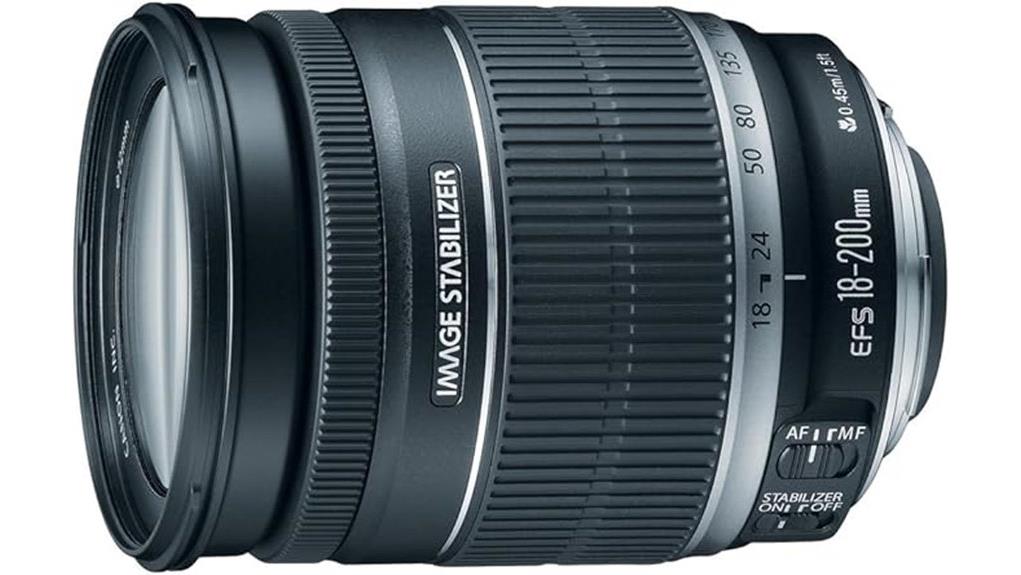
If you want a single, travel‑friendly APS‑C zoom that covers 18–200mm (≈29–320mm equiv.) with usable four‑stop Optical IS, the Canon EF‑S 18‑200mm f/3.5‑5.6 IS delivers practical versatility for vacations, street and general use. You’ll get good center sharpness at wide and mid ranges, softer edges and at 200mm, micromotor AF that’s adequate for stills, and noticeable distortion and CA correctable in RAW. Keep expectations modest for low‑light and pro IQ; more details follow. When considering Canon lens specifications for photographers, it's essential to prioritize features that align with your shooting style. Look for options that offer a good balance of light-gathering capability and sharpness across the frame. Additionally, lens performance can be influenced by factors like focal length and aperture, so choose wisely for your needs.
Some Key Takeaways
- Versatile 18–200mm (28.8–320mm APS-C equiv.) zoom ideal for travel and walkaround use with an 11.1× focal range.
- Good center sharpness at wide and mid focal lengths; edges and 200mm end exhibit softness.
- Optical IS provides about four stops of stabilization, enabling more handheld low-light shooting.
- Micromotor autofocus is adequate for stills but slower and noisier than USM for action.
- Lightweight, plastic build lacks weather sealing; expect distortion and chromatic aberration correctable in RAW.
Quick Verdict: Who This Canon EF-S 18-200mm F/3.5-5.6 IS Is Best For
While it won’t replace pro-grade primes, the Canon EF-S 18-200mm f/3.5-5.6 IS is ideal for amateur and travel-oriented APS-C shooters who want a single compact zoom that covers wide-to-telephoto ranges with usable stabilization and decent background blur; it’s especially suited for vacation, street, and general-purpose photography where convenience and focal flexibility outweigh the need for top-tier low-light performance or weather sealing. You’ll appreciate its travel versatility for packing light and adapting to diverse scenes. As a student kit option it reduces lens changes and cost, offering acceptable optical performance and stabilized handheld reach. It also makes a practical complement to a compact tripod for improved stability during longer focal-length shots and low-light situations compact tripod.
Key Specs That Matter: Focal Range, Aperture, Stabilization, and AF
Now that you know who this lens suits, let’s look at the specifications that determine everyday performance: focal range, maximum aperture, image stabilization, and autofocus. You get 18–200mm on APS-C (28.8–320mm equivalent), an 11.11:1 zoom ratio covering wide to tele. Maximum aperture is f/3.5–5.6; minimum aperture is f/22–38, affecting depth of field and diffraction limit. Optical IS claims up to four stops and stabilizes the viewfinder on compatible bodies. AF uses a micromotor—adequate but not as fast or quiet as USM. Filter thread size is 72mm for accessories and filters. This makes it a versatile choice for portrait shooters who prefer a broad focal range without swapping lenses. the canon ef 75300mm review highlights the lens's suitability for dynamic shooting scenarios. Its lightweight design and compact size also make it an excellent travel companion for photographers on the go. Overall, this lens offers solid performance that caters to both amateur and professional needs.
Real-World Performance: Image Quality, Stabilization, and Focusing in Day-to-Day Use
Test the EF-S 18-200mm across typical shooting scenarios and you'll find a competent all‑rounder: center sharpness at wide and mid focal lengths is good for prints and web use, but detail softens toward the edges and at longer telephoto settings where diffraction and residual aberrations become more apparent. You’ll get reliable stabilized shots thanks to the lens IS rated at about four stops, which aids low light performance for handheld work. Autofocus uses a micromotor AF: it's adequate for stills but not brisk for fast action. Chromatic aberration behavior is predictable—visible at high-contrast edges but correctable in RAW. This makes it a practical choice for many photographers who favor mirrorless systems and want versatile, everyday essential gear.
Strengths and Trade-Offs: Sharpness, Bokeh, Distortion, Weight, and Build
Having established how the lens performs in everyday shooting, let's examine its core strengths and trade-offs across sharpness, bokeh, distortion, weight, and build. You’ll find center sharpness strong at wide and short telephoto, falling toward edges and at 200mm; stopping down improves microcontrast but diffraction limits small apertures. Bokeh is generally pleasant thanks to a 7-blade circular diaphragm, though background rendition shows nervousness at long focal lengths. Barrel-to-pincushion distortion is noticeable across the range but correctable in RAW. Chromatic aberration is present at extremes; Super Spectra coating helps flare resistance. Construction is lightweight, plasticky, functional but not weather-sealed. If you plan to use a tripod, choosing the right tripod head can improve stability and framing, so consider a head that matches your shooting style and load capacity with a compatible tripod head.
Should You Buy the Renewed Canon EF-S 18-200mm F/3.5-5.6 IS?
If you're weighing practicality against ultimate image quality, the renewed Canon EF-S 18-200mm f/3.5-5.6 IS is a sensible grab for travel and walkaround use: it packs a vast 11.1× zoom range, effective 4-stop Optical IS, and compact, lightweight construction into a single, affordable unit. You’ll appreciate the value proposition if you need versatile focal coverage and stabilized handheld framing on APS-C bodies. Check used lens grading carefully, test AF and stabilizer function, and inspect optics for fungus or haze. Warranty considerations: renewed units typically carry a 90-day limited warranty, so factor long term reliability risk. Consider pairing the lens with a protective Pelican case to safeguard gear during travel and outdoor shoots.
Some Questions Answered
Is This Lens Compatible With Full-Frame Canon Bodies?
No — full frame? no. You're limited to APS-C bodies because the EF-S mount limitation prevents proper flange registration and the lens projects a smaller image circle sized for APS-C sensors. You shouldn’t mount it on full-frame Canon bodies without modification or risk of vignetting and physical interference. The lens uses an EF-S mount, so stick to compatible APS-C Canon DSLRs to guarantee correct focus, coverage, and safe mechanical fit.
Does the Renewed Model Include Original Caps and Hood?
Yes — renewed listings vary, so you should confirm accessory completeness before buying. Check the cosmetic condition description and seller notes for original caps and hood; some renewed EF‑S 18‑200mm units include both, others include generic replacements or only the rear cap. Inspect photos, ask the seller to verify included items, and request serial numbers or package contents in writing to make certain the renewal meets your expectations for accessories and appearance.
Can I Use This Lens for Video Autofocus on Canon Mirrorless With Adapter?
Yes — you can use this EF-S lens on Canon mirrorless bodies with an EF-to-R adapter, but autofocus reliability will be limited. The micromotor AF is slower and less precise than native STM/USM designs, so continuous tracking during video may be inconsistent, especially with fast-moving subjects or low light. You’ll often rely on contrast hunting, occasional manual focus, or camera-body AF improvements to achieve smoother video autofocus performance.
IS the Optical IS Effective for Low-Light Handheld Astrophotography?
No — the Optical IS helps handheld stability but won’t make it effective for low light performance in astrophotography. You’ll still need fast apertures, high ISO tolerance, and good coma control; this lens is slow (f/3.5–5.6) and shows noticeable coma and edge aberrations at wide apertures and long focal lengths. Use a fast prime or a tracked mount for true low-light astrophotography to minimize star elongation and noise.
What Warranty and Return Options Come With the Renewed Lens?
You get a 90 days limited warranty and a seller-specified return window for the renewed lens. You'll have warranty duration of 90 days covering functional defects per the limited terms; cosmetic wear is typically excluded. The return window varies by marketplace/seller—check the listing for exact days and restocking rules. Retain purchase records and inspect immediately so you can initiate returns or warranty claims within the stated return window and warranty period.