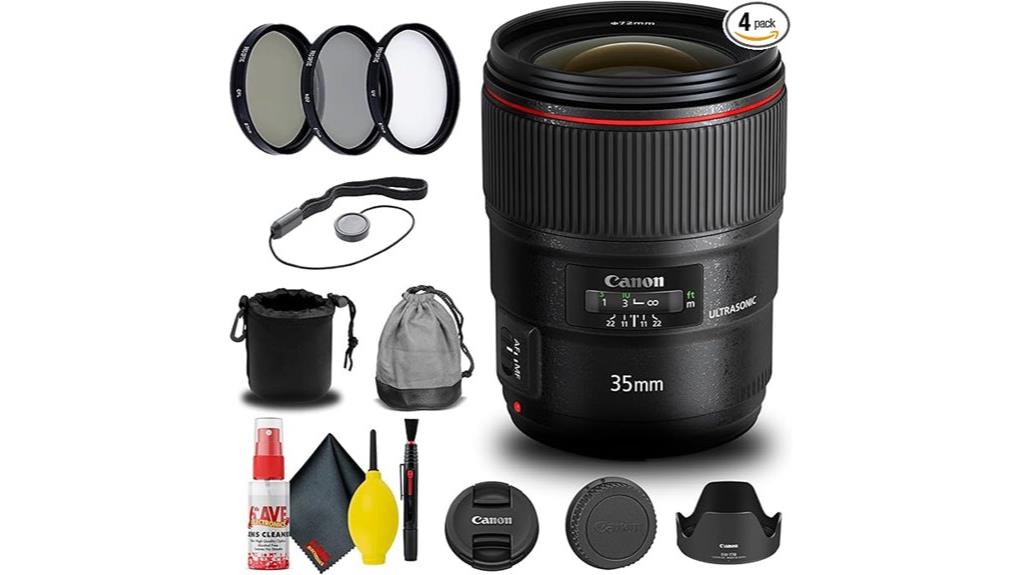
You’ll get a pro-grade 35mm prime with fast f/1.4 speed, BR and UD elements, dual asphericals, and SWC coating for excellent chromatic control, edge-to-edge sharpness when stopped down, and strong flare resistance. Ring USM autofocus is quick and precise with tactile manual override. Nine-blade diaphragm yields smooth bokeh; weather sealing and balanced handling suit handheld work. It’s costly but includes useful accessories and outperforms many counterparts — continue for a full breakdown of performance and alternatives.
Some Key Takeaways
- Outstanding sharpness center-to-corner by f/2.8–f/5.6, with usable wide-open performance at f/1.4 despite softer edges.
- BR, UD, and aspherical elements effectively reduce chromatic aberration, color fringing, and distortion for clean images.
- Fast Ring USM autofocus with tactile manual override and reliable low-light focusing performance.
- Robust weather-sealed construction, comfortable ergonomics, and balanced handling for professional use.
- Premium price but strong value due to optical coatings, included accessories, and versatility for portrait and street work.
What Makes the Canon EF 35MM F/1.4l II USM Special for Photographers?
Because it combines a very fast f/1.4 aperture with advanced optical corrections, the Canon EF 35mm f/1.4L II USM gives you both low‑light performance and high resolving power in a single wide‑angle prime. You’ll exploit shallow depth of field for subject isolation and maintain edge-to-edge acuity at typical working distances. The build delivers reliable AF speed and tactile manual override for decisive capture. Its weight and ergonomics suit sustained handheld use, aiding street storytelling and environmental portrait work; portrait versatility comes from focal length balance and bokeh rendition, letting you control background rendering while preserving contextual scene detail. It’s an excellent choice for photographers focused on prime lenses and image quality.
Key Specs and Optical Features That Affect Image Quality (BR, UD, Aspherical, SWC)
When you evaluate the Canon EF 35mm f/1.4L II USM's image performance, focus first on how each specialized element and coating addresses specific aberrations and contrast loss: the Blue Spectrum Refractive (BR) element shifts short-wavelength focus to reduce longitudinal chromatic aberration and color fringing, the UD element minimizes secondary spectrum for improved mid-to-high frequency resolution, and the two aspherical elements correct spherical aberration and field curvature to preserve edge sharpness and tight point-image reproduction across the frame. You’ll note BR optics and UD element provide Chromatic control; Aspherical elements handle Distortion correction. SWC coating gives Flare suppression; Fluorine coating aids Smudge resistance. Element arrangement, 9 blade diaphragm, Aperture range and overall optical layout drive Resolution improvements, Bokeh rendition and Low light performance. This lens is part of a lineup of specialized lens gear designed for serious photographers seeking improved optical performance.
Real-World Performance: Sharpness, Bokeh, Low-Light AF, and Flare Control
Having covered how the BR, UD and aspherical elements plus SWC shape the lens's optical baseline, we'll now assess how those design choices manifest in real shooting: sharpness across apertures and frame, the character and uniformity of bokeh, autofocus behavior in low light, and resistance to flare. Your sharpness testing shows center acuity peaks by f/2.8–f/4 with strong corner recovery by f/5.6; wide-open f/1.4 is usable but softer toward edges. Bokeh character is smooth with nine-blade diaphragm rendering. Autofocus performance remains fast and reliable in dim conditions courtesy of ring USM. Flare resistance is excellent with SWC. Gear Guide for Enthusiast Photographers and Camera Fans emphasizes practical accessory recommendations for users seeking to get the most from prime lenses like this one, including filters and lens hoods for lens protection.
Who Should Buy This Lens? Use Cases, Camera Compatibility, and APS-C Behavior
If you need a versatile wide-angle prime that balances high-resolution imaging with low-light capability, the Canon EF 35mm f/1.4L II is a prime candidate for full‑frame shooters and serious APS‑C users seeking a near‑standard field of view. You’ll appreciate it if you prioritize portrait versatility at wider apertures, environmental portraits, street documentary work, and low-light event shooting. It pairs natively with full‑frame EOS bodies for maximum angle of view; on APS‑C bodies you’ll get ~56mm equivalent, useful for tighter head-and-shoulder framing. Optical construction, weather sealing, and robust AF suit professional workflow and demanding conditions. It’s also a popular choice among mirrorless camera enthusiasts looking for essential gear that complements their setups.
Value and Alternatives: Price, Included Accessories, Warranty, and Comparable Lenses
You’ve seen how the 35mm f/1.4L II performs across genres and bodies; now assess whether its optics, build, and feature set justify the outlay and how it stacks up against alternatives. You’ll pay a premium versus standard 35mm primes, so a clear price comparison is essential: the L II commands higher street prices but adds BR optics, SWC coating, and robust weather sealing. Included accessories (hood, caps, soft case, filter kit, cleaning tools) reduce immediate add-on costs. Note warranty limitations: only a 90-day limited warranty, so factor potential service costs. Comparable alternatives include Canon 35mm f/2 IS and third‑party 35mm f/1.4 options. Many photographers who use adapters for legacy and mirrorless systems also value mount adapter compatibility when choosing a high-end 35mm lens.
Some Questions Answered
Is This Lens Compatible With Canon RF Bodies Using an Adapter?
Yes — you can mount this EF lens on RF bodies using a mount adapter. Using Canon’s EF‑RF adapter preserves electronic contacts so autofocus performance remains largely functional, including USM speed and full‑time manual override. Expect comparable AF accuracy, though subject to slight differences in tracking latency or power draw on some bodies. Make sure firmware on camera and adapter is current; third‑party adapters may vary in AF reliability and feature support.
Can I Use 72MM Screw-On ND or Polarizer Filters Safely?
Yes — you can safely use 72mm screw-on ND or polarizer filters on this lens. The filter size is 72mm and threads accept standard screw-on filters that sit on the front element. Use slim-profile filters to minimize vignetting at wide apertures and focal lengths. Make sure filters are high-quality multi-coated glass to preserve contrast and reduce reflections on the front element. Tighten gently to avoid cross-threading or stress.
How Weather-Resistant Is the Lens in Heavy Rain or Dusty Environments?
You're reasonably protected: the lens features weather sealing that resists dust and moisture but isn't fully waterproof, so you shouldn't expose it to heavy, sustained rain or submersion. Element coatings (fluorine on exposed elements and SWC) help repel moisture, fingerprints and reduce flare, improving survivability in damp or dusty conditions. In extreme rain or sandstorms you should use additional protection (rain cover, sealed housing) and avoid changing filters or caps outdoors.
Does the Lens Vignette at F/1.4 on Full-Frame Cameras?
Yes — you’ll see noticeable vignetting at f/1.4 on full-frame bodies. Measured vignette characteristics show darker corners versus center, with edge illumination falloff typically several stops wide-open. Stopping down to f/2–f/2.8 reduces the effect markedly; by f/4 it’s largely negligible for most scenes. The pattern is radially symmetric, influenced by lens design and filter thickness, and can be corrected in post or in-camera lens profiles.
What Is the Minimum Focusing Distance for Close-Up Work?
The minimum distance for close-up work is 0.28 m (28 cm) from the sensor plane. You’ll use that minimum distance to maximize subject magnification while maintaining sharpness. For close up techniques, stabilize the camera, use manual focus or focus peaking, and stop down slightly from f/1.4 to increase depth of field. Watch working distance to avoid casting shadows; consider extension tubes or cropping for greater magnification if you need closer framing.