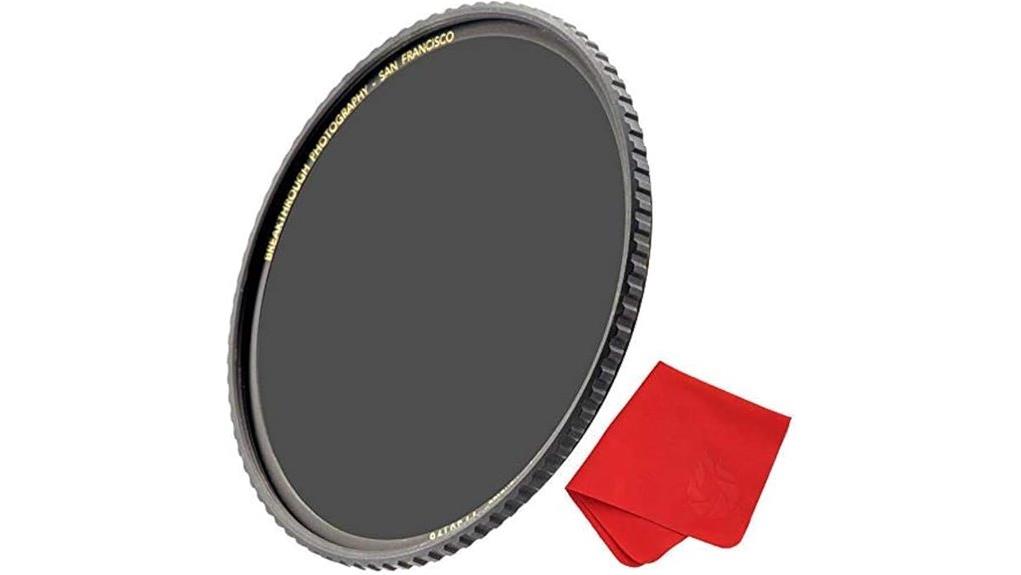
You’ll get a true, neutral 10‑stop reduction with the Breakthrough Photography X4 95mm ND, giving predictable exposure control and matching stop measurements for reliable long exposures. Its Schott B270 glass and MRC16 plus Nanotec coatings keep color shifts minimal, reduce flare and ghosting, and repel water and dirt. The ultra‑slim, weather‑sealed aluminum carrier holds tight tolerances for alignment and durability in harsh conditions. Keep going to see measured tests, comparisons, and warranty details.
Some Key Takeaways
- True 10-stop neutral density: provides accurate 10-stop reduction with flat visible-spectrum transmission for predictable long exposures.
- Excellent color neutrality: Schott B270 glass yields minimal white-balance shift and consistent color reproduction.
- Robust coatings and weatherproofing: MRC16 and Nanotec reduce flare, repel water/dirt, and tolerate harsh outdoor use.
- Reliable exposure control: measured stops match exposure compensation, simplifying metering, bracketing, and long-exposure workflows.
- Durable 25-year guarantee: serial activation registers ownership for long-term support and warranty coverage.
Quick Verdict: Who the X4 95mm 10‑Stop ND Is Best For
While you’re shooting long exposures or controlling motion in bright daylight, the Breakthrough Photography X4 95mm 10‑stop ND is for photographers who need uncompromising neutrality and durability. You’ll appreciate Schott B270 glass, MRC16 and Nanotec coatings, and the weather‑sealed, ultra‑slim build when you work in harsh conditions. The 10‑stop reduction gives predictable shutter-speed control; its flat transmission minimizes corrective grading. This filter suits landscape photographers demanding color fidelity during extended exposures and city shooters who tame highlights and traffic blur without hue shifts. You’ll value the 25‑year guarantee and serial activation for long‑term support and ownership tracking. It’s also a great choice for those learning to master ND filters who want reliable, neutral results from ND filters.
How the X4 Performs: Exposure, Color Neutrality, and Infrared Control
Because you need predictable exposure and faithful color through long exposures, the X4 delivers a true 10‑stop reduction with flat transmission across the visible spectrum and controlled infrared rejection, so you can dial in shutter speeds without compensating for unexpected hue shifts or IR contamination. You’ll find exposure latitude tight and repeatable: measured stops match exposure compensation, simplifying metering and bracket strategies. Color neutrality is excellent; white balance adjustments are minimal and consistent across scenes. Infrared rejection prevents red cast bleed in prolonged exposures under mixed light. Overall, the X4 gives reliable, technical control for critical long‑exposure work. Many landscape photographers also pair polarizing filters with ND filters to enhance contrast and manage reflections, especially when using polarizing lens filters.
Build, Glass, and Coatings: Schott B270, MRC16 and Nanotec Explained
When you put the X4 on your lens, its build and materials immediately signal a professional, purpose-driven design. You get Schott B270 optical glass for predictable thermal stability and flat transmission. The aluminum carrier shows tight manufacturing tolerances, minimizing stress and alignment error. MRC16 multi-resistance layers cut reflections, flare and improve surface hardness; Nanotec adds hydrophobic, dirt-repellent behavior. Together they extend coating longevity while keeping optical neutrality. Weather sealing and ultra-slim profile preserve performance in harsh conditions. For maintenance, follow manufacturer cleaning techniques: use blower, microfiber and approved solvent sparingly to protect coatings and maintain warranty. This kit is ideal for photographers who want to enhance photos with the right lens filters.
Real‑World Tests: Long‑Exposure Examples, Flare Control, and Weather Resistance
If you want predictable long‑exposure results, the X4's neutrality and coatings let you dial in multi‑stop exposures without color casts or unexpected flare. You’ll get consistent long exposure performance—flat transmission yields accurate color and predictable exposure comp calculation for minutes‑long shots and star trails. MRC16 plus Nanotec materially reduces flare and ghosting under direct lights; you’ll notice tighter point sources and fewer veiling reflections. Weatherproofing is effective: hydrophobic Nanotec and MRC16 repel water, oil, and dust, and the sealed, slim barrel resists wind and abrasive conditions. Salt resistance is strong for coastal work; rinse after exposure. The filter is especially useful for outdoor photography where variable environmental conditions demand reliable, neutral density performance.
Buying Guide: Compatibility, Warranty, and When to Choose This ND Over Alternatives
Having seen how the X4 performs on long exposures and in harsh conditions, you’ll want to match that capability to your gear and shooting needs before buying. Check your lens thread size (95mm here) — it must match the filter thread printed under the lens cap or on the barrel. Choose the X4 if you need true color neutrality, robust coatings (MRC16, Nanotec), and weather-sealed durability for landscape or seascape work. Register ownership via the activation link to enable the 25-year guarantee and support. Opt for alternatives only if you need variable stops, smaller budgets, or different thread-size options. Store negatives and prints properly using acid-free sleeves to preserve image quality for decades.
Some Questions Answered
Can I Stack This 10-Stop ND With Other Filters Safely?
Yes — you can stack the 10-stop ND with other filters, but you should watch for vignetting risks and potential color shifting. Stack slim-profile, high-quality glass (matching 95mm) to minimize corner darkening and spectral changes. Test combinations on your widest focal lengths and check exposures for unexpected tint. Avoid excessive thickness that breaches weather sealing or causes mechanical strain. Keep a backup single-filter test for critical shots.
Does the Filter Affect Autofocus or Metering Accuracy?
Yes — using the 10-stop ND can impact autofocus performance and metering reliability because it drastically reduces light reaching the sensor. You’ll often need to switch to manual focus or use focus assist, and expose via live view or use exposure compensation. In good light, modern cameras handle metering well with the ND, but low-light scenes or small-aperture shooting can produce slower AF and less reliable metering, requiring manual overrides.
Is a Filter Holder or Adapter Required for My Lens Hood?
No, you usually won’t need a filter holder or adapter for your lens hood if your lens accepts 95mm screw-in filters; the X4 95mm mounts directly to 95mm lens threads. Check lens compatibility and hood clearance, though: deep or built-in hoods can interfere with filter installation or vignetting. If hood clearance is insufficient, remove the hood or use a slim-profile filter adapter/holder solution. Verify thread size printed under the lens cap.
How Heavy Is the Filter for Travel Packing Considerations?
The filter weighs about 95–110 grams, so it’s light enough for travel packing. You’ll benefit from its lightweight construction without sacrificing durability. Pack it in a padded pouch or dedicated filter case to prevent scratches; carry it in an outer pocket of your camera bag for quick access. Consider a slim protective case to save space, and avoid stacking heavy items on top—these packing tips preserve coatings and maintain optical performance.
Can I Use the ND for Video Without Introducing Flicker?
Yes — you can use it for video without introducing flicker in most setups. Its neutral, flat transmission and robust coatings minimize frequency-dependent artifacts; however, you should test with your camera’s shutter pulldown and electronic dimming settings. Some cameras or LED lights with incompatible pulldown or aggressive electronic dimming can interact with heavy ND density, causing banding. Verify frame rates, shutter angles, and light modulation to guarantee flicker-free footage.