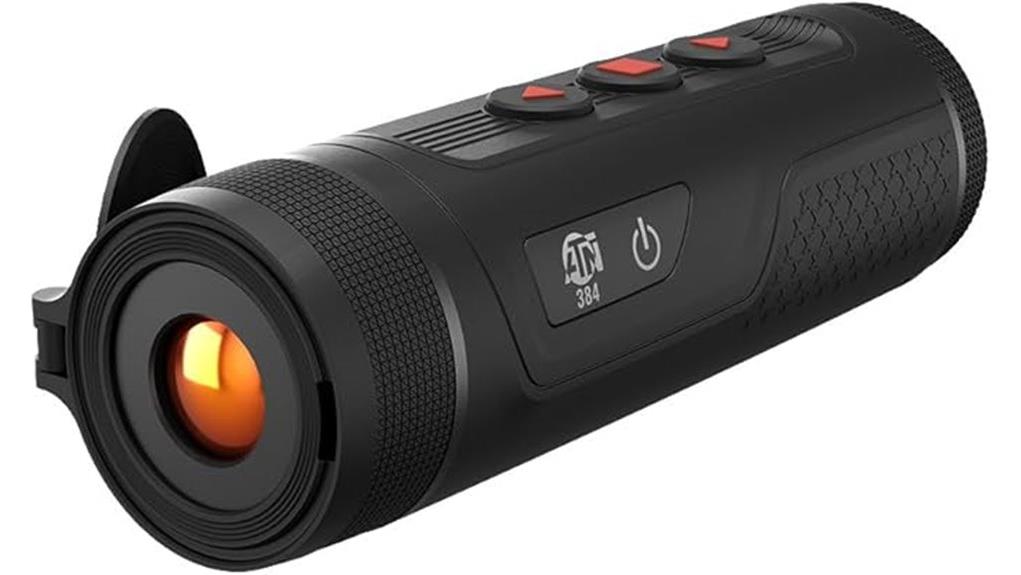
You’ll find the ATN BlazeTrek‑319 a compact, capable thermal monocular that’s built for hikers, hunters, and property watchers who want sharp short‑to‑mid‑range imaging and quick autofocus. It uses a 384×288 sensor with a 19 mm lens, <25 mK sensitivity, 50 Hz refresh and 8× zoom, plus onboard recording, Wi‑Fi app, microSD support and USB‑C battery charging. Expect strong contrast, occasional edge artifacts, and solid value for the price — keep going to see detailed performance and caveats.
Some Key Takeaways
- 384×288 sensor, <25 mK NETD, 50 Hz refresh, and 8× zoom deliver smooth, high‑contrast thermal images for short‑ to mid‑range use.
- 19 mm coated objective and quoted ~990 m detection for large heat sources, though small targets lose detail beyond several hundred meters.
- Compact (~0.7 lb) with USB‑C charging, removable Li‑ion battery, microSD support, and quick autofocus for field portability.
- Onboard photo/video, Wi‑Fi app control, and mini‑HDMI out enable recording and remote viewing, though live stream may show occasional latency.
- Good value for hikers/hunters/property-watchers with ATN’s three‑year coverage; consider rugged case and dry storage to prevent moisture issues.
Quick Verdict: Who Should Buy the ATN BlazeTrek-319 and Why
If you need a compact, high-sensitivity thermal monocular for spotting and short- to mid-range surveillance, the ATN BlazeTrek-319 is a strong choice—its 384×288 sensor, <25 mK NETD, 50 Hz refresh, and 19 mm lens give reliable detection out to the quoted ~990 m while built-in recording, Wi‑Fi/app control, and microSD support up to 256 GB add practical versatility. You’ll appreciate its balance of sensitivity and portability for wildlife observation and night navigation: it’s aimed at hikers, hunters, and property watchers who want clear, responsive imaging without bulk. Battery operation and app control make field use straightforward and efficient. The BlazeTrek-319 is also well suited for users seeking compact optics tailored to outdoor photography and observation diving camera accessories.
ATN BlazeTrek-319 Key Specs at a Glance (Sensor, Lens, Range, Battery)
You’ll find the BlazeTrek-319’s hardware choices drive its real-world performance: a 384×288, 12 µm-pixel thermal sensor paired with a 19 mm objective and <25 mK NETD gives high sensitivity and fine thermal contrast, while a 50 Hz refresh rate and 8× zoom keep images smooth and manageable for spotting and tracking. You’ll appreciate the quoted 990 m detection range and auto-focus. Battery life from the included lithium-ion cell is solid for typical outings, and USB‑C charging is convenient. A quality lens coating improves contrast; a potential sensor upgrade path exists. At 0.7 lb, weight reduction aids handheld use. Pelican cases offer rugged, weatherproof storage and transport for sensitive optics and gear, making them a natural choice for photographers who need durable protection in the field with hard-shell protection.
Real-World Performance: Image Quality, Detection Range, and Low‑Temp Sensitivity
When you put the BlazeTrek-319 to work, its 384×288, 12 μm sensor and <25 mK NETD translate into crisp, high-contrast thermal images that make small temperature differences visible even at moderate distances. You’ll appreciate strong contrast retention across palettes; targets stand out against cluttered backgrounds with minimal blooming. Detection near the quoted 990 m is practical for large heat sources, though small targets lose detail past several hundred meters. Cold start is quick—usable imagery appears within seconds—while sensitivity drift over hours is minimal but noticeable in extreme temperature swings. Occasional thermal artifacts appear around high-contrast edges; they’re manageable. For long-term reliability, store your thermal gear in a dry environment to minimize moisture-related degradation.
Usability and Features: Controls, Autofocus, Recording, Wi‑Fi App, and Storage
Having covered image quality and detection limits, let’s look at how the BlazeTrek-319’s controls and features affect real-world use. You’ll find the button layout logical: power, menu, and capture are reachable without shifting your grip, and autofocus triggers quickly on most targets. The Recording workflow is straightforward—press capture for photo, hold for video; file naming is automatic. Wi‑Fi and the app provide remote view and control, though occasional App latency appears during live streaming. Storage management is simple with MicroSD support to 256 GB; you’ll appreciate clear folder structure and easy USB‑C offload. For photographers who also use video or external monitors, knowing compatible mini HDMI options can simplify connecting the monocular to larger displays.
Pros, Cons, and Value: Warranty, Price Considerations, and Final Recommendation
Although the BlazeTrek-319 packs high-sensitivity thermal imaging, fast autofocus, and solid build quality, you should weigh those strengths against a few trade-offs before buying. You’ll get long-range detection, multiple palettes, onboard recording, and app connectivity; autofocus and 50 Hz smoothness matter in dynamic scenes. Consider warranty details: ATN’s three-year coverage plus many sellers’ 30-day return window reduces ownership risk. On price comparison, it sits mid-to-high for monoculars with similar specs; shop bundles and seller ratings. Recommendation: if you need reliable thermal performance and features for fieldwork, it’s a strong value; casual users might prefer cheaper alternatives. For those who shoot landscapes and want enhanced perspective, consider using wide-angle phone lenses to expand framing options and creative possibilities with expanded perspectives.
Some Questions Answered
Does It Come With Lens Caps or Protective Covers?
No, it doesn’t include dedicated snap-on lens caps, but it does ship with a soft carrying case and a holster that provide basic lens protection and storage solutions. You’ll want a fitted lens cover or protective cap for long-term scratch and dust prevention, especially in rough field use. Consider third-party caps or a padded case with sealed compartments to improve protection and secure storage for the monocular and accessories.
Is It Waterproof or Water-Resistant Rated?
No—there’s no stated ingress protection rating, so you shouldn’t assume full waterproofing. You’ll get some moisture tolerance from its sealed design and included holster, but ATN doesn’t list an IP class for submersion or heavy rain. Treat it as splash-resistant and avoid prolonged exposure, immersion, or harsh weather. For reliable wet-weather use, consider adding aftermarket protection or contacting ATN support to confirm real-world moisture tolerance and care recommendations.
Can It Be Tripod-Mounted and What Tripod Thread Size?
Yes — you can tripod-mount it; the monocular has a standard 1/4"-20 tripod thread for tripod compatibility. You’ll attach directly or use mounting adapters for other thread sizes or quick-release plates. That gives stable long-duration observation and easier documentation. If you plan heavy-duty rigs or specialty plates, get an adapter or ball-head with a 1/4"-20 screw. Verify clearance with holster or case before finalizing your setup.
Are There Firmware Updates and How Are They Applied?
Yes — you’ll get firmware maintenance and updates. Check ATN’s site or the BlazeTrek app for notices, download the latest firmware, and follow the update procedure: connect the monocular via USB‑C or Wi‑Fi to your computer or phone, transfer the firmware file to the device (or use the app’s OTA option), then run the installer and reboot. You’ll verify version in settings and keep logs for troubleshooting.
Is the Unit Compatible With External Power Banks for Extended Use?
Yes — you can use external power banks to extend run time, but check battery compatibility and power delivery specs first. The BlazeTrek-319 accepts USB-C power input; you’ll want a power bank that supports stable 5V output and sufficient mA (ideally 2A+) to avoid brownouts. High-capacity banks work well, though fast-charge PD profiles aren’t required. Always use quality cables and avoid unregulated supplies to protect device and battery.