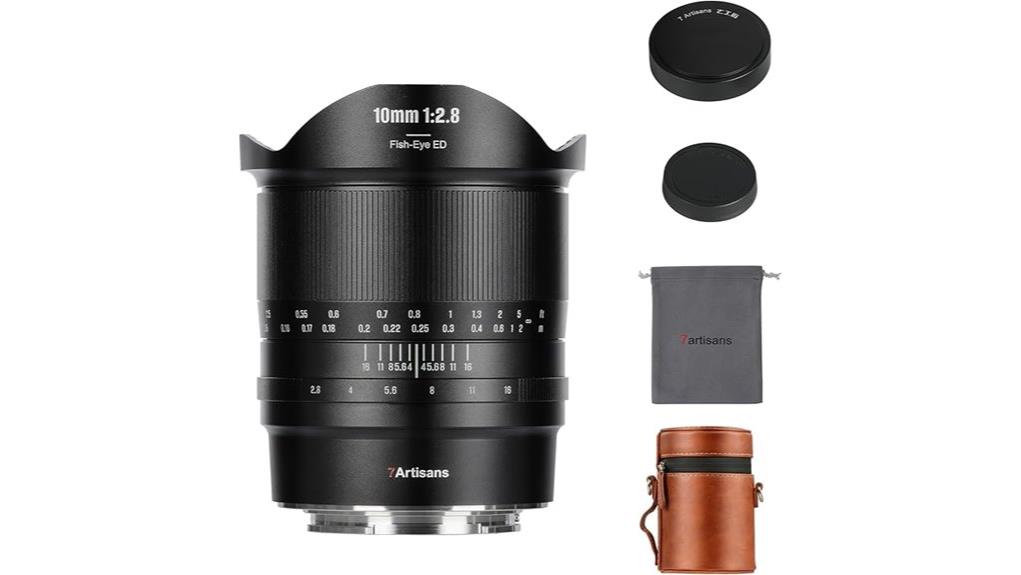
You’ll get an affordable, mechanical 185° fisheye for Leica L/Panasonic/Sigma L bodies that delivers dramatic wide-angle framing and a fast f/2.8 for low-light and night work, but you’ll trade autofocus, weather sealing, and stabilization. Center sharpness is good wide open while corners soften until you stop down; distortion is extreme by design and chromatic fringe is minor and correctable. It’s excellent for creative interiors, landscapes, and close-focus portraits—continue for detailed tests and handling notes.
Some Key Takeaways
- Ultra-wide 185° diagonal fisheye for Leica L/Panasonic/Sigma L-mount bodies, delivering dramatic creative perspectives.
- Manual-focus, non-weathersealed 602 g lens with solid metal build and long, damped focus throw.
- Good center sharpness at f/2.8; corners soften wide-open but improve markedly when stopped down.
- Extreme distortion is intentional and predictable; minor chromatic fringing is usually correctable in post.
- Best for creative wide-angle, night, interiors, and close-up portraits; avoid if you need AF, stabilization, or sealing.
Real-World Verdict: Who Should Buy the 7artisans 10mm F2.8 II and Why
If you shoot on Leica L, Panasonic, or Sigma L-series mirrorless bodies and want an extreme, creative wide-angle without autofocus or weather sealing, the 7artisans 10mm F2.8 II delivers a compact, affordable tool for striking perspectives. You'll want this if you value dramatic 185° framing, close-focus exaggeration, and a fast f/2.8 for low-light or night work. It's ideal for experimental street photography and bold travel vlogging where manual control and striking composition matter more than autofocus or weather resistance. Avoid it if you need stabilization, sealed durability, or rapid autofocus for run-and-gun commercial shoots. As a specialist retailer focused on mirrorless camera accessories, we recommend pairing it with mirrorless-specific accessories for best results.
How the 10mm F2.8 II Handles Optics: Sharpness, Distortion, and Chromatic Aberration
When you stop the 7artisans 10mm F2.8 II down slightly from its fixed f/2.8 it delivers surprisingly clean central sharpness and usable detail across much of the frame; wide-open the center is good for a manual fisheye but corners soften noticeably and require careful composition or cropping. You’ll find edge sharpness improves a stop or two, though residual field curvature causes peripheral micro contrast to drop. Distortion is extreme by design but predictable, so you can compose around it. Chromatic fringing is controlled—ED and aspherical elements help—but bright high-contrast edges can still show minor color fringing that’s correctable. The lens is aimed at photographers who enjoy creative, immersive perspectives and pairs well with accessories for fisheye photography.
Shooting Tests and Use Cases: Night, Landscape, Interiors, and Creative Portraits
Having seen how stopping down cleans up the field and how the lens controls chromatic aberration and predictable distortion, you can now evaluate real-world performance across shooting scenarios. You’ll get usable night astrophotography at f/2.8 with short exposures and controlled coma toward edges; stars remain usable centrally, and careful framing reduces edge elongation. For landscapes the 185° view delivers immersive foreground-to-sky separation, best stopped to improve edge sharpness. In creative interiors the fisheye excels for tight rooms and dramatic perspective, though you’ll manage converging lines in composition. Creative portraits benefit from close-focus “big head” effects, but watch for facial distortion. For product photography and small-object work, a light box photo tent helps tame reflections and produce clean, consistent backgrounds.
Practical Handling, Build, and Compatibility With Leica L / Panasonic / Sigma L Cameras
Because the 7artisans 10mm F2.8 II is a manual-focus, non‑weathersealed optic with a relatively substantial 602 g mass, you'll notice a solid, metal-feel build that balances well on Leica L / Panasonic / Sigma L mirrorless bodies but demands a firm grip for rapid framing. You operate precise manual ergonomics via a long, damped focus ring with clear distance markings; throw is moderate for quick adjustments. No stabilization means you rely on camera support. Native L mount fits directly; if you use Mount adapters for other mounts verify flange distance and electronic coupling needs. Overall construction is robust but not weatherproof. This makes it a good candidate for pairing with a sturdy L-bracket mount.
Buying Considerations: Price, Return Policy, Warranty, and Alternatives to Compare
After getting a feel for the lens' manual focus ergonomics and weight on L‑mount bodies, you should weigh price, returns and warranty before buying. You'll compare street price against used and competitor offers — do a systematic price comparison including shipping and taxes. Verify the voluntary 30-day return guarantee and confirm restocking fees with the retailer. Inspect warranty details: duration, what’s covered, and authorized service centers for Leica L/Panasonic/Sigma L mounts. Consider alternatives (native ultra‑wide primes, other fisheyes) balancing optical specs, weight, and cost. Buy from sellers with clear return policies and documented warranty support. Also consider protective shipping and storage solutions like Pelican cases to keep lenses safe in transit and on location.
Some Questions Answered
Does the Lens Come With a Lens Hood or Protective Cap?
No — the package typically doesn't include a dedicated lens hood; you get a lens cap and a soft pouch instead. You'll handle the manual-focus 10mm carefully since it's not weather-sealed. The soft pouch offers basic protection for transport, while the lens cap protects the front element from dust and scratches. For stray light control or extra protection, you should buy a compatible screw-in hood or a hard case separately to improve physical security and flare control.
Is There an AF Confirmation Chip or Electronic Contacts?
No — the lens lacks AF confirmation and built-in electronic contacts. You’ll use it as a manual-focus optic on Leica L / Panasonic / Sigma L mounts, so your camera won’t receive lens data or provide electronic focus confirmation. That means no EXIF aperture or focal-length reporting and no AF-assist chip. You’ll rely on your camera’s manual-focus aids (peaking, magnification) for critical focus; evaluate workflow impacts before buying.
Can This Fisheye Be Adapted to Other Mounts Safely?
Yes — you can adapt it, but check mount adapters and flange compatibility carefully. You’ll need manual-focus-only mechanical adapters that match the lens’s Leica L/Sigma L flange distance to your camera’s mount. If your camera has a shorter flange focal distance than the lens, adapters work reliably; longer distances won’t. Expect no electronic communication, no AF confirmation, and potential optical performance changes. Use quality adapters to maintain alignment and avoid light leaks.
What Tripod or Collar Support Is Recommended for Balance?
Use a compact, low-profile tripod collar and quick-release plate to achieve proper tripod collar placement and lens balancing. You’ll want an L-bracket or Arca‑Swiss compatible collar that clamps near the lens mount, supporting the 602 g body while keeping the optical center over the tripod. Choose metal construction with secure locking, minimal play, and a counterweight option for heavier rigs. Test balance on your head/ball head before extended shoots.
Are There Recommended Filters or Filter Holders for This Lens?
You can’t use front-thread filters; you’ll rely on rear filter solutions. Use thin gelatin filters or a dedicated rear filter holder designed for Leica L/Sigma L mounts to control color, ND or diffusion without vignetting. Evaluate holders for secure seating and low light-leak risk. Avoid thick glass at the rear. Test for color cast and check compatibility with manual focus operation. Keep spares; gelatin is inexpensive and easy to trim.