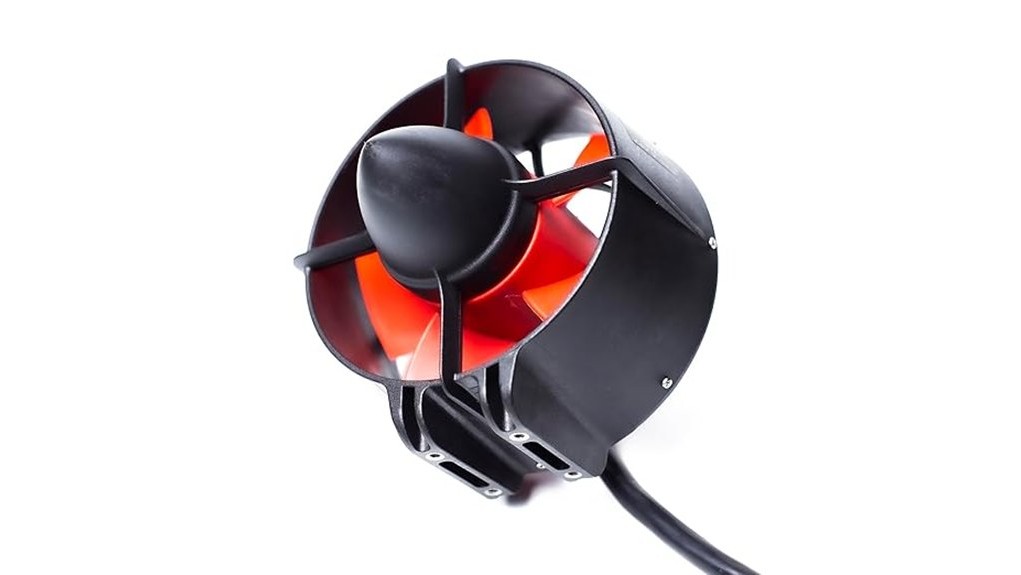
If you need a compact, high-thrust 24V CCW thruster for kayaks, paddleboards or hobby ROVs, the ApisQueen U92 delivers — a sealed, modular 24–25.2V brushless unit (150KV) that peaks near 11.8 kg thrust while weighing ~2.3 lb. You’ll drive it with an ESC/PWM (no integrated electronics), mind corrosion-prone fasteners and seals, rinse after salt use, and provide vibration isolation and proper mounts. Keep costs for ESC, cables and connectors in your plan; more details follow.
Some Key Takeaways
- Compact 24V CCW brushless thruster delivering measured peak thrust ~11.8 kg, suitable for small craft and hobby ROVs.
- Lightweight (~2.3 lb) high thrust-to-weight unit, practical cruising speeds around 5 km/h under load.
- Requires external ESC/PWM (24–25.2V support); calibrate throttle endpoints and use ESC rated above continuous current.
- Composite housing resists impacts, but metal fasteners and shaft seals corrode in seawater—rinse, inspect, and use sacrificial anodes.
- Good mid-range value for modular installs; budget for ESC, mounts, cabling, connectors, and maintenance supplies.
Which Buyers Should Consider the ApisQueen U92 24V CCW Underwater Thruster?
If you need a compact, high-thrust propulsion unit for small craft or ROV projects, consider the ApisQueen U92 24V CCW: it delivers up to 11.8 kg (26.1 lbs) of thrust from a 24V brushless waterproof motor while weighing about 2.3 lb, making it well suited for kayaks, paddle boards, inflatables, and hobbyist ROVs where power-to-weight matters. You’ll prefer this thruster if you need a sealed, modular unit compatible with seawater and freshwater, require ESC/PWM control integration, and prioritize high thrust density over integrated control electronics. It’s aimed at users upgrading kayak motors or building lightweight hobby ROVs with limited payload. This product fits well with enthusiasts shopping for kayaks and fishing crate accessories who enjoy water adventures.
Real-World Specs and Performance: Thrust, Speed, Voltage, and Weight
When you evaluate the U92 24V CCW’s real-world performance, focus on the key trade-offs between its 150KV motor characteristics, 24V nominal (up to 25.2V) supply, and the measured 11.8 kg (26.1 lb) peak thrust for a 2.3 lb unit; this combination yields a high thrust-to-weight ratio that favors short-burst acceleration and payload handling in small craft and ROVs. You’ll see a steep initial thrust curve with rapid decay as prop loading and battery internal resistance increase. Expect practical speed near 5 km/h under load. Monitor for voltage sag under sustained high current draws—thermal limits and battery capacity will define continuous versus peak performance. This performance profile makes the U92 well suited for water-based gear used by outdoor enthusiasts and in kayak-supported operations.
Installation and Control: ESC, PWM Setup, and Orientation Tips
Having examined how the U92’s high thrust-to-weight and 150KV motor profile drive steep initial acceleration and voltage sag under load, you now need to focus on properly installing and controlling the thruster to harness peak and sustained performance. Select a 24–25.2V ESC rated above continuous motor current; perform ESC calibration with your transmitter or controller to align throttle endpoints and braking behavior. Route power and signal to minimize voltage drop and noise; use proper waterproof connectors. For Mounting orientation, align the CCW propeller thrust vector with intended travel, minimize hull interference, and assure secure vibration-isolated fixtures for repeatable performance. Also ensure you have appropriate rescue rope bags and safety gear on hand when testing in open water to protect both operator and equipment.
Durability and Environment: Seawater Use, Materials, and Maintenance
Because seawater accelerates corrosion and fouling, you should treat the U92’s composite housing and plastic components as durable but service-dependent: the high-strength moulded body resists structural damage and most galvanic reactions, yet metal fasteners, motor shaft seals, and any exposed electrical contacts remain vulnerable and demand regular inspection, sacrificial anodes where applicable, and rinsing after use to preserve sealing integrity and prevent performance degradation. You should implement a strict maintenance schedule: rinse with fresh water, dry, inspect seals and connectors, replace degraded fasteners, and verify anode condition. Prioritise corrosion resistance testing and biofouling prevention coatings for extended deployments. Consider also using biodegradable cleaners and eco-friendly maintenance products to minimise environmental impact and protect sensitive waterways while servicing your equipment, especially when rinsing and degreasing in the field with biodegradable cleaners.
Value Check: Use Cases, Alternatives, and Final Recommendation
After addressing seawater effects and maintenance, you should evaluate whether the U92 24V CCW meets your application requirements and budget constraints. You’ll assess propulsion needs (11.8 kg thrust), power system compatibility (24V, 6S LiPo), and intended platform: kayaks, SUPs, inflatables, or ROVs. Perform cost analysis including ESC, mounts, and cabling; note packaging omits connectors. Check mounting options—integrated mould allows flexible placement but verify load paths and vibration isolation. Alternatives include lighter hobby thrusters or higher-end marine units with corrosion-resistant alloys. Recommendation: choose the U92 system if you need mid-range thrust with modular installation and controlled spending. Consider also basic patch and repair supplies for inflatables and kayaks, especially if you plan on frequent on-water use and essential gear.
Some Questions Answered
Is a Spare Propeller or Impeller Available for Purchase?
Yes — spare availability is limited but possible. You’ll need to confirm prop compatibility with ApisQueen: the U92 uses a specific impeller/prop designed for its shaft and housing, so generic props often won’t fit. Contact ApisQueen or authorized dealers for replacement parts and part numbers. If sourcing third-party blades, verify diameter, spline count, pitch, and mounting method to guarantee secure fit and preserve thrust and motor cooling performance.
Does the Thruster Come With a Warranty or Return Policy?
Yes — you’ll get standard seller warranty terms and return conditions, but specifics depend on the retailer. Check the product listing for warranty period, coverage scope, and claims procedure; the manufacturer typically covers defects in materials and workmanship but not misuse or water damage beyond intended use. For returns, confirm time window, condition requirements, and restocking fees. Keep order/serial info handy to streamline warranty or return requests.
What Connector Type Is Used for the Power Cable?
The product uses a waterproof connector for power termination; you’ll need to supply your own mating plug. It doesn’t include a specific pre-wired harness, so you’ll terminate power with a waterproof connector compatible with 24V/25.2V, adequate current rating for ~11.8 kg thrust, and ESC wiring. You should choose corrosion-resistant contacts, appropriate wire gauge, and secure seals. Verify pinout and ESC compatibility before final assembly to avoid damage.
Can Multiple Thrusters Be Synchronized for ROVS?
Yes — you can synchronize multiple thrusters for ROVs. You’ll need matched ESCs and a central controller or networked microcontrollers to minimize controller latency; use closed-loop speed feedback or ESC telemetry if possible. Account for prop wash interactions by spacing thrusters and phasing commands to avoid destructive interference. Calibrate thrust curves and implement PID synchronization to maintain vectoring accuracy and prevent oscillations from timing or flow disturbances.
Is There an Approved Underwater Lubricant for Seals?
Yes — you should use marine grease on external threaded seals and approved silicone alternatives for elastomer o-rings; avoid generic household silicones. You’ll pick a marine-grade, saltwater-compatible grease rated for submerged use and a non-corrosive, low-permeability silicone or fluorosilicone compatible with nitrile/EPDM/Viton as appropriate. Test compatibility with seal material, apply sparingly, and recheck torque and seal compression after installation to guarantee long-term watertight integrity.