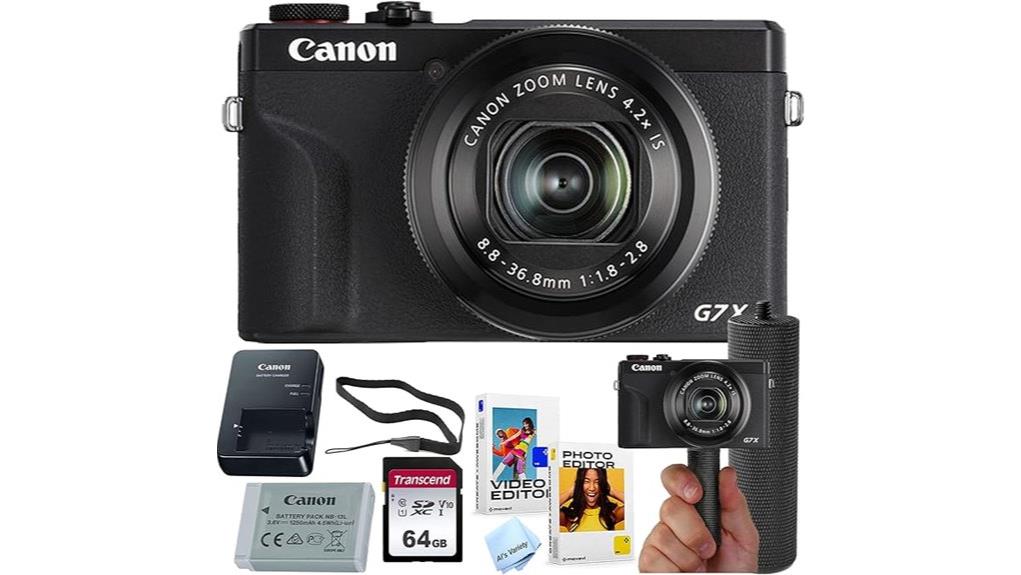
You’ll get a pocketable vlogging camera that pairs a 1‑inch 20MP stacked sensor with a fast f/1.8–2.8 lens and clean 4K/30p HDMI output, so low‑light shots and shallow depth of field look good for a compact unit. Stabilization helps handheld walking shots but won’t replace a gimbal, and autofocus is fine in good light yet can struggle with fast shifts. Battery life is modest, so bring spares — keep going to see detailed performance and tradeoffs. this canon powershot g10 image quality review highlights the camera's ability to produce vibrant colors and sharp details, especially in well-lit conditions. Users will appreciate how the dynamic range captures subtle tonal variations, making it a great choice for landscape and portrait photography alike. Even when facing challenging lighting situations, the g10 maintains a solid performance that many budget options struggle to achieve.
Some Key Takeaways
- 1-inch stacked 20MP sensor with DIGIC 8 delivers excellent JPEGs and usable low-light performance up to about ISO 1600.
- Fast f/1.8–2.8 lens offers shallow depth of field and good low-light capability in a pocketable body.
- 4K/30p and 1080/120p recording, clean HDMI output, and mic input make it strong for vlogging and streaming.
- Compact ergonomics, built-in OIS, and flip-up touchscreen suit run-and-gun creators, though grip fatigue can occur on long shoots.
- Limited autofocus in low contrast/fast action, no interchangeable lenses, and modest battery life are main trade-offs.
Which Features Make the Canon PowerShot G7 X Mark III Stand Out for Vloggers?
If you’re vlogging, the G7 X Mark III lines up key features that prioritize portability and image quality: a 1.0-inch stacked 20MP CMOS sensor with DIGIC 8 delivers low‑noise footage in tight spaces, the fast f/1.8–2.8 lens gives shallow depth of field and better low‑light performance, and the 4K/30p plus 1080p/120p recording modes (with clean HDMI and external mic support) cover high‑resolution interview and slow‑motion needs while enabling live streaming directly to YouTube. You’ll appreciate the flip up touchscreen for framing self-shots, compact body for run-and-gun, and reliable optical stabilization. Battery life and single AF point are trade-offs. Consider pairing it with an on-camera LED light to brighten low-light scenes and improve skin tones for vlogs on-camera LED lights.
Real-World Image and Video Performance: Low Light, Stabilization, and Autofocus
Having covered why the G7 X Mark III appeals to vloggers, let's look at how it actually performs when light levels drop, when you’re handheld, and when you need reliable focus. You’ll find the 1‑inch sensor and f/1.8–2.8 lens deliver usable low light images to about ISO 1600; beyond that noise and detail loss become evident. Optical Image Stabilizer compensates for handheld motion in walking shots but won’t replace gimbal-level steadiness. Autofocus is quick in good light; continuous AF and single-point AF are adequate. However, focus tracking struggles with fast subject shifts and low-contrast scenes, requiring manual intervention. Regular sensor cleaning helps maintain image quality and reduce artifacts from dust on the sensor.
Handling, Battery Life, and Connectivity for Live Streaming and On-the-Go Use
While compact and pocketable, the G7 X Mark III's ergonomics and power setup demand compromises for prolonged handheld use and streaming. You’ll find the small grip and lightweight body manageable for short vlogs, but fatigue appears during extended shoots; add the supplied stabilizing pistol grip to improve handling. Battery endurance is modest with the NB-13L (1250mAh); expect to swap batteries or use external power for long sessions. Connectivity is well-targeted: clean HDMI, mic input, Wi‑Fi/Bluetooth and YouTube live support enable portable streaming workflows. Workflow notes: bring extra batteries, a charger, and a reliable USB/HDMI cable for continuous operation. For shooting sessions that run long, consider carrying spare camera batteries compatible with the NB-13L to avoid downtime.
Strengths and Limitations Compared to Mirrorless Vlog Cameras in the Same Price Range
Because the G7 X Mark III packs a 1-inch stacked sensor, fast f/1.8–2.8 lens, and clean HDMI into a pocketable body, it gives you image quality and streaming-ready features that rival many mirrorless vlog cameras at the same price—especially for run-and-gun creators who prioritize portability and low-light framing. You get excellent JPEGs, usable 4K, and simple live-streaming without extra rigs. Sensor tradeoffs include smaller dynamic range and shallower depth control versus APS-C/ Micro Four Thirds bodies. Lens adaptability is limited—no interchangeable optics—so you sacrifice focal flexibility and specialized glass for compact convenience and integrated stabilization. This makes the G7 X Mark III a strong choice for photographers rediscovering the joy of compact point-and-shoot photography who want capable performance in a small package.
Final Verdict: Who Should Buy the G7 X Mark III (and Recommended Alternatives)
If you prioritize pocketable image quality, straightforward live streaming, and low-light performance in a single, easy-to-use package, the G7 X Mark III is a strong choice—especially for vloggers and content creators who need a compact camera that just works without extra gear. You’ll get a 1-inch stacked sensor, DIGIC 8 processing, 4K/30p, clean HDMI, and tilt touchscreen for selfie framing. Buy it if you’re a budget vloggers or travel photographers seeking minimal kit, good low-light output, and streaming ease. Consider a mirrorless APS-C alternative for better autofocus, interchangeable lenses, and futureproofing. It’s also a great match for photographers who value mirrorless camera accessories that enhance portability and shooting convenience.
Some Questions Answered
Does It Support External SSD Recording via USB-C?
No — you can't record directly to an external SSD via USB-C. The camera supports external recording through clean HDMI output and has USB 2.0 for file transfer, but not direct external recording over USB. For external recording and broader storage compatibility, you’ll need an HDMI recorder connected to the camera’s HDMI Type A output. You’ll then capture video to the recorder’s SSD with proper format and power arrangements.
Can the Touchscreen Be Used for Autofocus Point Selection During Video?
Yes — you can use the touchscreen for touch AF and touch tracking during video. You’ll tap to set a focus point, drag for touch tracking, and use touchscreen gestures for quick framing adjustments. Face priority remains active for subjects detected, helping maintain focus on people. It’s responsive but not foolproof: tracking can lose fast, erratic motion and low-contrast scenes may force refocus hunting, so test in your shooting conditions.
Is There Weather Sealing or Dust Protection on the Body?
No — the body doesn’t offer weather resistance or internal sealing. You shouldn’t expect dust or moisture protection from this compact design. For casual outdoor use in dry conditions it’s fine, but you’ll need a protective case or rain cover for dusty, wet, or humid environments. If you require sealed construction, consider a camera explicitly rated for weather sealing or a rugged housing to safeguard electronics and lens assemblies.
Does It Accept ND Filters or Lens Adapters on the Front?
No — the front of the G7 X Mark III doesn’t natively accept standard screw-on ND filters or common lens adapters. You’ll need third-party filter adapters or custom hoods that clamp to the camera body or slide over the retractable lens; these can allow ND, CPL, or protective filters but add bulk and may limit zoom. Evaluate build fit and vignetting risks; opt for well-reviewed adapter kits for reliable alignment and minimal optical compromise.
Are Firmware Updates Easy to Install Without a Computer?
No — you’ll need a computer to install firmware updates for this camera. Updating requires downloading the firmware file to a formatted SD card from your PC, then using menu navigation to run the update in-camera. The process is straightforward but technical: make certain full battery life or use a charged spare to avoid failure, follow Canon’s instructions precisely, and don’t interrupt power during installation to prevent bricking.