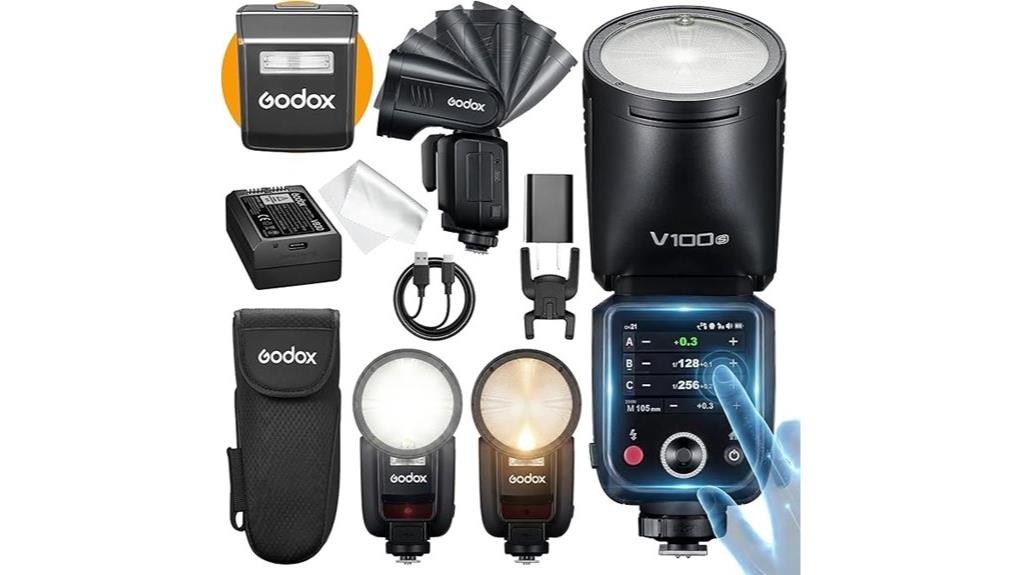
The GODOX V100 S gives you 100 Ws of compact, Sony‑compatible power with precise 1/1–1/256 steps, reliable TTL and HSS to 1/20000s, and a removable VB30 battery for fast recycling. Its touchscreen and SU‑1 sub‑flash add flexible control, while advanced cooling supports sustained bursts. Expect solid TTL on modern Sony bodies, occasional minor tweaks in extreme contrast, and no weather sealing. Keep going to see detailed performance, mounting notes, and firmware caveats.
Some Key Takeaways
- Compact 100 Ws Sony‑compatible flash offering accurate TTL and HSS up to 1/20000s for action and wide‑aperture work.
- Sony hot shoe integration provides reliable TTL/HSS handshakes and on‑camera control, with a touchscreen UI for precise adjustments.
- Single removable VB30 lithium battery enables fast recycle times and sustained bursts of 50–100 full‑power flashes with cooling.
- Minor limitations include no weather sealing, a 3300 K fixed color bias, and occasional tiny TTL compensation in extreme contrast.
- Recommended for Sony mirrorless shooters seeking portable TTL/HSS power; consider firmware updates and sync cables for multi‑flash setups.
What the GODOX V100 S Is and Who It’s For
Although it's compact enough to sit on your camera, the GODOX V100 S is a professional-grade on‑camera flash head designed for Sony hot‑shoe users who need high power and fast recycling in a small package. You’ll get compact portability without sacrificing output: a 100 Ws maximum, rapid recycle and advanced cooling let you shoot bursts reliably. It’s aimed at hybrid shooters and advanced amateurs who want portable power, and it’s forgiving for beginner photographers stepping up from pop-up flashes. Controls are direct and technical, the touchscreen aids workflow, and firmware updates keep compatibility current—efficient, precise, and purpose-built. Many photographers who care about exposure accuracy also learn to use light meters to make the most of portable flash systems.
Key Specs That Matter for Sony Shooters (Power, Modes, Battery, Mount)
Focus on the specs that directly affect your shooting: the V100 S delivers 100 Ws of peak output with 1/1–1/256 power steps, TTL and Manual control, HSS up to 1/20000s for action or wide-aperture work, and a Sony‑compatible hot shoe for full on‑camera integration. You get TTL, M, HSS and second‑curtain sync in a compact head with consistent output. A single removable VB30 lithium‑ion battery balances weight and battery life versus recycling needs; expect many cycles and up to ~50–100 full‑power bursts with advanced cooling. Mounting options are straightforward—Sony hot shoe compatibility guarantees reliable communication. Designed for mirrorless camera enthusiasts, it pairs well with mirrorless camera accessories tailored to compact systems.
Real‑World Performance: TTL, HSS, Recycling, and Full‑Power Burst
Having covered the V100 S’s core specs for Sony shooters, let’s look at how those translate in the field for TTL responsiveness, HSS behavior, recycle times, and sustained full‑power output. You’ll find TTL accuracy solid on modern Sony bodies—exposure errors uncommon across mixed lighting—though occasional minor compensation is useful with extreme contrast. HSS behavior is reliable up to very high shutter speeds, keeping catchlights controlled but reducing range. Recycling speed is fast at mid and low power; full power replenishes in a few seconds. Burst durability impresses: the cooling and battery let you sustain roughly 50–100 full‑power flashes. For photographers shooting portraits and events, pairing the unit with LED panels can help create consistent fill and color balance in mixed lighting.
Mounting, Compatibility, and Use With Global‑Shutter Sony Bodies
When you mount the GODOX V100 S on a Sony hot shoe, the physical fit and electrical contacts match Sony’s protocols so TTL and HSS work reliably across a wide range of bodies (a7/a9 series, a6000-series, a77/a99 lines, etc.). You get solid shoe compatibility with secure locking and consistent TTL handshakes. With global‑shutter bodies (example: A9 III), prioritize HSS or manual mode to avoid partial exposures; shutter timing and flash pulse alignment matter. Use manual flash timing (ADJ) when precise sync is required. Overall, integration is robust; just update firmware and verify HSS timing for best results. For improved handling when using top-mounted flashes, consider adding a top handle to enhance grip and comfort.
Verdict: Pros, Cons, and When to Buy the V100 S (Alternatives and Firmware Notes)
Because it balances portable power, modern controls, and solid Sony hot‑shoe compatibility, the GODOX V100 S is a strong choice for on‑camera flash work where TTL and HSS matter. You get 100 Ws output, a responsive touchscreen, SU‑1 detachable sub‑flash, and robust cooling for many consecutive full‑power pops. Pros: compact power, accurate TTL/HSS, clean UI, growing accessory ecosystem. Cons: no weather sealing, 3300 K fixed color temp bias, firmware updates needed for edge-case camera support. Buy if you need compact, reliable TTL/HSS on Sony bodies; check the firmware roadmap and consider alternatives for studio power. Consider adding a dedicated sync cable or optical slave when integrating the V100 S into multi‑flash setups for consistent triggering with flash sync and off‑camera configurations.
Some Questions Answered
Does the V100 S Support Multi-Flash Optical Slave Triggering?
Yes — you can use the V100 S as an optical slave for multi-flash setups. You’ll get optical sync triggering and assignable slave groups, and TTL pass through works when paired properly with a master flash or camera commander. Sync speed and HSS behavior remain important: use HSS for global-shutter cameras or fast shutter work, and test flash timing to avoid misfires. Update firmware for best reliability.
Can the SU-1 Sub-Flash Be Used Independently Off-Camera?
Yes — you can use the SU-1 sub-flash for independent firing off-camera. It supports independent firing via RF/wireless linkage when detached, and you can configure sync modes (TTL, HSS, M) from the master unit or on the SU-1 depending on connection. You’ll get reduced power and simplified controls versus the full V100 S, so evaluate exposure flexibility and recycle time for your multi-flash setups before relying on it as a primary off-camera head.
Is There a Dedicated Mobile App for Remote Control or Firmware Updates?
Yes — you can use a mobile app for control and firmware updates. You’ll pair the V100 S via its wireless RF/Bluetooth interface, then use Godox’s mobile app to adjust settings, trigger the flash remotely, and apply Firmware updates when available. You’ll want to keep firmware current for reliability and HSS/global-shutter compatibility. The app’s interface is technical but straightforward; it expedites setup, backup, and occasional firmware maintenance.
What Is the Battery Charging Time and Can It Charge In-Camera?
You’ll get about 1.5–2 hours to fully charge the VB30 battery; with fast charge you can shorten top-up times markedly. You can’t charge the battery in-camera, but you can power the flash via USB C charging when mounted if your camera supports power passthrough or external USB power delivery. That lets you run or top up the unit on location, though in-camera charging of the removable battery isn’t supported.
Are There Color Gel Accessories or Modifiers Included or Sold Separately?
No, the V100 S doesn’t include color gelsets or large modifiers; you’ll get the SU-1 sub‑flash, VB30 battery, USB cable, case and cloth. You can buy color gelsets and small filters separately from Godox or third‑party vendors. For softening and shaping light you’ll want dedicated modifiers; look for compatible modifier pouches and magnetic adapters designed for the V100 series to keep gels, grids and diffusers organized and securely mounted.