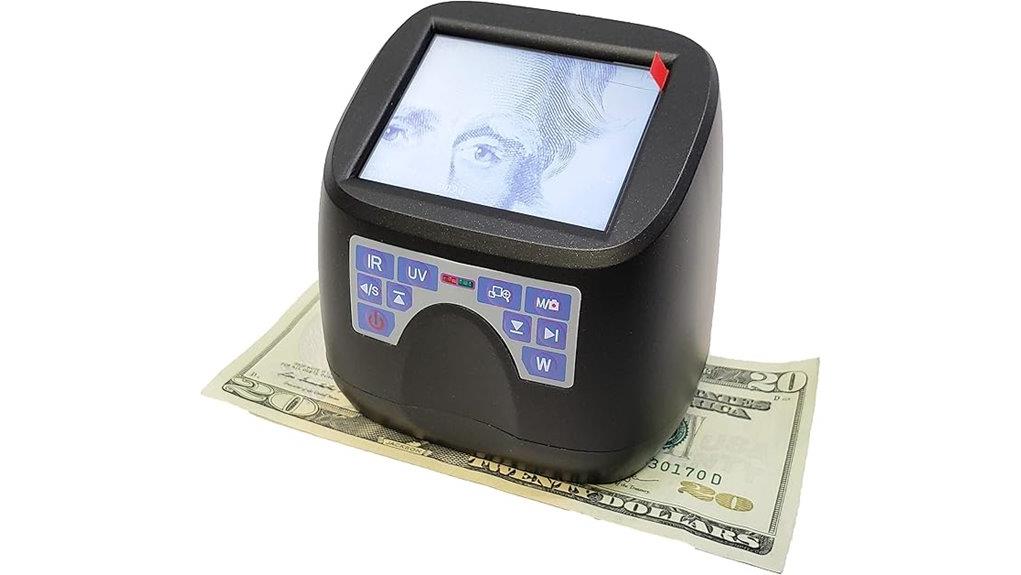
You’ll find the Vividia FM-130 useful if you need a portable, all‑in‑one inspection camera for on‑site document and trace‑evidence screening. It packs a 5 MP sensor, 1080p video, 1x/15x/30x digital zoom, manual focus, and a field of view suitable for handwriting and small-item work. Integrated UVA/UVC, IR and laser LEDs expand contrast options, and HDMI/USB/SD outputs simplify documentation. It’s not a lab microscope, but it’s a capable screening tool — keep going to see practical tests and limits.
Some Key Takeaways
- Portable all-in-one inspection camera ideal for field investigators and archivists needing UV/IR/visible illumination and HDMI output.
- Integrated 5 MP CMOS sensor captures 5 MP stills and up to 1080p video with digital zoom stages (1x, 15x, 30x).
- Built-in UV (365 nm) fluorescence, IR (850/940 nm), and laser options reveal inks, undertexts, and latent prints.
- 3-inch LCD plus HDMI output, SD/USB recording, and ergonomic manual focus support on-site documentation and chain-of-custody files.
- Limited by battery life, non-waterproof housing, and not a substitute for lab-grade microscopes—best for screening and preliminary analysis.
Quick Verdict: Who the Vividia FM-130 Is Best For
Who needs the Vividia FM-130? You do if you require a portable, all-in-one document inspection tool. You’ll find it suits field investigators who need rapid, on-scene imaging and archival conservators who require non-destructive lighting options. You’ll appreciate integrated LEDs across UV, IR and visible bands, HDMI output for clear review, and a compact form that travels easily. It won’t replace lab-grade microscopes, but it gives reliable, repeatable captures for screening, documentation, and preliminary analysis. Choose it when mobility, versatile illumination, and straightforward image capture matter more than highest-magnification optics. For photographers transporting delicate gear, pairing the FM-130 with a sturdy Pelican case helps ensure it arrives protected and ready to use.
How the FM-130’s Optics and Imaging Perform (Resolution, Zoom, Focus, FOV)
Examine the FM-130’s imaging and you’ll find a pragmatic balance between portability and usable resolution: its integrated 5 MP CMOS sensor delivers effective 5 MP stills and up to 1080p video, providing sufficient detail for screening and documentation but not for microscopy-grade analysis. You’ll get high resolution capture for forensic overview tasks, with digital zoom stages (1x, 15x, 30x) and screen-dependent magnification roughly 3x–60x that trade field of view (21×15 mm down to 10×7 mm) for detail. Manual focus control gives precise plane selection, while ISO 100–3200 handles varied scenes without optical zoom artifacts. The FM-130’s compact design pairs well with a sturdy tripod for stable, shake-free imaging, especially during high magnification shots that require precise framing and exposure control (tripod stability).
Lighting and Spectral Modes Explained: UVA, UVC, IR, Laser, and White Light
Because lighting determines what you can detect and how you document it, the FM-130’s multiple spectral modes give you targeted options for different forensic tasks. You’ll use UV/blue and white LEDs to reveal latent prints, inks, and biological residues; UVA fluorescence highlights many substrates under 365 nm. For surface sterilization or microbial work consider UVC 254 nm but respect UVC safety—avoid exposure and use shielding. IR imaging at 850/940 nm penetrates inks and shows undertexts; contrast improves with the camera’s IR long-pass filter. Laser illumination (980 nm anti-Stokes) offers narrow, intense excitation for specific materials. For studio and field photographers looking to enhance scene control, consider choosing purpose-built LED panels designed for photographic use.
Usability, Display, Recording, and Connectivity in the Field
Although compact, the FM-130 puts practical display, recording, and connectivity choices in your hands so you can document scenes without extra adapters or computers. You see a sharp 3-inch TFT-LCD viewfinder or route 1080p HDMI to a monitor; USB 2.0 and SD storage let you export MP4, AVI, or JPEG files quickly. Controls favor ergonomic handling with logical buttons and manual focus for precise framing. Expect roughly two hours battery life per charge; recharge via USB or AC. Recording options and fixed-aperture exposure modes are straightforward, minimizing setup time and maintaining chain-of-custody-ready files in the field. Many photographers pair on-camera LED lights like those sold for camera use to brighten subjects and improve image quality in low light on-camera LED lights.
Real-World Tests and Use Cases: Document, Latent Print, and Evidence Imaging
When you put the FM-130 to work on real evidence, its array of lighting options and IR/UV filters lets you capture documents, latent prints, and trace evidence with methodical consistency and minimal setup. You’ll document handwriting, obliterations, and watermarks using visible and UV bands, then switch to IR or oblique lighting to reveal indented writing and impressions. Latent prints respond to alternating wavelengths and oblique contrast; trace fibers and residues appear under high-magnification and cross lighting. Maintain chain of custody with timestamped JPEG/MP4 exports. Note environmental limitations—battery life, ambient light, and non-waterproof housing affect field deployment. For fieldwork involving water exposure, consider using a dedicated waterproof housing to protect your camera and accessories.
Some Questions Answered
Does the FM-130 Support Live Streaming Over USB to Forensic Software?
Yes — you can use USB streaming for Live capture from the FM-130, but it functions as a USB video device (UVC-like) and may require compatible forensic software that accepts standard webcam inputs. You’ll connect via USB and select the FM-130 as the video source; resolution and frame rate are limited to its 1080p/USB capabilities. Test compatibility and drivers first, as some forensic suites need specific capture device support.
Can the Device Geotag Photos or Embed Metadata Automatically?
No — it doesn’t natively perform GPS tagging or automatic metadata embedding. You’ll capture JPEG/MP4 files with basic EXIF (camera settings) but no embedded geolocation. To add GPS tagging or richer metadata embedding, you’ll need to export files via USB/SD to a PC or forensic tool that supports geotagging and metadata editing. Use chain-of-custody procedures to document edits and preserve original files for evidentiary integrity.
Is There Encryption or Password Protection for Stored Files?
No — the device doesn’t offer built‑in password protection or encryption availability for stored files. You’ll rely on external measures: remove the SD/internal storage and secure it, copy files to an encrypted drive, or use PC software to add passwords and encrypt archives. For forensic chain‑of‑custody, you’ll need to implement your own file‑level encryption and access controls since the camera stores JPEG/MP4 files unprotected internally.
Are Replacement Batteries or an External Power Option Available?
No, you won’t find user-replaceable batteries; the unit uses an integrated rechargeable battery with about two hours runtime. Battery options are limited to internal replacement via service or authorized repair. For longer sessions you can use External power: the device charges and runs via AC or USB power, so you can operate continuously when plugged into AC adapter or a USB power source or laptop, bypassing battery runtime constraints.
Does the FM-130 Meet Any Forensic Imaging Calibration Standards?
No — the FM-130 doesn't inherently meet formal forensic accreditation standards. You should implement your own calibration procedures, documenting sensor performance, scale accuracy, color/IR response, and image metadata workflows. For admissible evidence you’ll need routine checks, calibrated reference targets, traceable measurements, and written SOPs aligned with your lab’s accreditation body. Treat the unit as a tool requiring validated procedures rather than a pre-accredited forensic imaging system.