You’ll get staggering 88MP stills and flexible 8K/4320p capture in a compact Micro Four Thirds body, but you’ll trade raw telephoto reach, continuous 8K runtime, and CFexpress-style workflow simplicity for travel-ready versatility. The fixed dual-lens layout and 6-axis electronic anti-shake favor framing flexibility and handheld detail, while hybrid AF and practical controls suit content creators. Expect heavy AVI files, heat limits on long takes, and a need for gimbals and fast cards—more specifics follow.
Some Key Takeaways
- Delivers 88MP stills with exceptional detail, though 12-bit JPEG compression can cause artifacts in complex textures.
- Offers 8K/4320p at 24/30/60 fps, but massive AVI files and heat/duty-cycle limits strain workflow and recording duration.
- Dual fixed Micro Four Thirds lenses prioritize overlapping fields and synthetic focal extension over distinct prime-grade optics.
- 6-axis electronic stabilization aids handheld shooting but crops frame and can introduce processing artifacts; gimbals recommended.
- Hybrid AF with face/eye detection and customizable tracking performs well for travel, content creation, and studio use.
What This Review Covers and Who the XNSIAKXA DC226 Is For
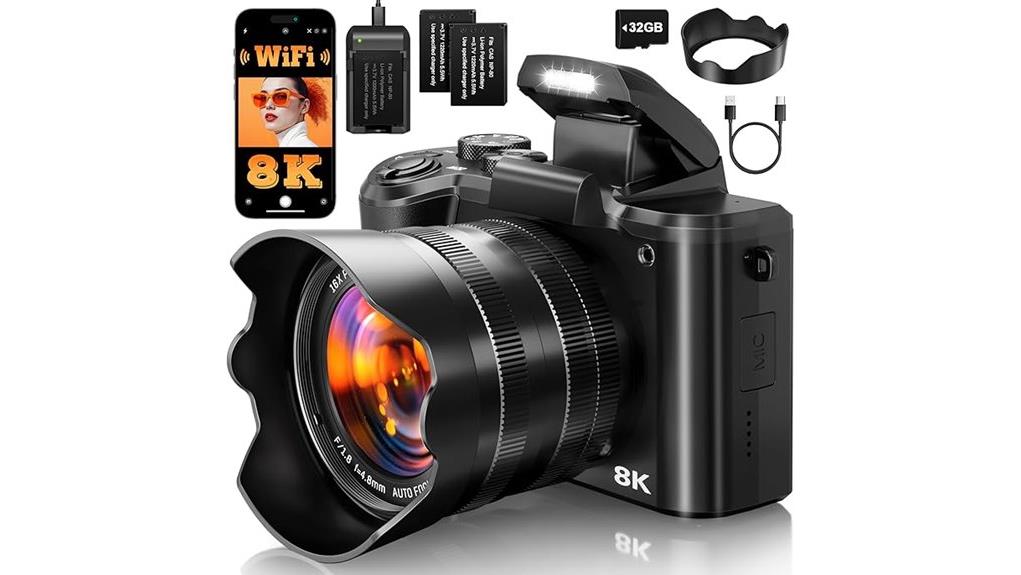
Although it targets enthusiasts who want high-resolution stills and modern connectivity, this review focuses on the DC226’s real-world imaging performance, handling, and feature trade-offs. You'll get clear assessments of ergonomics, control logic, battery life, stabilization effectiveness, autofocus behavior, and connectivity workflow rather than marketing specs. I’ll assess how the Micro Four Thirds mount, fixed dual-lens layout, 6-axis electronic anti-shake, and hybrid AF serve practical use cases like travel, content creation, and studio reference shots. This review defines the target audience — hybrid shooters wanting compact gear with high-res output and app-driven transfer — and what compromises you should expect. We also recommend a few pieces of essential mirrorless gear for owners who want to get the most from the DC226’s capabilities, such as compact stabilizers and fast SD cards.
Real-World 8K Photo and Video Performance: Resolution, Frame Rates, and File Handling
Having set expectations about who the DC226 suits, let’s examine how its 88 MP stills and 8K/4320p video behave in real use. You’ll get exceptional detail from 88 MP JPEGs, but 12-bit JPEG and heavy compression can introduce compression artifacts in complex textures; shoot conservatively for critical prints. 8K at 24/30/60 fps delivers flexible framing, yet massive AVI files create workflow bottlenecks—storage, transfer, and edit hardware must scale. Color grading is workable but limited by JPEG/AVI color headroom; plan shots accordingly. Continuous 8K recording stresses heat management; expect duty-cycle limits during extended takes. For best color consistency across devices, consider proper calibration with a color calibration workflow to ensure accurate results.
Lens, Zoom, and Stabilization: How the Dual-Lens Micro Four Thirds Setup Behaves
When you pair the DC226’s dual-lens Micro Four Thirds compatibility with its fixed front/rear configuration, expect a versatile but pragmatic optical experience: the system gives you the depth and crop-friendly sensor geometry of MFT while relying on a primarily digital reach (16× digital zoom, optical zoom listed as 0.1) that emphasises framing flexibility over true telephoto resolution. You’ll notice dual lens behavior prioritises overlapping fields for wider coverage and synthetic focal-length extension rather than distinct prime quality. The 6-axis electronic anti-shake reduces blur for handheld video and stills, but stabilization tradeoffs include cropped framing, processing artifacts, and limited benefit at extreme digital zoom. For shooters using gimbal setups, pairing the camera with a compatible stabilizer can maximize smooth footage and minimize handheld shake, especially during motion shots with active pans and tilts — see gimbal stabilizers for compatible options.
Autofocus, Shooting Modes, and Creative Controls You’ll Actually Use
If you want reliable subject tracking without digging through menus, the DC226’s hybrid AF system (phase + contrast) and face/eye detection deliver fast, practical focusing across AF-A, AF-C and AF-S modes, with continuous shooting supported for action sequences. You’ll tweak autofocus customization via a concise submenu: adjust sensitivity, tracking speed, and single-point bias to match subjects. Shooting modes cover Auto, Program, Manual, Scene, Timelapse and Slow Motion, plus Filter and Creative modes that add real value. Use creative bracketing for exposure or color shifts in successive frames, then pick the best result or merge in post for expanded control. For extended shooting projects and hands-off operation, pair the camera with an intervalometer remote to automate capture and precise timing for sequences like timelapses or astrophotography using remote control functionality.
Ergonomics, Display, Controls, and Connectivity for Everyday Shooting
Because the DC226 balances compact Micro Four Thirds compatibility with tactile controls, you’ll find it comfortable to handle for long shoots and quick adjustments. The 360° rotary dial and well-spaced buttons give a logical button layout so you can change modes without fumbling. The 3.2-inch IPS/LCD touchscreen offers reliable touchscreen responsiveness for menu navigation and focus pulls, while an electronic viewfinder provides stable framing in bright conditions. Connectivity is practical: built-in Wi‑Fi with iSmart DV2 app, HDMI and USB outputs, and webcam support let you offload, livestream, or tether fast. Controls are precise, ergonomic, and workflow-oriented. Consider pairing the DC226 with a suitable tripod head to maximize stability and composition control during shoots, especially when using pan-and-tilt movements.
Battery Life, Storage, Reliability, and Long-Term Support
Typically, you’ll get dependable runtime from the DC226’s dual lithium-ion setup: two 27.6 g batteries ship in the box and deliver extended shooting without frequent swaps, and you can top them off on the included charging stand while continuing to shoot. Expect solid battery longevity for mixed stills and 8K recording, though heavy 60 fps use shortens cycles. The 32 GB card is limiting; storage expansion via SD/TF cards or external USB/HDMI drives is straightforward. Reliability is pragmatic: not water resistant but built for everyday use, backed by 12-month warranty coverage and seven-year spare parts availability. For photographers looking to maximize shooting time, choosing the right camera battery can make a noticeable difference.
Final Verdict: Strengths, Trade-Offs, and Who Should Buy the DC226
While the DC226 packs impressive specs—88 MP stills, 8K/60p video, Micro Four Thirds compatibility, and dual batteries—its strengths and trade-offs make it a specialist tool rather than an all‑purpose camera. You’ll get high-resolution capture, robust codec support, and compact ergonomics ideal for content creators prioritizing detail. Trade-offs include a small 1/4‑inch sensor with potential sensor latency in high‑frame scenarios, modest optical zoom, and reliance on lithium‑ion battery chemistry that limits peak runtime despite two batteries. Buy it if you need dense resolution, portability, and 8K capability; skip it if low‑light or long continuous recording are priorities. For serious photographers working with high data rates, consider using CFexpress memory cards to ensure reliable sustained write performance.
Some Questions Answered
Does the Camera Support RAW Image Capture?
No — it doesn’t support raw capture; it outputs fine 12-bit JPEGs only. You’ll rely on those JPEGs for highlight and shadow recovery, so dynamic range is constrained by in-camera processing and the 12-bit pipeline. If you need full raw flexibility for heavy grading or maximum dynamic range retention, you’ll want a different body or an external recorder/workflow that can better preserve sensor latitude.
Can I Use Third-Party Micro Four Thirds Lenses Without Issues?
Yes—you can use third-party Micro Four Thirds lenses, but check Lens compatibility and adapter quality. The native Micro Four Thirds mount accepts most MFT optics directly; Mount adapters let you fit other mounts but may affect autofocus, metadata, and stabilization. You’ll get mechanical fit and manual control reliably, yet expect potential limitations with hybrid AF speed, continuous tracking, and electronic aperture communication depending on lens, adapter firmware, and camera compatibility.
Is There Built-In GPS or Geotagging Support?
No — there’s no built‑in GPS or native geotagging sensor. You can use GPS options via your smartphone: connect over Wi‑Fi and transfer images with location metadata from the phone or sync timestamps to a GPS logger, then batch geotag on a computer. Be mindful of Location privacy: disable auto‑sharing, strip EXIF GPS data before uploading, or use app settings to control when and how location info is embedded in files.
Are Firmware Updates User-Installable Over Wi‑Fi?
Yes — you can install firmware updates over Wi‑Fi using the iSmart DV2 app; you’ll download and apply updates from your phone to the camera. You should verify firmware security before installing, checking signatures or release notes. Follow the manufacturer’s update schedule to avoid interruptions and keep backups of settings. If automatic push updates appear, you’ll want to confirm integrity and schedule installs during downtime to prevent power loss.
What Accessories Are Compatible With the Charging Stand?
The charging stand supports the included lithium‑ion batteries, USB power banks, and USB‑PD chargers; it’s also compatible with third‑party USB cables and HDMI pass‑through adapters for simultaneous charging and data. You can mount small accessories using the accessory mounting points—cold shoe adapters, mini tripods, and wireless charging receivers can attach if physically compatible. You’ll want to confirm connector polarity and power specs before using wireless charging or non‑OEM accessories for safe operation.