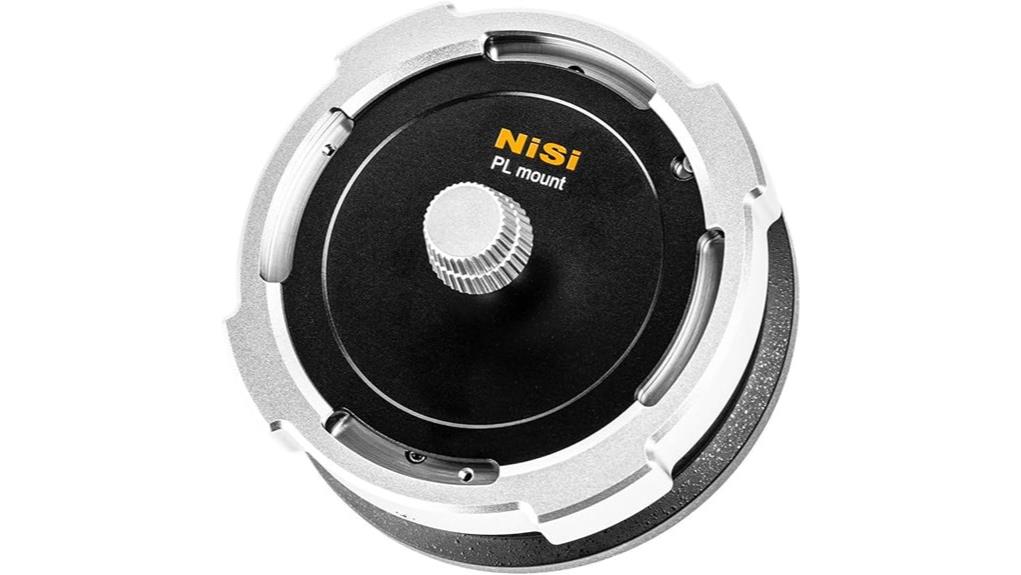
You’ll get rock‑steady mechanical adaptation of Arri Maxi PL cinema glass to Fujifilm GFX bodies with the NiSi Athena PL‑GFX adapter. It preserves flange distance and infinity focus, uses stainless‑steel construction with precise machining, and stays robust without adding glass so image character isn’t compromised. Focus is manual but accurate, and internal flocking cuts stray reflections on high‑DR sensors. It’s a practical, rugged choice if you accept manual control — keep going and you’ll find compatibility tips and caveats.
Some Key Takeaways
- Enables mounting Arri Maxi PL cinema lenses (including NiSi Athena PL) on Fujifilm GFX bodies while preserving flange distance and infinity focus.
- All‑metal stainless steel construction offers precise fit, no play, and durable handling for heavy cinema glass.
- No optical elements added, so image character is retained; CA or softness depends on the lens, not adapter.
- Manual‑focus only with internal flocking reduces flare and preserves contrast on high‑DR GFX sensors.
- Verify rear element clearance, frame coverage, and tripod/rig interference before critical shoots.
Quick Verdict : Is the NiSi Athena PL-GFX Adapter Worth It?
While the NiSi Athena PL‑GFX adapter can’t transform a stills body into a cinema camera, it does let you mount ARRI Maxi PL lenses — including NiSi’s Athena PL glass — on Fujifilm GFX bodies with reliable mechanical precision and minimal optical compromise. You’ll get solid mount compatibility, stainless steel durability, and precise flange distance that preserves infinity focus. Expect manual focus control, internal flocking to avoid flare, and consistent lens calibration potential without added optical glass. If you value rugged, accurate adaptation for cinema lenses on GFX bodies, this adapter delivers practical, no-nonsense performance at a fair tradeoff. This makes it a useful choice for photographers who need durable protection and transport solutions for their adapted setups, especially when using Pelican cases for gear storage and travel.
Which Cameras and PL Lenses Work Best With This Adapter?
Because the NiSi Athena PL‑GFX adapter was engineered specifically for Arri Maxi PL to Fujifilm GFX mounts, you'll get the best results pairing it with GFX bodies—GFX 100S, GFX 100, GFX 50S II, and GFX 50R—where its precise flange distance and stainless‑steel build preserve infinity focus and mechanical stability for heavy cinema glass. You should mount NiSi Athena PL lenses and other PL‑mount Cinema Lenses for consistent coverage, flat field performance, and reliable manual focus. It accommodates most PL glass without optical compromise; just verify rear element clearance and frame coverage on your Fujifilm GFX before critical shoots. For best compatibility and creative results, consider how different lens mount adapters affect flange focal distance and handling.
Build Quality and Mechanical Fit: Stainless Steel, Weight, and Handling
Boasting a stainless‑steel construction with a spray‑coated exterior, the NiSi Athena PL‑GFX feels solid in your hands and resists slips when you’re mounting heavy cinema lenses. You’ll notice stainless durability in the finish and junctions—no wobble, no play—thanks to precise machining. At listed ~164 g (marketing cites 186 g), it’s lightweight yet reassuringly weighted for balanced handling on GFX bodies. The mount locks cleanly and releases without fuss; tolerances keep lenses aligned mechanically. Grip ergonomics are thoughtful: knurled edges and the coating aid one‑handed operation. It’s a rugged, no-nonsense adapter built for production use. Essential camera body caps are useful accessories for protecting your mount and sensor when the adapter or lens is not attached, especially for photographers who value durability and convenience in the field and studio camera body caps.
Real-World Performance: Focus, Alignment, Reflections, and Image Quality
Having established how the adapter feels and locks onto the body, let’s look at how it performs optically on set. You’ll find focus accuracy consistent across NiSi Athena PL lenses thanks to precise flange distance and machining; manual focus feels direct and repeatable. Alignment holds solidly during movement, so infinity lock remains trustworthy. Internal flocking reduces stray reflections, preserving contrast on high-DR GFX sensors. You may still see lens-dependent chromatic aberration at high-contrast edges, but the adapter itself introduces no notable color fringing or softening. Overall, image quality keeps the character of your PL glass without adding optical compromise. NiSi also offers a range of lens calibration tools and accessories that complement the adapter for photographers seeking precise focus and alignment.
Buying Checklist: Warranty, Compatibility Gotchas, and Who Should Buy
When you’re deciding if the NiSi Athena PL-GFX adapter fits your kit, focus first on compatibility and coverage: it reliably mounts ARRI Maxi PL lenses (including NiSi Athena PL glass) to Fujifilm GFX bodies, but double-check that your specific GFX model is supported and that any exotic PL lenses won’t foul the camera body or accessories. Check for compatibility nuances like rear element clearance and tripod/rig interference. Note warranty limitations: 12-month limited warranty needs proof of purchase and excludes water or impact damage. Buy if you shoot cinema lenses on GFX bodies, value precise alignment, and accept manual focus only. Consider pairing with an L-bracket for added stability and tripod compatibility.
Some Questions Answered
Does the Adapter Support Electronic Aperture Control or Lens Metadata Passthrough?
No — it doesn’t support electronic aperture control or metadata passthrough. You’ll encounter electronic limitations because the adapter is a purely mechanical PL-to-GFX mount, so aperture and lens metadata won’t communicate with the camera body. You’ll need to set aperture and focus manually on the lens, and you won’t get lens-recorded EXIF or electronic stabilization data. That’s intentional for robust, cinema-style mechanical operation.
Can I Use This Adapter With a Tripod-Mounted Powered Lens Support?
Yes — you can use this adapter with a tripod-mounted powered support. You’ll mount the PL lens to the stainless-steel adapter, secure the adapter+lens assembly to your tripod or rig, and attach your powered support to the lens foot or support point. The adapter’s rugged build and precise alignment suit tripod compatibility and powered support, but you shouldn’t rely on the adapter itself as the primary load-bearing support—use proper lens support gear.
Is the Adapter Compatible With Cinema Matte Boxes or Follow Focus Gears?
Yes — you’ll find mechanical compatibility with matte boxes and follow focus gears depends on the PL lens you mount, not the adapter itself. The stainless steel adapter keeps standard Arri Maxi PL dimensions and flange spacing, so matte box sizing follows your lens front diameter and matte box rail positions. Follow focus gears attach to the lens focus ring; the adapter won’t interfere unless you use exotic lens offsets or nonstandard gear placement.
Are There Known Issues Mounting on Weather-Sealed GFX Bodies in Rain?
No — there aren’t specific reports of the adapter causing weather sealing failures, but you shouldn’t assume full protection; the adapter itself isn’t water resistant and can allow water ingress at the mount interface. You’ll want to avoid heavy rain, use additional sealing measures (gaskets, tape, rain covers), and remove the adapter for prolonged wet work. Be cautious: water ingress can harm both adapter and GFX body despite the camera’s weather sealing.
Does the Adapter Affect Autofocus Performance on Adapted Lenses?
No — you won’t get autofocus from PL lenses on the adapter, so you won't measure autofocus latency or tracking accuracy because autofocus isn't supported. You’ll rely on manual focus and focus peaking or magnification on the GFX body. That means no AF-driven latency or tracking errors, but you’ll also lose AF convenience; plan for deliberate focusing techniques in fast-moving or run-and-gun situations.