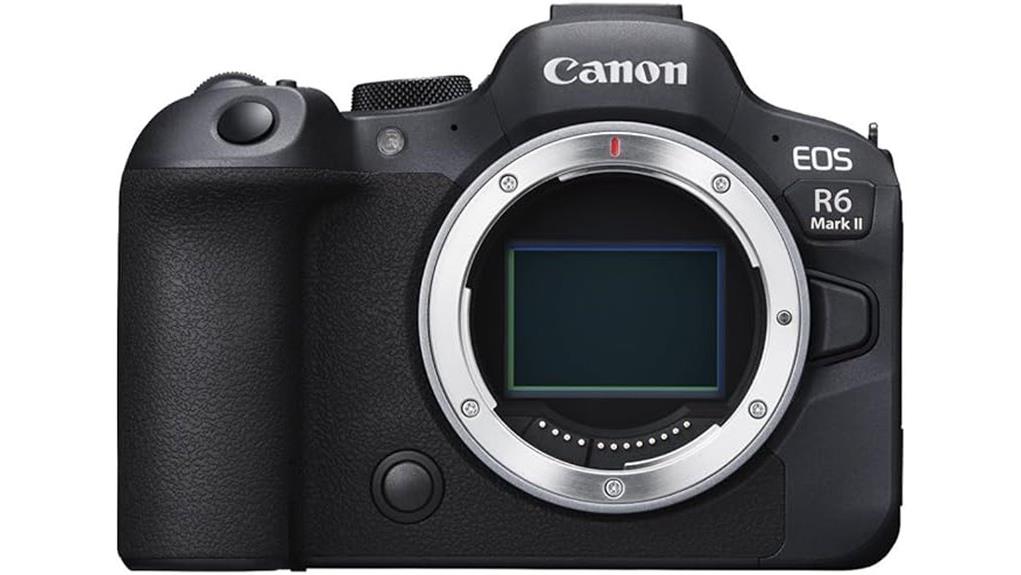
The Canon EOS R6 Mark II gives you pro-grade speed, reliable Dual Pixel AF, and strong low‑light imaging in a weather‑sealed body. Its 24.2MP sensor with DIGIC X balances detail and noise control, while phase‑detect AF, head/eye/animal detection, and predictable tracking suit sports, wildlife, and documentary work. You’ll get up to 40 fps electronic bursts, 6K oversampled 4K/60, and 180 fps Full HD slow motion, though large files and heat require workflow planning — more specifics follow.
Some Key Takeaways
- Excellent hybrid performance: fast Dual Pixel CMOS AF, 40 fps electronic bursts, and reliable subject tracking for photo and video.
- Image quality: 24.2MP full‑frame sensor with DIGIC X, strong dynamic range, and usable high‑ISO results.
- Video features: 6K oversampled to 4K/60, 180 fps Full HD, and well‑controlled rolling shutter for extended recording.
- Build and handling: robust, weather‑sealed body with refined ergonomics, vari‑angle screen, and responsive EVF.
- Recommended accessories: bring extra batteries, fast cards, and protective transport (e.g., Pelican case) for serious use.
Verdict: Is the Canon EOS R6 Mark II Worth Buying?
Although it's not a budget body, the EOS R6 Mark II delivers a compelling mix of speed, autofocus, and video features that make it worth buying for many enthusiasts and pros. You get robust build quality with weather sealing that suits demanding use. Ergonomics and handling are refined: controls fall to hand, the vari-angle screen aids framing, and the EVF is responsive. Battery life is improved versus predecessors but you'll still want spares for extended shoots. The lens ecosystem is mature, offering native RF glass and EF compatibility via adapter. Overall, it balances performance, usability, and system depth for serious users. For photographers who enjoy mirrorless systems, pairing it with essential accessories like extra batteries and protective gear enhances long-term use and versatility, especially within the mirrorless camera ecosystem.
Image Quality and Low‑Light Performance (24.2MP Sensor + DIGIC X)
Having covered handling and feature balance, let’s examine how the 24.2MP full‑frame sensor paired with the DIGIC X processor shapes image quality and low‑light performance. You’ll get strong tonal range and controlled noise at elevated ISOs; DIGIC X’s algorithms produce efficient noise reduction without overly smearing fine structure. High ISO handling is class-leading for this resolution, delivering usable files well beyond native ISO settings. Detail retention remains notable: the 24.2MP resolves fine textures while keeping file sizes manageable. Dynamic range is solid for shadow recovery, and in-camera processing preserves microcontrast, giving clean, detailed results under challenging light. Proper monitor calibration with true-to-life color ensures what you see on-screen accurately reflects the camera’s output.
Autofocus and Subject Tracking in Real Shooting (Dual Pixel AF, Head/Eye/Animal)
When you rely on the Canon EOS R6 Mark II in real shooting scenarios, its Dual Pixel CMOS AF and advanced detection algorithms deliver fast, consistent subject acquisition across stills and video. You’ll notice reliable Real World performance: the Dual Pixel AF maps phase-detect across the frame, reducing hunting and maintaining lock during panning. Head Tracking and Animal Eye detection work concurrently with body/face recognition, letting you prioritize eyes or heads for humans and animals. The system also auto-selects subject types (people, small animals, vehicles), accelerating acquisition. In practice you get predictable, low-latency tracking for documentary, sports, and wildlife use. For run-and-gun shoots where audio matters, pairing a shotgun mic can help capture clearer on-camera sound with less ambient noise and better dialogue intelligibility, especially when using directional pickup techniques.
Speed, Video, and Recording Limits (40 Fps, 6k→4k60, 180FPS, Continuous Record)
Reliable autofocus lays the groundwork for high-speed capture, and the R6 Mark II follows through with extensive burst and video performance to match fast-moving subjects. You’ll shoot up to 40 fps with the electronic shutter at 20MP; buffer management is robust, but sustained JPEG+RAW bursts depend on card speed and write performance. Video options include 6K oversampled to uncropped 4K/60 and 180 fps Full HD for slow motion; rolling shutter is well controlled thanks to the DIGIC X. Heat mitigation lets you record extended Full HD clips; plan file workflows for large 4K/6K files and fast transfer. External camera monitors can help with framing and exposure in long shoots external camera monitors.
Who Should Buy It and Best Alternatives at Each Price Point
Although the R6 Mark II targets hybrid shooters who need fast AF, high burst rates, and robust video, it's best suited for serious enthusiasts and pros who prioritize low-light performance, in-body stabilization, and versatile codec options. You’ll choose it if you require reliable Dual Pixel AF, 40 fps electronic bursts, and 6K-oversampled 4K60 for run-and-gun work or portrait lighting control in mixed studios. For tighter budgets, consider the Canon R8 with budget pairing for lenses; for advanced sports or wildlife, the Sony A7 IV or Nikon Z6 II offer similar AF and ergonomics. For video-first pros, the Panasonic S5 II is a strong alternative. Protect your gear during travel with Pelican cases designed for photographers and their equipment.
Some Questions Answered
Does It Support In-Body Image Stabilization (IBIS) for All Lenses?
Yes — the camera provides in-body image stabilization, but stabilization compatibility varies by lens. You’ll get IBIS with most RF lenses and many adapted EF lenses, though effectiveness depends on lens optical design and firmware. With adapters, lens adapter behavior influences stabilization modes and the degree of correction; some legacy or third-party lenses may lack full coordinated control. Check specific lens/adapter firmware updates for peak IBIS performance and mode pairing.
What Battery Model and How Many Shots per Charge in Real Use?
You use the LP‑E6NH battery; battery performance in real world shots typically ranges around 300–500 images per charge depending on usage. With heavy AF, IBIS, and frequent LCD/EVF use you'll see ~300–350 shots. With conservative settings and power-saving you can reach ~450–500 shots. Video, burst shooting, and wireless transfers reduce endurance more dramatically; plan for spare batteries or external USB‑C power for extended shoots.
Is There Dual Card Slot Configuration and Card Type Supported?
Yes — you get Dual Slots supporting CFexpress Type B and SD UHS-II Card Types. You’ll be able to configure recording across slots (relay, backup, RAW/JPEG separation) and assign stills/video to specific cards. CFexpress Type B gives highest write speeds for high-bitrate 6K/4K video and fast continuous shooting; SD UHS-II provides broad compatibility and lower cost. Slots operate independently, letting you optimize performance, redundancy, or workflow.
Can It Tether to a Computer for Live Streaming or Webcam Use?
Yes — you can tether the camera to a computer for live streaming or webcam use. You’ll use USB tethering via the USB Type-C port; Canon’s Webcam Utility supports clean HDMI-less output and simplified plug‑and‑play webcam functionality. For higher quality or capture-card workflows you can use the camera’s clean HDMI output. Configure USB tethering/Webcam Utility in camera menus, enable clean output, and set resolution/frame rate to match your streaming app.
What Weather Sealing Level and Recommended Care for Harsh Conditions?
The camera features thorough weather sealing—dust and moisture resistance at body and mount interfaces—but it’s not fully waterproof. For harsh conditions, follow care tips: avoid prolonged exposure to heavy rain or immersion, use a rain cover or waterproof housing, dry and clean seals after use, remove battery/memory cards before storage, and service seals periodically. You should also store it in a dry, desiccant-filled case to prevent corrosion and mold.