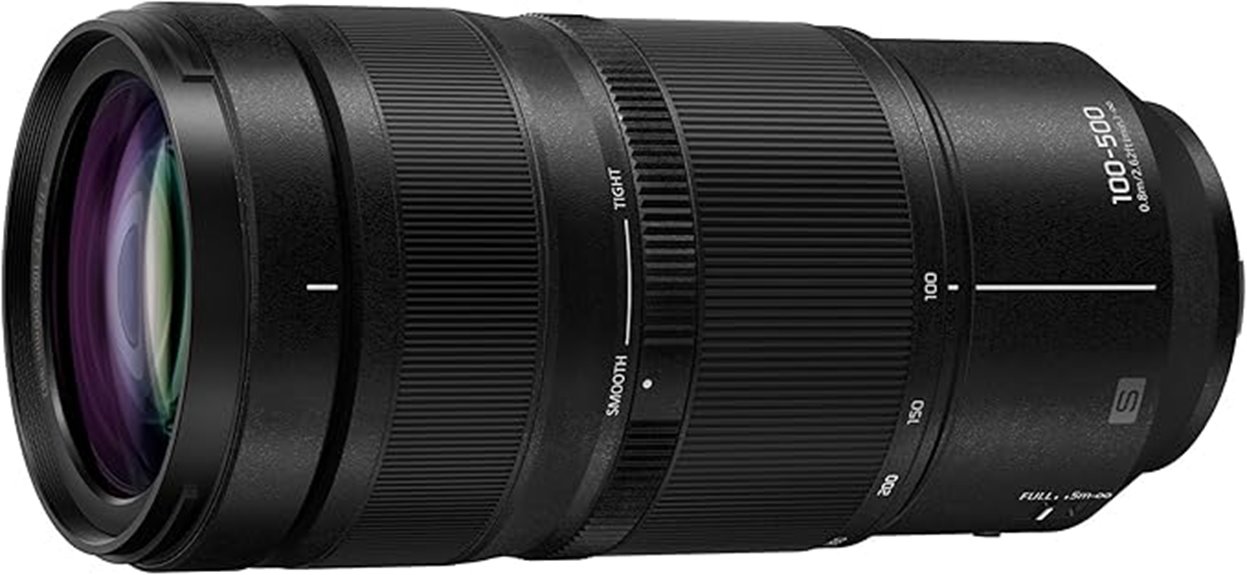
You’ll find the Panasonic LUMIX S 100–500mm S‑R100500 gives you consistent high resolution across 100–500mm with teleconverter support (1.4×/2.0×) and Dual I.S. for up to ~7 stops of stabilization. It preserves edge sharpness and microcontrast for wildlife and sports, offers 0.8 m close focus and 0.36× magnification for creative framing, and uses fast Dual Phase Linear Motors for reliable tracking. It’s robust, weather‑sealed, and there’s more on handling, video use, and alternatives if you keep exploring.
Some Key Takeaways
- Exceptional 100–500mm sharpness with edge-to-edge resolution across the zoom range, suitable for wildlife and sports.
- 0.8 m close-focus and 0.36× magnification deliver near-macro capability and creative subject isolation.
- Dual Phase Linear Motor AF and reduced latency enable fast, reliable long-range tracking.
- Dual I.S. plus lens stabilization yields up to 7 stops correction and strong video-friendly performance.
- Robust, weather-sealed build with tripod collar, programmable controls, and teleconverter support (1.4×/2.0×).
Optical Performance and Reach: 100–500mm Range, Teleconverter Support, and Image Quality
Although the lens spans a broad 100–500mm ultra-telephoto range, you'll find its resolution remains consistently high from end to end, delivering sharp detail whether you're framing vehicles at 100mm or distant birds at 500mm. You’ll appreciate the reach versatility when comparing this zoom to shorter telephotos; its optical formula preserves edge-to-edge sharpness while teleconverters (1.4×, 2.0×) extend reach with minimal degradation. Contrast rendition stays strong across apertures, maintaining microcontrast and tonal separation even at long focal lengths. Objectively, the lens balances magnification and clarity, offering technical performance suitable for wildlife and sports without notable compromises. This makes it a strong choice for photographers focused on telephoto lenses and long-reach shooting scenarios.
Close-Focus, Magnification, and Creative Framing: 0.8 M Closest Focus and 0.36× Max Magnification
With a closest focusing distance of 0.8 m at 100mm and a maximum magnification of 0.36× at the telephoto end, this zoom gives you near-macro capability uncommon in ultra-telephoto optics. You can render flower portraits with substantial subject isolation at the wide end, while longer focal lengths let you achieve tight, compressed framing without approaching skittish subjects. Compared to typical 100–400mm designs, the S 100–500mm yields higher magnification and more working distance. Creative foreshortening becomes practical for abstract compositions and insect detail when you exploit the 0.8 m close focus and 0.36× telephoto magnification. Using versatile accessories like a 5-in-1 reflector helps you control light and shape catchlights to enhance these close-focus compositions.
Autofocus, Stabilization, and Video Features: Dual Phase Linear Motor, Dual I.S., and Video-Friendly Controls
Having explored how the 0.8 m close-focus and 0.36× magnification expand compositional options, consider how the lens’ drive and stabilization systems keep those frames sharp and usable. You get Dual Phase Linear Motor actuation that prioritizes speed and positional accuracy, reducing autofocus latency versus traditional motors; tracking is smooth at long focal lengths. Dual I.S. pairs lens stabilization with compatible camera bodies to deliver up to 7 stops of correction, improving handheld utility and panning stability. Video-oriented features—suppressed focus breathing and micro-step aperture—combine with stabilization compatibility to produce stable, repeatable results for hybrid shooters. This makes the lens a strong match for photographers and videographers who use gimbal stabilizers to master smooth shots.
Build, Handling, and Environmental Resistance: Size, Weight, Controls, Weather Sealing, and Freeze Resistance
Because it's built for demanding fieldwork, the LUMIX S 100–500mm combines robust construction with ergonomic controls that keep handling predictable across long shoots. You’ll notice ergonomic balance that favors body-mounted use; weight is substantial but distributed so handheld bursts are feasible. The Tripod collar is sturdy, offering smooth rotation and clear detents for portrait work. Control layout is logical: zoom, focus, and limiter rings are tactile and reachable, with programmable switches placed for quick access. Manual override on AF gives immediate focus control without mode switching. Sealing resists dust and splash, and operation endures down to −10°C. For transporting and protecting the lens in challenging conditions, consider a hard shell camera case designed for protecting your gear.
Who Should Buy It and Alternatives: Ideal Users, Real-World Pros/Cons, and Comparable Lenses
While not aimed at casual shooters, the LUMIX S 100–500mm will suit photographers who need an all-in-one ultra-tele zoom that balances reach, resolution, and durability. You’ll appreciate it for wildlife portraits and as a travel telephoto when you need versatility without multiple primes. Pros: exceptional sharpness across 100–500mm, strong AF, Dual I.S., teleconverter support, weather/freeze resistance. Cons: size/weight versus short teleps, cost, and less aperture speed than super-tele primes in low light. Alternatives: Canon RF 100-500mm, Sony FE 100-400mm + 1.4x/2.0x, or dedicated 600/800mm primes if ultimate reach or speed matters. Teleconverters can further extend reach and are a practical option for many users who want more focal length without buying larger primes; learn how to make the most of them.
Some Questions Answered
Is This Lens Compatible With Non-Lumix Camera Bodies Without an Adapter?
No — you can't mount it on non‑Lumix bodies without an adapter. Native L‑mount third party compatibility is limited to cameras supporting L‑mount; otherwise you'll need a mechanical/electronic adapter that preserves electronic contacts for AF, stabilization and aperture control. Compared to native mounts, adapters can introduce latency or limit functionality; choose one rated for full electronic communication and compatible flange distance to maintain autofocus speed and Dual I.S. performance.
What Is the Filter Thread Size and Availability of Drop-In Filters?
The lens uses a 95mm filter size and doesn’t offer a rear drop-in slot, so drop in availability is none. You’ll screw standard 95mm filters onto the front; compared to some super-telephotos with rear drop-in holders for large ND/IR filters, this design limits convenience for specialty filters. If you need drop-in availability, you’ll have to use camera-mounted solutions or seek third-party adapters or converters that provide rear filter options.
Does the Lens Include Image Stabilization When Used Handheld With Teleconverters?
Yes — you’ll retain optical stabilization when using teleconverters. The lens’ Dual I.S. system remains effective with Panasonic’s 1.4x and 2.0x teleconverter compatibility, so you get up to the stated stabilization benefit handheld, though effective stops may vary with increased focal length. Comparatively, stabilization performance can diminish slightly versus native focal lengths, so you’ll rely more on faster shutter speeds or support at extreme reach for consistently sharp results.
How Heavy Is the Lens When Mounted on a Gimbal or Drone for Aerial Use?
You’ll find the lens weighs about 1.7 kg (approx. 3.75 lb), so for gimbal or drone use you must account for gimbal balance and payload limits. Compared with common cinema primes it’s heavier, demanding sturdy gimbals and drones rated above that mass plus camera. You’ll need to offset balance with counterweights or adjustable mounts, and verify your drone’s payload limits, flight time reduction, and flight dynamics before operational use.
Are There Recommended Tripod Collars or Third-Party Mounting Rings?
Yes — you can use both Manfrotto collar-style mounts and Arca Swiss clamp-compatible rings. You’ll want a dedicated tripod collar with tripod foot that accepts an Arca Swiss clamp for fastest workflow; many third-party collars (e.g., Kirk, Really Right Stuff-style dovetail adapters) offer better ergonomics and lighter weight than OEM. Compare torque ratings, locking stability, and weather sealing. Make sure collar alignment matches lens balance point for gimbal or tripod usage.