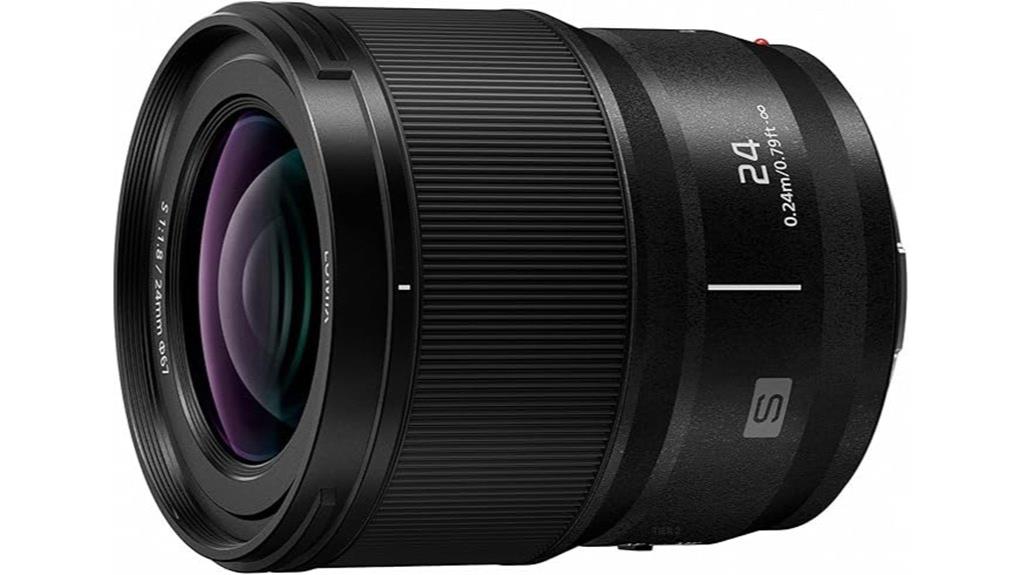
You’ll find the Panasonic LUMIX S S‑S24 24mm F1.8 a compact, well‑sealed wide prime that favors usable f/1.8 low‑light performance, quick AF, and cinematic aperture control over absolute corner‑corner resolution. It delivers strong center sharpness, predictable corner falloff wide open, creamy bokeh with mild onion‑ringing, and decent coma for night work. Handling is solid with damped focus, minimal breathing and good weather resistance. Keep going and you’ll uncover full test results and comparison notes.
Some Key Takeaways
- Excellent everyday wide-angle for landscapes, street, and environmental portraits with bright f/1.8 for low-light use and background separation.
- Strong center sharpness; stop to f/4–f/5.6 for optimal overall acutance and improved edge performance.
- Compact, weather‑sealed metal build with damped focus ring and reliable handling for all‑day travel and street shooting.
- Fast, consistent AF on L‑Mount bodies and smooth, cinematic aperture for video, with minimal focus breathing.
- Pleasing creamy bokeh with mild onion‑ringing; decent coma control but not ideal for demanding astrophotography.
What This 24mm F1.8 Lens Is Best For
Frequently, you'll reach for the 24mm F1.8 when you need a wide, sharp perspective that still lets you isolate subjects; its 24mm field frames landscapes, environmental portraits, and street scenes with natural context while the bright F1.8 aperture gives usable low-light performance and attractive background separation. You’ll rely on its compact build and weather sealing for all-day street photography and travel duty, exploiting 0.24m close focus for contextual detail. Autofocus speed and minimal breathing suit run‑and‑gun video. You can apply astrophotography fundamentals for wide‑field nightscapes, but expect compromises versus ultra‑fast or specialized astro optics. Perfect Tripods offers accessories that help stabilize and protect gear for extended shoots, especially when shooting handheld or on uneven terrain with tripods and supports.
Real‑World Image Quality: Sharpness, Bokeh, and Distortion
You’ll notice the lens balances impressive center sharpness with a predictable falloff toward the edges, especially wide open at f/1.8 where corner resolution lags behind the frame center; stopping to f/4–f/5.6 tightens detail across the frame and yields its best overall acutance. You’ll get pleasing, creamy bokeh for foreground separation given the f/1.8 aperture, though out‑of‑focus highlights show mild onion‑ringing and some nervousness near busy edges. Edge sharpness improves markedly when stopped down, but expect slight field curvature. Coma control is decent for astrophotography—stars show limited tailing—but it's not class‑leading. For studio and portrait work, pairing this lens with silver reflectors can help sculpt highlights and improve subject separation by redirecting light precisely silver reflectors.
Autofocus, Video Behavior, and Handling on an L‑Mount Body
Typically, the S-S24 locks quickly and reliably on an L‑Mount body, with Panasonic’s high‑speed AF delivering consistent results for stills and video. You’ll notice excellent autofocus consistency in static and moderately moving subjects, though tracking can hesitate on erratic motion. Video benefits from a cinematic aperture mechanism with smooth, step-free changes, but you must manage subtle focus breathing during long pulls—it's minimal but detectable on critical clips. Handling is positive: controls are well-placed and weight aids handheld stabilization when paired with in-body stabilization, yet you’ll prefer gimbals for demanding run-and-gun work to eliminate residual micro‑jitter. For those shooting with external displays, pairing the lens with an external camera monitor can help with precise focus and composition, especially when using external camera monitors for critical framing.
Build, Weather Sealing, Size, and Field Usability
Although compact, the S‑S24 feels solid in hand and keeps weight down for long shoots, with a precisely machined metal mount and a damped focus ring that resist play. You’ll appreciate the robust construction: alloy barrel, tight tolerances, and responsive control rings. Panasonic rates the lens as dust-, splash-, and freeze-resistant, so weather resistance isn't marketing copy — it holds up in adverse conditions though you shouldn't test it aggressively. Size favors pocket portability for larger coat pockets or light packs, but not true pants-pocket carry. Field usability is strong: quick handling, minimal balance shift on L‑Mount bodies, predictable ergonomics. Owners of lighting gear cases often prefer compact lenses for easier case organization and transport.
Who Should Buy It and How It Compares to Alternatives
With its compact, weather-sealed build and agile handling, the S‑S24 targets shooters who need a reliable wide‑angle everyday tool rather than a specialist optic. You’ll appreciate its F1.8 for low‑light travel photographers and street shooters who require shallow depth and quick AF; event shooters gain dependable coverage and smooth aperture for video. It’s less ideal for astrophotographers demanding extreme coma control and ultra-high magnification. Versus heavier 24mm primes, the S‑S24 trades absolute edge resolution for portability and consistent S Series ergonomics. If you value system integration, low weight, and versatile performance, it’s a strong, pragmatic choice. For photographers shopping accessories, consider compatible tripod heads designed for mirrorless systems that help maximize stability with lightweight lenses tripod heads.
Some Questions Answered
Does This Lens Include Image Stabilization?
No — it doesn't include in-body or optical stabilization. You’ll rely on camera-body stabilization (IBIS) or faster shutter speeds to control blur; that affects stabilization and optical performance in low-light stills and handheld video. The lens’s optical performance, autofocus speed, and smooth aperture help mitigate absence of stabilization, but you shouldn’t expect the same handheld low-light results as with a stabilized optic. Plan for tripod or IBIS when needed.
Is There a Lens Hood or Case Included in the Box?
No — the box doesn't include a plastic hood or lens pouch as standard; you get the lens body only. You’ll need to buy a compatible plastic hood separately to control flare and protect the front element, and a lens pouch if you want soft-case protection for transport. That omission is disappointing given the lens’s weather-resistant build and video-focused features; you’ll spend extra for the basic accessories most competitors bundle.
Can It Be Used on APS-C L‑Mount Bodies and What's the Crop Equivalent?
Yes — you can mount it on APS-C L‑mount bodies; expect APS C performance differences and focal equivalence effects. You’ll get a narrower field of view equivalent to about 36mm on full‑frame (24mm × 1.5 crop). Optical characteristics shift: depth of field deepens, background separation and bokeh reduce, and effective reach increases. Autofocus, aperture control, and weather sealing remain, but image rendering and composition behavior will reflect the APS‑C conversion.
How Compatible Is It With Autofocus Adapters for Other Mounts?
You’ll find adapter compatibility limited but functional: high‑quality AF adapters (e.g., Metabones, Sigma) often provide autofocus on many mirrorless bodies, yet performance varies by camera brand and firmware. Expect reliable focus confirmation on supported pairings, but slower or inconsistent AF, occasional hunting, and loss of advanced features on unsupported systems. Test your specific camera+adapter combo; firmware updates can improve behavior, but native L‑Mount remains ideal.
What Warranty and Service Options Does Panasonic Offer for This Lens?
You get a standard limited warranty covering defects in materials and workmanship for a specified period from purchase; check your region for exact terms and duration. You can purchase extended service plans where available to prolong coverage and add accidental-damage options. Be aware warranty excludes normal wear, misuse, and unauthorized repairs. Register promptly, keep proof of purchase, and confirm local service center availability to avoid unexpected downtime or repair costs.