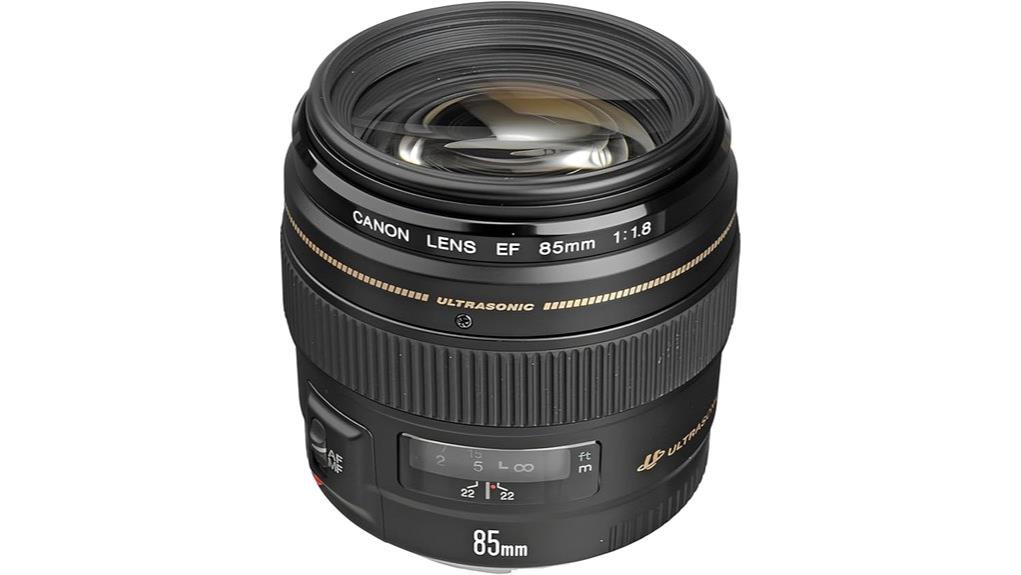
If you want a compact, affordable portrait lens that delivers consistently sharp images, the Canon EF 85mm f/1.8 USM is a strong choice. You’ll get excellent center resolution wide open, smooth nine‑blade bokeh, fast quiet USM autofocus with manual override, and a non‑rotating front for filters. It’s lightweight, well built, and great for weddings, studio headshots, and low‑light handheld work. Keep going and you’ll find technical test results, handling notes, and alternatives.
Some Key Takeaways
- Compact, affordable 85mm f/1.8 USM delivers consistently sharp center resolution and pleasing subject isolation for portraiture.
- Fast, quiet USM autofocus with manual override and short focus throw enables reliable, responsive focusing in real-world shooting.
- Nine-blade diaphragm produces smooth bokeh with minimal onion-ring artifacts and strong background separation wide open.
- Lightweight, well-built design with rear-focusing, non-rotating front element suits filters; lacks image stabilization and robust weather sealing.
- Excellent value for beginner-to-enthusiast photographers seeking pro-level sharpness per dollar; consider pricier f/1.4–f/1.2 alternatives for shallower depth.
Commercial Investigation: Quick Verdict and Who Should Buy the Canon EF 85MM F/1.8 USM
If you need a compact, affordable portrait lens that delivers consistently sharp images and pleasing background blur, the Canon EF 85mm f/1.8 USM is a strong choice. You’ll get a lightweight, well-built prime that suits budget portraiture and studio-to-field work without complex controls. It’s a beginner friendly option: autofocus is fast, manual override is available, and the 85mm framing is intuitive for head-and-shoulders shots. Expect reliable performance on Canon DSLRs, simple handling, and straightforward maintenance. Buy it if you want high image quality per dollar and a no-frills telephoto prime for portrait assignments. The lens is especially well-suited for photographers focused on portrait camera lenses and achieving flattering subject isolation.
Portrait and Low‑Light Performance: Sharpness, Bokeh, and F/1.8 Usability
Having established its value as an affordable, easy-to-use portrait prime, let's examine how the 85mm f/1.8 performs where it matters most for portraits and low-light work: resolution across the frame, out-of-focus rendering, and practical use at its maximum aperture. You’ll find sharpness testing shows strong center resolution wide open with slight corner falloff that improves by f/2.8–f/4. The nine-blade diaphragm and optical design yield smooth bokeh character with minimal onion-ring artifacts and pleasing highlight roll-off. Low light usability is excellent for handheld portraits under modest portrait lighting, letting you maintain subject separation and usable shutter speeds at f/1.8. Accessories like quality telephoto lens hoods and teleconverter compatibility can extend creative options for wildlife and sports photography.
Autofocus, Handling, and Build: USM, Rear‑Focusing Behavior, and Ergonomics
While the 85mm f/1.8 uses Canon's ultrasonic motor (USM) and a rear-focusing design to deliver fast, quiet focus acquisition, you'll notice consistent, repeatable AF performance across typical portrait distances. You benefit from efficient USM mechanics that minimize hunting and allow quick lock-on. Rear focusing keeps the front element stationary, preserving filter orientation and improving balance during AF. Manual override is direct and predictable; focus throw is short, suitable for rapid adjustments but less refined for micro‑precise racks. Build is lightweight yet solid; the focus ring and mount offer reliable tolerance. Grip comfort is good for extended handheld use. This lens is a popular choice among portrait shooters who often pair it with a tripod for added stability and composition control.
Real‑World Sample Scenarios: Wedding, Studio, Street, and Travel Use Cases
After noting the lens's fast, repeatable USM autofocus and stable rear‑focusing behavior, consider how those traits map to real shooting situations. You’ll capture wedding details—rings, lace, and candid expressions—without focus hunting, keeping f/1.8 bokeh isolating subjects from clutter. In studio work you’ll exploit sharpness and consistent focus shift for tight headshots, relying on nine‑blade diaphragm for smooth highlights. For street candids the fixed 85mm enforces distance, letting you compress scenes and preserve subject separation while remaining discreet. Travel use favors compact size and reliable AF for environmental portraits; lack of IS means using higher shutter speeds or stabilized bodies. The piece also ties these observations back to broader tips for mastering zoom lenses and choosing the right optics for each scenario, highlighting lens selection as a key consideration.
Value and Alternatives: Price, Pros/Cons, and Comparable Lenses to Consider
Because it delivers pro-level sharpness, fast USM focusing, and pleasing bokeh at a modest weight and price, the Canon EF 85mm f/1.8 USM represents strong value for portrait and event shooters who don't need image stabilization. You’ll find new units affordable; the used market often lowers entry cost further, making it a high-performance choice for budget-conscious buyers. Pros: compact, sharp wide-open, reliable USM, non-rotating front for effects filters. Cons: no IS, limited weather sealing. Consider alternatives: Canon EF 85mm f/1.2L II (premium), Sigma 85mm f/1.4 (artistic), Tamron 85mm f/1.8 (value). Account for accessory costs. This lens is a great match for DSLR enthusiasts and photographers seeking essential portrait gear for DSLR cameras.
Some Questions Answered
Does the Front Element Accept Polarizers or Rotating Filters Safely?
Yes — the front element doesn’t rotate, so you can mount polarizers without worry. You’ll avoid polarizer safety issues tied to filter rotation because the lens’s front group is fixed during focusing. For compatibility concerns, use a 58 mm circular polarizer sized to the lens; it won’t interfere with the rear focusing USM. Note this doesn’t address vignetting with thick filters at wide apertures, so choose low-profile filters if needed.
Is This Lens Compatible With Canon APS-C Bodies for Portrait Use?
Yes — you can use this lens on APS C bodies for portraits. The 85mm behaves like roughly 136mm after the 1.6x crop factor, giving tighter headshots and longer reach. You’ll get strong subject isolation and attractive bokeh at f/1.8, though working distance increases. It’s optically sharp and autofocus-capable on EF-mount APS C DSLRs, making it a practical, technical choice for portrait work.
Can the Lens Be Used Reliably With Third‑Party Teleconverters?
You can use third‑party teleconverters, but expect reduced teleconverter performance and potential AF accuracy loss. The 85mm f/1.8’s rear focusing USM handles one‑stop or two‑stop extenders mechanically, yet effective aperture narrows (e.g., f/2.8 or f/4), diminishing light and contrast. Autofocus may become slower or hunt, and some bodies may lose AF altogether at smaller effective apertures. Test combinations before critical shoots and prioritize high‑quality converters.
Does the Lens Have Any Electronic Contacts for Firmware Updates?
No — the lens doesn't have firmware contacts, so it has no update capability built into the mount. You’ll rely on the camera body’s firmware and the lens’ fixed electronics for AF and EXIF communication. There’s no separate contact set for lens microcode revision or user updates; any required corrections would come from Canon service or a replaced unit. You can still use it normally with compatible EF bodies without firmware updates.
Is There a Known Serial‑Number Range With Manufacturing Defects?
No — there’s no widely documented serial number patterns tied to defects. You should monitor manufacturer bulletins and forum reports for production anomalies, but Canon hasn’t published a recall or specific defective serial ranges for this model. If you suspect a fault, log the serial and contact Canon support or your retailer; they can check service records for production anomalies and advise repair, replacement, or warranty coverage based on that serial number.