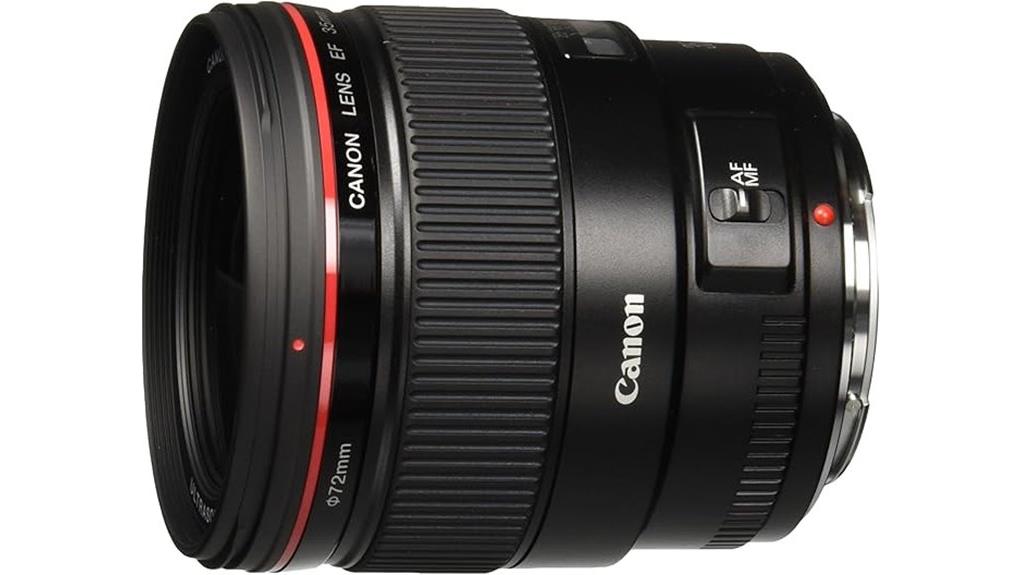
You’ll find the Canon EF 35mm f/1.4L USM a legacy wide-angle prime that still earns attention for low-light work and sharp, contrasty results. It gives strong center and good edge resolution straight at f/1.4, tightens to peak sharpness by f/4–f/5.6, and renders smooth bokeh with mild onion‑ring texture. Fast ring‑type USM and a floating focus reduce breathing and keep focus reliable. It’s a professional-feel lens with practical tradeoffs—more details follow if you want them.
Some Key Takeaways
- Outstanding f/1.4 low-light performance with strong center and edge sharpness even wide open.
- Fast, quiet ring-type USM and floating rear-focus system deliver reliable AF and reduced focus breathing.
- Smooth, characterful bokeh with mild onion-ring diaphragm texture and well-controlled chromatic aberration.
- Robust L-series build, ergonomic handling, and full-time manual focus suit professional run-and-gun use.
- Good value retention; compare used copies and newer lighter primes for cost-to-performance trade-offs.
Performance Summary and Verdict: Is the Canon EF 35MM F/1.4l USM Worth It?
Although it's a legacy design, the Canon EF 35mm f/1.4L USM still delivers performance that justifies consideration if you need a fast, sharp wide-angle prime; you’ll get excellent low-light capability, strong center and edge resolution even at f/1.4, and fast, quiet AF thanks to the ring-type USM and floating focus system. You’ll find build quality and consistent focus make it reliable for demanding assignments, aiding composition with subtle creative filters in-camera or post. Expect solid value retention due to L-series reputation. If you prioritize low-light speed, ergonomics, and proven optics, this lens remains a pragmatic purchase. Our store also offers a selection of compatible tripod heads to help stabilize wide-angle shots.
Optical Quality Breakdown: Sharpness, Bokeh, Distortion, and Coatings
When you judge the Canon EF 35mm f/1.4L USM on optical terms, it impresses with a combination of detailed center resolution, controlled edge performance, and characterful out-of-focus rendering; its aspherical element and subwavelength coating play key roles in keeping contrast high and suppressing flare. You’ll find peak sharpness near center at f/1.4 with measurable improvement stopped to f/4; edges tighten by f/5.6. Bokeh is smooth with mild onion-ring texture from the diaphragm. Lateral chromatic aberration is well controlled, longitudinal CA is minimal. The micro contrast coating flare control preserves color fidelity and shadow detail. This lens is a popular choice for photographers who favor wide-angle lenses when shooting landscapes and environmental portraits.
Autofocus, Handling, and Build: AF Speed, Manual Focus Feel, and L-Series Construction
Having covered optical character and bokeh, it's equally important to look at how the lens performs in use: the EF 35mm f/1.4L USM pairs its strong image quality with a fast, reliable ring-type USM that grabs focus swiftly and quietly on Canon EF bodies, making it well suited for run-and-gun shooting or low-light handheld work. You’ll notice precise AF mechanics: the ring USM drives a rear-focusing, floating system for minimal focus breathing and consistent rendering across distances. The full-time manual focus via the focus clutch feels damped and direct. L-series construction delivers solid, professional handling and durability. This makes the lens a great choice for enthusiasts looking to upgrade their setup with essential lens gear.
Real-World Use Cases and Sample Scenarios: Low Light, Street, Portrait, and Travel
Because the Canon EF 35mm f/1.4L USM gives you wide coverage with a very fast aperture, it excels in low-light, street, portrait, and travel scenarios where you need both speed and image quality. You’ll capture night portraits with subject separation and minimal ISO push, exploiting f/1.4 and the lens’ contrast. On streets, the focal length frames environmental storytelling while AF stays fast for candid moments. For travel you get compact handling and consistent sharpness across distances; the floating focus preserves edge detail. In low light action, the lens lets you maintain shutter speed without sacrificing depth or dynamic range. Consider adding a reflector for better fill and control of shadows when shooting portraits or street scenes with strong directional light Mastering Light.
Buying Considerations: Compatibility, Accessories, Price vs Alternatives, and Warranty
Although the EF 35mm f/1.4L USM fits any Canon EF-mount SLR or DSLR body, you should confirm full compatibility with your camera’s metering and autofocus features (especially on older or third‑party bodies) and consider whether you need an EF-to-EF‑S adapter for crop‑sensor use. Check mount compatibility to guarantee AF and exposure coupling work as expected. Evaluate accessory bundles: included hood, case, and warranty reduce initial cost. Compare price vs alternatives—newer lighter primes or used L-series copies—for performance-per-dollar. Note the one‑year limited warranty and typical retailer return windows when calculating total ownership risk and value. This retailer focuses on gear for mirrorless camera enthusiasts and related accessories.
Some Questions Answered
Does This Lens Vignette Heavily on Full-Frame Cameras at F/1.4?
No, it doesn't vignette heavily at f/1.4, but you will see noticeable corner shading and mild edge softness wide open. You’ll get strong central sharpness and contrast, while corners darken moderately on full-frame bodies. Stopping down to f/2–f/2.8 markedly reduces shading and improves edge acuity. For critical work in low light, be prepared to correct residual corner shading in RAW or during postprocessing to achieve uniform illumination.
Can It Be Used With APS-C Bodies Without Significant Crop Issues?
Yes — you can use it on APS‑C bodies without APS C coverage issues. You’ll get full frame image circle sampled by the smaller sensor, so there’s no vignetting crop problem inherent to the lens. Expect an effective focal length around 56mm on Canon APS‑C (1.6x crop), shifting its wide‑angle character toward standard/short‑telephoto. You’ll retain f/1.4 depth‑of‑field and low‑light performance, with slightly tighter framing and similar sharpness.
Is the Lens Suitable for Video Autofocus During Recording?
No — it isn’t ideal for reliable video autofocus during recording. You’ll get fast, quiet continuous AF from the ring-type USM, but many Canon bodies don’t support smooth servo AF with this lens, so focus hunting can occur. Also expect noticeable focus breathing and limited AF tracking compared with modern STM or dual-pixel systems. For controlled video, you’re better off using manual focus or a camera with proven continuous AF performance.
How Well Does the Lens Resist Flare in Backlit Portraits?
You’ll find the lens resists flare well in backlit portraits thanks to its lens coatings and aspherical element, offering effective ghosting control. You’ll still see some veiling at extreme sun positions, but contrast and color hold up impressively wide open. Use careful framing and the supplied hood to minimize stray light; stop down slightly if you need maximal microcontrast and to further suppress residual ghosts.
Are Third-Party 72MM Filters Compatible Without Vignetting?
Yes — most third-party 72mm filters will be compatible without vignetting on full-frame bodies, because the lens’s 72mm thread matches standard filters. You should check filter compatibility and coatings for optical quality; cheaper filters can introduce reflections or color cast. If you need different filter sizes, use high-quality thread adapters to avoid added spacing or mechanical vignetting. Test wide-aperture performance with the filter installed to confirm no edge darkening.