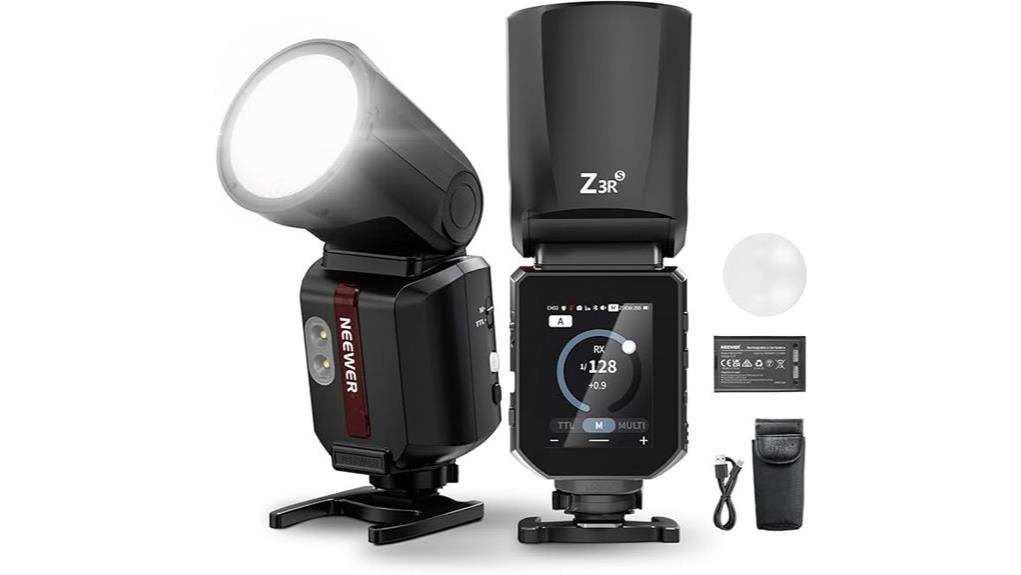
You’ll get a compact 100Ws flash that’s ideal if you shoot run‑and‑gun portraits, events, or are building a budget studio kit. It gives HSS to 1/8000s, stable ~6000K color, and fine 0.1‑EV power steps on a responsive touchscreen. The 3000mAh battery handles hundreds of pops but throttles with sustained full‑power bursts. Wireless works with common transmitters though firmware juggling can be needed. Keep going and you’ll find full test notes, pros, cons, and alternatives.
Some Key Takeaways
- Compact 100Ws flash offering HSS to 1/8000s, ideal for run-and-gun portraits and events.
- Stable 6000K color temperature across power range for consistent skin tones and easy mixing.
- 3000mAh battery with USB‑C charging gives hundreds of pops, ~1.7s recycle at mid/low power.
- Responsive touchscreen, 4 groups/32 channels, Q/Godox/X compatibility but may need firmware juggling.
- Great value under $200 with portable power, limited battery for heavy studio use and modest build.
Quick Verdict : Who Should Buy the NEEWER Z3R-S 100Ws
If you need a compact, high-speed flash that’s reliable for run-and-gun portraits, event work, or action photography, the NEEWER Z3R-S 100Ws is a strong choice. You’ll appreciate its balance of power and portability: Portrait photographers get crisp freeze-frame capability and stable color, Vlog creators gain consistent output for interviews, Event shooters benefit from rapid recycle and many full-power shots, and Studio beginners find a forgiving, easy-to-control head. It’s not for heavy studio banks or those needing system-exclusive features, but if you want a versatile, budget-friendly monolight that performs across scenarios, this fits well. It’s also a good option for photographers wanting to improve outdoor flash techniques with practical, portable gear for better lighting.
Core Specs and Controls You Need to Know (Power, CCT, Battery, Touchscreen)
When you’re choosing a compact monolight, the Z3R-S gives a clear set of performance parameters you can count on: 100Ws of power with HSS up to 1/8000s, a flash range from 1/256–1/1 in 0.1‑EV steps, and a stable 6000K color temperature for predictable white balance. You’ll appreciate precise output control, magnetic diffusion, and ten modeling lamp steps for previewing setups. The 3000mAh battery delivers solid battery life—hundreds of pops at mixed power—and USB-C charging adds convenience. The large color touchscreen makes adjustments fast; touchscreen responsiveness is good, letting you change power, mode, and groups without fumbling. The Z3R-S pairs well with compact LED panels for continuous lighting setups and workflow consistency, making it a practical choice for photographers who use both flash and LED panels.
Real-World Performance : Flash Output, Recycling, and Continuous Firing Tests
The specs give you a solid baseline, but real shooting tells the story—so I ran output, recycling, and burst tests to see how the Z3R-S performs under typical and demanding use. You get consistent flash consistency across most power steps; metered stops match the 0.1 EV increments and color holds close to 6000K. Recycling hits the quoted ~1.7s at mid and low power, while full-power bursts slow after about 80–100 pops as thermal throttling kicks in. Battery sag appears minimal until sustained full-power firing, where output dips slightly. Trigger latency felt negligible for handheld and studio work. This model is a great fit for photographers who use external triggers and flash modifiers with flash triggers to shape light in their setups.
Connectivity and Workflow : Wireless Systems, Transmitter Compatibility, and Meter Support
Because Neewer built the Z3R-S with multiple radio systems, you’ll find it flexible across studio and on-location workflows. You’ll appreciate transmitter interoperability: it works with Q, Godox 2.4GX (RX COMP) and X-series transmitters, though Q and X can’t run simultaneously without firmware juggling. Channel management is straightforward via the color touchscreen with 4 groups, 32 channels and 99 IDs, reducing setup time. Wireless latency is minimal in tests, letting you sync reliably in HSS. Sekonic L-858D support and RT-GX slave mode help with meter calibration so exposures remain predictable when you push power or alter modifiers. The Z3R-S complements a broader ecosystem for photographers who use wireless flash triggers across different shooting scenarios.
Pros, Cons, and How It Compares to Alternatives Under $200
Having covered how the Z3R-S talks to transmitters and meters, let’s look at what that means for real-world use: you get a lot of studio-grade features for under $200, but there are trade-offs to weigh. You get 100Ws power, HSS to 1/8000s, stable 6000K color rendering, and USB-C charging—great value if you prioritize consistent light and flexible wireless control. Downsides: battery capacity and proprietary system quirks limit continuous pro use, and firmware juggling for cross-system compatibility adds friction. Compared to rivals, it’s compelling for budget studios if you accept modest build durability and ecosystem compromises. It also pairs well with selfie ring lights for creators who want consistent, studio-style illumination without a huge investment.
Some Questions Answered
Is a Protective Carry Case Included With the Z3R-S?
No, a protective carry case isn’t included. You’ll need to plan carrying options yourself; Neewer supplies the unit and battery but not dedicated luggage. Consider third-party soft pouches or hard cases matched to the flash’s round head and dimensions. Check case materials—neoprene or padded nylon for light travel, ABS or molded foam for rough handling. You’ll want a snug fit to protect the touchscreen, modeling lamps, and mount during transport.
Can the Flash Be Used While Charging From a Power Bank?
Yes — you can use the flash while charging from a power bank. You’ll get battery passthrough so the unit runs off external power, letting you shoot longer without relying on internal charge. Be aware fast drawdown at high power can exceed USB supply limits, so recycling may slow or cut to conserve. Test your power bank (5V/2A recommended) to verify stable performance during heavy continuous use.
Does It Support TTL on Sony/Canon/Nikon Cameras?
No — it doesn’t offer native TTL compatibility for Sony, Canon, or Nikon bodies. You’ll get manual power control and HSS with Sony support via the Z3R-S’s systems, plus cross-compatibility with Godox/X systems for manual use, but TTL isn’t supported out of the box. If TTL is essential, you’ll need a flash/transmitter that explicitly lists TTL compatibility for your camera mount or consider firmware/transmitter solutions that might add limited functionality.
What Is the LED Modeling Lamp Color Temperature?
The modeling lamp is stable around 6000K, so you’ll get a neutral daylight tone. You can expect good color rendering for previewing mixes, though there’s no bi color adjustment to shift warmer or cooler from the built-in lamps. That means you’ll rely on gels or camera white balance for different looks. Overall, the lamp gives consistent previews and accurate color rendering for most daylight-balanced setups, but it’s not adjustable.
Is There an Accessory Port for External Sync Cables?
Yes — you get a sync port on the unit, so you can use wired sync cable options when needed. You’ll appreciate the flexibility: use standard PC sync cables or compatible proprietary leads for reliable triggering. That’s handy if wireless isn’t available or you want lower latency. Overall, the presence of a sync port and multiple cable options gives you dependable tethered triggering for studio setups and controlled shoots.