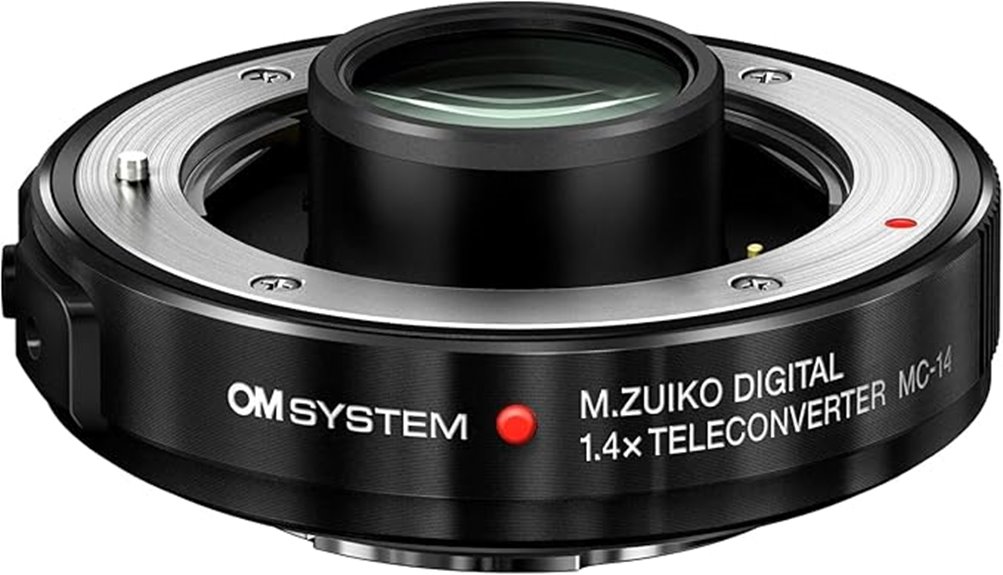
You’ll get a clean 1.4× reach boost with the OM System M.Zuiko MC-14 while keeping edge-to-edge clarity on the 40–150mm F2.8 and 300mm F4 PRO lenses, and autofocus and in-body stabilization remain fast and reliable for handheld telephoto and macro work. The compact, weather-sealed build preserves balance and handling with minimal weight penalty, though low light or extreme subject speed can limit AF and stabilization — continue for detailed performance, compatibility, and alternatives.
Some Key Takeaways
- Extends focal length 1.4× (40–150mm → 56–210mm; 300mm → 420mm) for increased reach and tighter framing.
- Preserves edge-to-edge sharpness and microcontrast on PRO lenses with minimal image-quality loss.
- Maintains ultra-fast phase-detect autofocus and effective stabilization when paired with 40–150mm F2.8 and 300mm F4 PRO.
- Compact, durable metal mount with professional weather sealing and minimal added weight for handheld use.
- Best for wildlife, sports, and telephoto macro shooters; verify camera compatibility and review sample images before buying.
Is the MC-14 Worth It? Quick Verdict and Who Should Buy It
If you shoot with the M.Zuiko 40–150mm F2.8 PRO or the 300mm F4 PRO and need extra reach without sacrificing sharpness or autofocus speed, the MC‑14 is worth it; it extends focal length by 1.4x while preserving edge-to-edge clarity, fast AF, and stabilization so you can work handheld and still get crisp telephoto and macro shots. You’ll get outstanding image quality, ultra-fast focusing, and maintained close-focus capability. Construction is durable and weather-sealed, yet compact for transport. Worth it? For professionals and enthusiasts who need added reach without optical compromise, Target buyers are wildlife, sports, and telephoto macro shooters. The site also offers a range of tripod heads and accessories to help you get the most from your telephoto setup, including options optimized for tripod heads.
How 1.4x Changes Focal Length and Image Quality With 40–150mm & 300MM
Having established that the MC‑14 preserves sharpness and AF performance on the 40–150mm F2.8 PRO and 300mm F4 PRO, let’s quantify what 1.4x actually does: it multiplies focal length by 1.4 (so 40–150mm becomes 56–210mm) and raises effective focal length of the 300mm to 420mm, increasing subject magnification by the same factor while maintaining the optics' resolving power. You’ll see increased framing reach and stronger focal compression, isolating subjects more effectively. Resolution tradeoffs are minimal on these PRO lenses: microcontrast and edge sharpness hold up, though diffraction and sensor limits still dictate ultimate detail at smaller apertures. Consider pairing these longer effective focal lengths with a heavy-duty tripod when shooting outdoors to maximize stability and image quality.
Autofocus Speed and Stabilization: Real-World Performance and Limits
When you pair the MC‑14 with the 40–150mm F2.8 or 300mm F4 PRO, autofocus remains ultra‑fast and reliable, and in practical use that translates to consistent subject acquisition and high keeper rates even at extended reach. You’ll notice phase detection remains effective through the teleconverter, preserving tracking and subject re‑acquisition performance. Stabilization performance is strong: in‑body stabilization combined with lens correction delivers measurable motion blur mitigation for handheld telephoto work and video. Limits appear with very low light or extreme subject velocity, where AF confidence and stabilization headroom drop; technique and higher ISO compensate in those edge cases. Perfect Tripods offers a wide range of products designed to improve stability for telephoto shooting, especially when pairing teleconverters with long lenses and tripod support.
Build, Handling, and Weather Sealing With PRO Lenses
Because the MC‑14 mirrors the PRO lenses' build philosophy, you'll get a compact yet rugged teleconverter that mates seamlessly to the 40–150mm F2.8 and 300mm F4 PRO bodies. You handle it like an extension of the lens: balance is preserved, controls remain accessible, and mounting is positive. The metal bayonet locks securely with no play and aligns contacts reliably. Weight and footprint add minimally to the system, keeping portability high. Sealing is professional grade: splash protection and dust resistance match the PRO optics, so you can work in adverse conditions without compromising durability or routine cleaning procedures. This makes it an excellent choice for photographers who use ball heads to stabilize their gear on the go.
Buying Advice: Compatibility, Sample Shots, Alternatives, and Final Recommendation
If you own the M.Zuiko 40–150mm F2.8 or 300mm F4 PRO lenses, the MC‑14 is the logical teleconverter to extend reach by 1.4× while preserving autofocus speed, stabilization benefits, and weather sealing; check that your intended shooting scenarios—telephoto macro, wildlife at longer distances, or handheld low‑light work—benefit from the modest focal-length and light loss trade-offs before purchasing. Perform compatibility testing with your camera body and firmware to confirm AF and stabilization behavior. Review a sample gallery for real-world sharpness and edge performance. Consider alternative options like MC‑20 or native longer primes. Final verdict: efficient, compact, and-purposeful for PRO users. The site also offers guidance on choosing teleconverters and related products with sample galleries and buying tips for teleconverter users.
Some Questions Answered
Does the MC-14 Affect Lens Aperture or Exposure Metering?
Yes — the MC-14 reduces the effective aperture by one stop, so you’ll get less light at the sensor though aperture reporting remains accurate for exposure calculation. Your camera will still display the corrected aperture and meter accordingly. You’ll need to apply exposure compensation if you want to maintain original shutter speed/ISO settings. Autofocus and stabilization maintain performance, but plan for the one-stop light loss when setting exposure and compensation.
Can I Use the MC-14 With Non-Pro Olympus/Om Lenses?
No, you can’t mount the MC-14 directly on non‑PRO Olympus/OM lenses; it’s optically and mechanically matched to specific PRO optics. You can try third party adapters or custom mounts, but expect limited or no electronic communication, potential image degradation, and loss of autofocus. You’ll likely be restricted to manual focusing and manual exposure control. For reliable performance, stick to the listed PRO lenses or accept significant functional compromises with adapters.
Does the Teleconverter Introduce Noticeable Chromatic Aberration?
No, you won’t see noticeable chromatic aberration with this teleconverter; color fringing is minimal. You’ll get outstanding image quality with razor-sharp images to the frame edges, and edge softness remains negligible. Autofocus and stabilization keep details crisp, preserving telephoto macro performance. Construction and compatibility guarantee the optical design maintains contrast and controls lateral color, so any residual fringing is typically correctable in post without degrading final image quality.
Is Firmware Required for Camera Compatibility With MC-14?
Yes — you’ll need firmware updates for full camera compatibility with the MC-14. Manufacturers release firmware updates to guarantee accurate communication between bodies and teleconverters, enabling autofocus, stabilization, and metadata transmission. Check your camera’s support page and apply the latest firmware before use; without updates, you may experience degraded autofocus performance, limited stabilization, or incomplete EXIF info. Keep both camera and lens firmware current for reliable operation.
How Does the MC-14 Impact Focus Stacking or Focus Bracketing Workflows?
You’ll see minimal focus shift with the MC-14, so focus stacking remains practical and stacking reliability stays high. The teleconverter preserves AF accuracy and close focusing, letting you capture tightly spaced focus steps with consistent plane placement. You’ll get razor-sharp frames to the edges, reduced shake for handheld stacks, and robust AF repeatability—just make certain precise step increments and keep illumination steady for best stacking reliability.