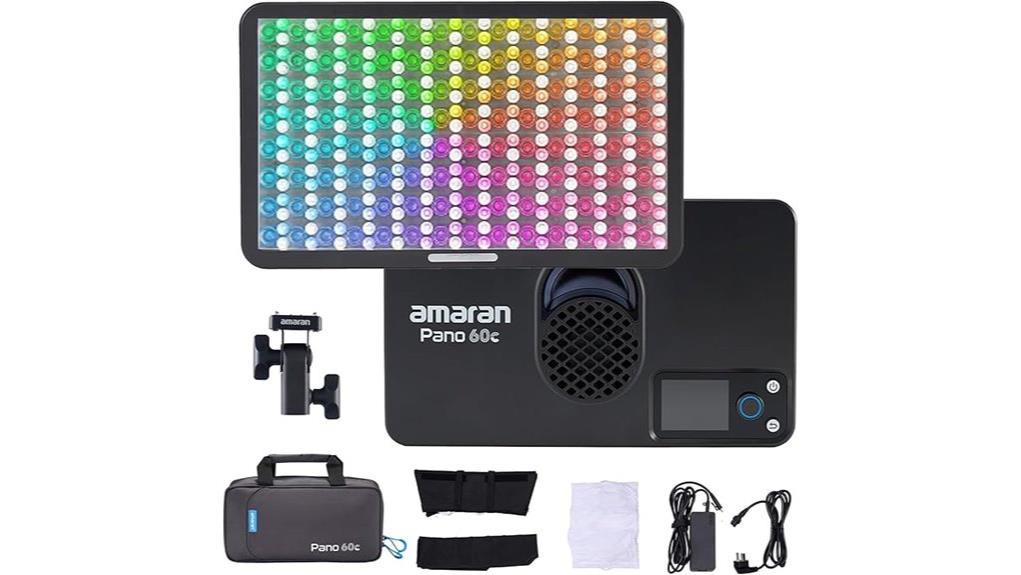
You’ll get a travel-ready 60W RGBWW tablet that’s optimized for run-and-gun, handheld interviews, and weddings. It delivers up to 22,220 lux at 0.5 m (6,500K), a 2,300–10,000K CCT range with green–magenta correction, and CRI 96/TLCI 97 for reliable skin tones. USB‑C PD lets you run from batteries, and the kit includes a softbox, grid, case, and Ace Lock adapter for fast rigging. Continue for detailed performance, controls, and mounting options.
Some Key Takeaways
- Compact, travel-ready 60W RGBWW panel delivering strong output and portability for run-and-gun and wedding work.
- Excellent color accuracy (CRI 96 / TLCI 97) with reliable skin tones and tight green–magenta correction.
- Wide 2,300–10,000K range, RGB/HSI control, and 12 effects for creative looks and ambient matching.
- USB-C PD battery support, Bluetooth/app grouping, and tactile controls enable flexible, repeatable on-set use.
- Kit includes softbox, grid, case, and Ace Lock adapter but raw output is modest versus larger fixtures.
Quick Verdict: Who the Amaran Pano 60c Kit Is Best For
If you need a compact, travel-ready RGBWW panel that delivers accurate color and flexible control, the Amaran Pano 60c Kit is a strong choice. You’ll appreciate its tablet-sized form, 60W output, and high color fidelity for content creators needing reliable, portable light. It’s optimized for run and gun setups, handheld interviews, and wedding shooters who require quick setup, app or onboard controls, and battery-capable USB-C power. You’ll get stepless dimming, green–magenta correction, and effects for creative needs without bulky gear. Its build and kit accessories suit on-location work where weight, space, and color accuracy matter. The kit’s accessories and compact design make it ideal for photographers focused on portable lighting and minimal kit setups.
Key Specs and What They Mean for Real Shoots (Output, CCT, CRI/TLCI, Effects)
Because output, CCT, CRI/TLCI, and effects directly shape how a scene reads on camera, understanding their practical implications helps you choose settings and accessories that match your shoot. The Pano 60c’s 60W output and high lux lets you rely less on gain or exposure compensation, preserving noise floor. Broad 2,300–10,000K CCT and green–magenta control let you match ambient light and avoid corrective gels. CRI 96 / TLCI 97 mean skin tones reproduce accurately, reducing heavy skin retouching in post. RGB/HSI control and 12 effects provide practical in-camera looks; use grids and diffusion to control spill. For continuous-light setups, consider light-shaping tools and placement to optimize falloff and create the desired mood with the Pano 60c’s versatile output and color controls, which is especially valuable when mixing with ambient lighting.
Performance Tests: Brightness, Color Accuracy, and Power Options
When you run the Pano 60c through bench tests, its brightness, color accuracy, and power options reveal predictable, camera-relevant behavior: the panel delivers up to 22,220 lux at 0.5 m (6,500K) from a 60W draw, holds CCT across 2,300–10,000K within tight green–magenta adjustment, and consistently posts CRI 96 / TLCI 97 readings, meaning you can trust on-set exposures and color rendition without heavy post correction. You’ll find flicker testing shows stable PWM at common frame rates, battery longevity depends on PD bank capacity, ambient interaction is minimal due to directional output, and thermal performance remains controlled under continuous load. The kit is well-suited for photographers and videographers who value portability and consistent studio-grade light output, reflecting the needs of those focused on LED panels for photography.
Usability on Set: Controls, App/Bluetooth, Mounting, Portability, and Accessories
Having established the Pano 60c’s reliable photometric and color performance, you’ll find its on-set usability aligns with that consistency through straightforward controls, wireless options, and lightweight mounting. You operate via a clear controls layout: a color screen plus a tactile dial give precise, repeatable adjustments without menu hunting. Bluetooth and the amaran app let you group units, recall presets, and tweak HSI/RGB parameters remotely. The Ace Lock adapter and included softbox/grid mount securely to stands; the panel’s 610 g weight and slim profile boost travel durability and fast rigging. Included case and power options support efficient location workflows. Brighten your photos with the perfect ring light setup for versatile shooting situations.
Final Pros, Cons, and Buying Recommendations (Kit vs. Bare Panel and Alternatives)
Although compact, the Pano 60c Kit delivers professional-grade color fidelity and flexible power/connectivity options that make it a versatile tool for location and studio work; you get a 60W RGBWW source with high CRI/TLCI, full HSI/RGB control, and app/Bluetooth grouping in a travel-friendly package. Pros: accurate color, USB-C PD support for varied battery choices, app grouping, and included softbox/grid. Cons: modest raw output versus larger fixtures, limited native lens modifiers, and single-year warranty. Buy the kit if you need accessories and case durability for travel; buy the bare panel to integrate custom mounting options or specialized modifiers. This makes the Pano 60c a strong choice for photographers who value bi-color video lights and portability.
Some Questions Answered
Does the Kit Include a Protective Case for Airline Carry-On Compliance?
Yes — you get a hard shell carrying case that’s airline friendly and designed for carry on. You’ll find a padded insert protecting the Pano 60c panel, softbox, grid and accessories, keeping components secure during transit. The case dimensions and padding aim for overhead-bin compatibility and impact resistance. You should still verify specific airline size limits and gate-check rules before travel to guarantee full compliance.
Can the Panel Be Daisy-Chained to Power Multiple Lights From One Supply?
No — you can't reliably power daisychain multiple panels from one USB-C source because the Pano 60c lacks a native power daisychain output. You can power a single unit via USB-C PD or AC; chaining requires an external distribution solution. Be mindful of supply limitations: USB-C PD power banks and chargers have watt and current caps, and the panel's 60W draw plus cable losses will limit how many units you could safely feed even with a powered splitter.
Is There an IP or Weather Resistance Rating for Outdoor Use?
No, there’s no IP rating for the panel, so you shouldn’t assume inherent weather resistance. You’ll need weatherproofing options for reliable outdoor use: protective housing, rain covers, or sealed enclosures and gaskets for connectors, plus elevated mounts and cable strain relief. For battery operation, use PD power banks in waterproof packs. Always avoid direct exposure to heavy rain or dust without proper protective accessories to prevent moisture ingress and component damage.
Are Replacement Diffusers or Grids Sold Separately by Amaran?
Yes — you can buy replacement diffusers and compatible accessories separately. You’ll find amaran replacement diffusers and light-control grids sold as spare parts or kit extras, and third-party color gels fit the Pano 60c’s slim frame for finer color shaping. Check amaran’s parts listings or authorized dealers for exact model fitment and dimensions. You’ll want to verify compatibility, material type, and whether mounting hardware or adhesive is included.
Does the Light Support DMX Control With a Third-Party Interface?
No — it doesn't offer native DMX compatibility via XLR, so you can't directly hook standard DMX desks. You can, however, use third party interfaces that translate protocols: connect via Bluetooth or USB-C to the Amaran app or a compatible controller that supports "third party interfaces" and network-to-protocol converters. That setup relies on the manufacturer's app/USB link and a protocol bridge; latency and feature support depend on the converter used.