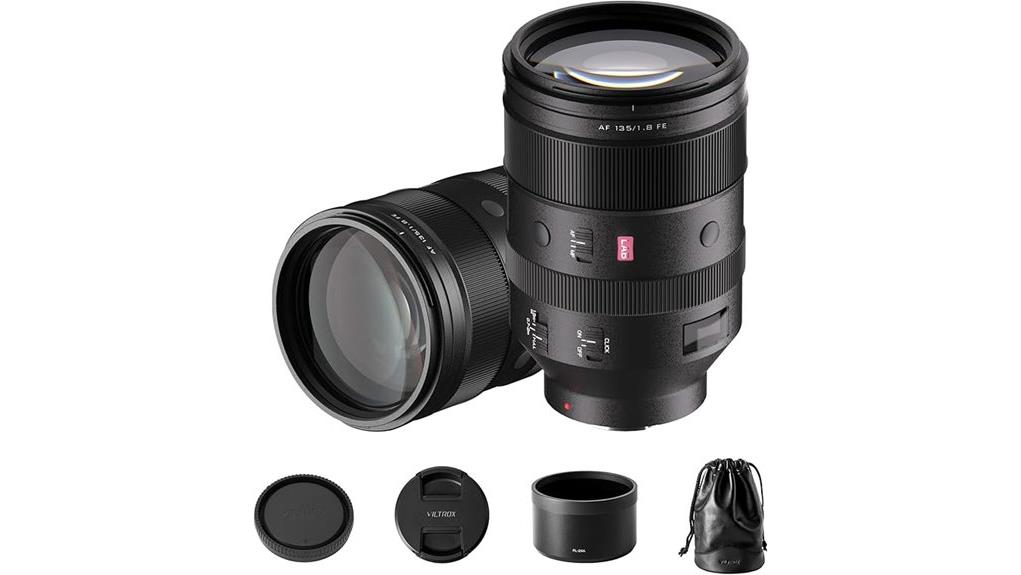
You’ll get a fast, high-resolution 135mm that pairs f/1.8 subject isolation with strong on-axis resolution and controlled chromatic aberration, optimized for high-pixel Sony E bodies. Bokeh is creamy from an 11-blade diaphragm, with smooth highlight rendition and manageable onion-ring artifacts. HyperVCM AF is markedly faster and more consistent, and close-focus to 0.72 m at 0.25x stays sharp. Controls and customization aid workflow, and continued info covers performance trade-offs and shooting scenarios.
Some Key Takeaways
- Excellent portrait lens: 14 elements (4 ED, 2 HR) deliver high on-axis resolution optimized for high-pixel Sony E bodies.
- Fast f/1.8 aperture gives strong subject isolation, creamy bokeh from 11-blade diaphragm, and good low-light usability.
- AF is notably improved: HyperVCM system with ~150% faster acquisition and reliable tracking versus traditional STM.
- Very usable close-focus (0.72 m, 0.25x) with dual floating elements maintaining sharpness across the focus range.
- Stopping down to f/2.8–f/4 improves micro-contrast and corner sharpness; minimal residual lateral CA correctable in post.
Optical Performance and Resolution: Sharpness, Aberrations, and Edge-to-Edge Detail
Because Viltrox engineered the 135mm f/1.8 with 14 elements in 9 groups—including 4 ED and 2 HR elements—you'll see strong on-axis resolution and controlled chromatic aberration across most of the frame. You can expect peak central resolution optimized for high-pixel sensors, rendering fine detail suitable for aggressive RAW sharpening. Off-axis performance shows gradual falloff: microcontrast diminishes toward the edges but remains usable. Corner sharpness improves noticeably when stopping down two stops, with diffraction-limited behavior beyond f/8. Residual lateral chromatic aberration is minimal and correctable in post; sagittal/meridional balance maintains consistent rendering across field shifts. The lens pairs well with dedicated video light kits to support low-light shooting and consistent exposure in both photography and video.
Bokeh, Contrast, and Low-Light Handling at F/1.8 and Stopped Down
Typically, at f/1.8 you'll get very strong subject isolation and a pleasingly smooth rendition of out-of-focus areas thanks to the 11-blade diaphragm and the lens's optical formula. You’ll observe creamy highlights and controlled onion-ring artifacts; specular rendition stays compact without harsh coronas. Contrast at f/1.8 is high centrally, yielding punchy subject separation for night portraits while maintaining manageable flare. Stopping down to f/2.8–f/4 increases micro-contrast and edge acuity, reduces residual aberrations, and tightens shallow layering for greater depth continuity. Low-light handling benefits from the wide aperture and optical design, preserving tonal gradation and usable shutter/ISO combinations. This makes the Viltrox a compelling choice for photographers focused on portrait optics and selecting perfect portrait lenses for their kit.
Autofocus, Focus Feel, and Close-Focus Performance With HyperVCM
Experience with the HyperVCM system shows a marked improvement in responsiveness and tracking consistency: focus acquisition is noticeably faster (about 150% over traditional STM) and the dual floating elements maintain sharpness across the focus range. You’ll notice fast acquisition in single and continuous AF modes, with smooth shifts between distances and reliable subject re-locking. Close up performance reaches 0.72 m and 0.25x magnification without noticeable degradation. Focus feel is precise and predictably damped, offering tactile responsiveness through the ring during manual override. Overall, HyperVCM delivers measurable speed gains and consistent sharpness for portrait and short-teleshooting workflows. This makes the Viltrox 135mm an excellent addition for photographers using lens adapters to expand compatibility and creative options.
Handling, Controls, and Customization: Limiter, Fn Buttons, and Multi-Function Ring
Reach for the limiter, Fn buttons, or multi-function ring and you’ll see how Viltrox prioritizes practical control: the focus limiter narrows the AF range to reduce hunting in predictable scenarios, the dual customizable Fn buttons let you map common commands for quick access, and the multi-function ring provides on-the-fly adjustment of exposure-related parameters without menu diving. You’ll find tactile, well-damped rings and responsive switches that suit field use. Button mapping supports two distinct custom layouts for different shoots; you can switch between them quickly. Overall, controls reduce operational friction and improve repeatable workflows in demanding shoots. The site also offers a range of compatible camera grips designed to enhance handling and stability for photographers using lenses like this.
Who Should Buy It? Use Cases, Camera Compatibility, and Value vs Alternatives
While the Viltrox 135mm f/1.8 targets portrait and low-light shooters who need high-resolution rendering and fast AF, it also fits event, studio, and telephoto-close-up work where subject isolation and detail matter. You’ll find it tailored to portrait shooters, wedding photographers, and event videographers who need f/1.8 throughput, accurate AF on Sony E bodies, and clean bokeh from the 11-blade diaphragm. It’s less ideal for landscape enthusiasts or street photogs seeking compact primes, though astrophotography seekers may value the f/1.8 and ED elements. Versus alternatives, it balances optical performance and price for high-pixel sensors. Check our selection of mirrorless camera gear to pair this lens with compatible bodies and accessories.
Some Questions Answered
What Is the Lens's Weather Sealing Rating?
The lens has no official weather sealing rating; you should treat its weather resistance as limited sealing and not rely on full moisture protection. You’ll get some basic resistance at joints and mount but no standardized IP or manufacturer-rated spec. In tactical use you should assume exposure to light spray is possible but prolonged moisture, heavy rain, or submersion will risk damage. Use additional protection or avoid harsh conditions to be safe.
Does It Support In-Camera Lens Corrections and Metadata?
Yes — you’ll get in camera corrections and lens metadata support when the camera firmware recognizes the lens. The lens transmits EXIF lens metadata (focal length, aperture, focus distance, serial ID) to compatible Sony E-mount bodies, enabling automatic distortion, vignetting and chromatic aberration correction in-camera. You should verify compatibility with your camera model and firmware; older bodies may need updates or offer limited correction profiles.
What Is the Filter Thread Size and Available Lens Hood?
The filter thread is 82mm and the lens hood is a petal-shaped, bayonet-mount hood that you attach for flare control and protection. You’ll screw 82mm filters onto the front; the hood mounts securely to the lens and won’t vignette on full-frame bodies. This combination preserves image contrast and bokeh quality while allowing use of neutral density and polarizing filters. The hood is removable for storage or stacked filter use.
IS There Image Stabilization In-Lens or Reliance on Body IS?
No, it doesn’t have optical stabilization; you’ll rely on in-body stabilization or support. The lens focuses with a HyperVCM motor and dual floating design, improving speed and minimizing focus breathing, but stabilization is absent in-lens. That means you should use a stabilized Sony body or tripod for slow shutter speeds or handheld low-light work. Consider IBIS performance and focal length when estimating usable shutter speeds for sharp results.
What Are the Lens's Weight and Dimensions for Travel Planning?
The lens weighs approximately 760 grams and measures about 90 mm in diameter by 120 mm in length, so you’ll plan accordingly for travel. You’ll find its compact size and travel friendly profile useful despite not being pocketable design; it’s airline friendly when packed in carry-on luggage. You’ll appreciate the balance between optical complexity and portability for fieldwork, and you’ll assess weight distribution on your camera body during extended shoots.