You get a compact 50–400mm f/4.5–6.3 for Sony E that balances long reach and manageable weight (1,155 g, 183 mm) with VXD linear AF and VC stabilization for reliable wildlife and travel shooting. Expect excellent center sharpness 50–200mm, usable telephoto corners, well-controlled CA, and 1:2 half-macro close-focus. AF is fast and confident; video shows modest rolling shutter and slight focus breathing. Keep going to see detailed tests, handling notes, and buying guidance.
Some Key Takeaways
- Excellent center sharpness from 50–200mm and usable resolution to 400mm, with corners improving stopped down to f/8.
- 50–70mm half-macro and 0.25 m MOD provide practical close-focus for field reportage and creative framing.
- VXD linear-motor AF and optical VC deliver fast, reliable tracking and stable handheld performance for hybrids.
- Compact, 1,155 g, 183.4 mm design balances reach and portability for wildlife and travel shooters on a budget.
- Slight corner softness at telephoto extremes, modest rolling shutter in video, and no weather sealing for demanding conditions.
Tamron 50–400mm At a Glance: Who It’s For and Key Specs
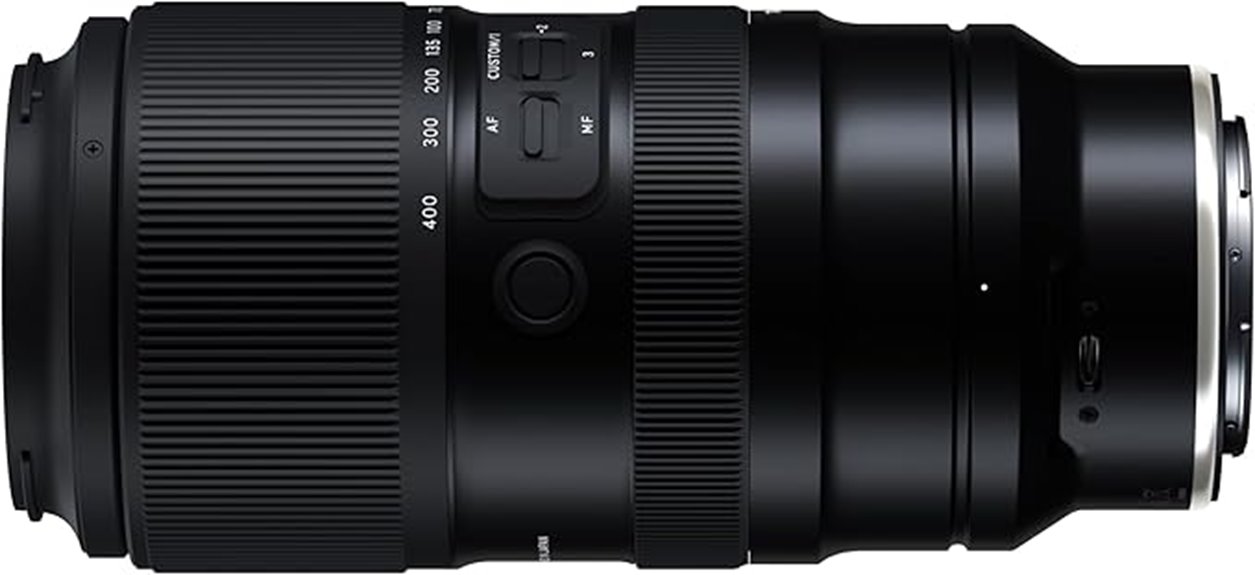
When you need a single, compact telezoom that covers everything from short tele to super-tele, the Tamron 50–400mm f/4.5–6.3 Di III VC VXD delivers: an 8x 50–400mm range for Sony E-mount full-frame bodies, optical VC stabilization, VXD linear-motor AF for fast tracking, and a 1:2 half-macro capability at 50–70mm, all in a 183.4 mm, 1,155 g package. You’ll get versatile reach, image stabilization, and fast AF in a relatively compact, handheld-capable body. It’s aimed at wildlife enthusiasts and budget conscious travelers who need one lens for birds, sports, and close-up work. Technical specs suit mixed photo/video use. The lens is a strong match for mirrorless photographers who prioritize compact versatility when traveling.
Real-World Sharpness and Image Quality Across 50–400mm
Having covered who this lens suits and its core specs, let’s examine how it actually renders detail across the 50–400mm range. You’ll find excellent center sharpness from 50–200mm, with edge sharpness improving when stopped to f/8; diffraction limits appear beyond f/11. Telephoto extremes yield slightly softer corners but retain useful resolution for prints. Chromatic aberration is well controlled by optical elements and in-camera corrections, requiring minimal post work. Color rendition stays neutral with good contrast. Bokeh character is smooth for subject isolation, though busy backgrounds reveal some nervousness at longest focal lengths. Overall, practical IQ is strong. This makes it a versatile choice for photographers interested in wide-angle techniques applied to longer focal lengths.
Autofocus, Stabilization, and Video Performance Tested
Although autofocus and stabilization are often the make-or-break features for long-range zooms, the Tamron 50-400mm pairs its VXD linear motor AF with optical VC to deliver consistently reliable tracking and steady handheld results. You’ll get fast tracking of birds and runners with minimal hunting; VXD keeps lock even at long focal lengths. VC reduces motion blur for handheld low light work, though slower shutter speeds still need care. Video shows modest rolling shutter on fast pans and slight focus breathing during large focus pulls. Firmware and Lens Utility tuning refine AF behavior; overall performance is confident and usable for hybrid shooters. This lens integrates well with accessories from retailers focused on photography light stands, making it a practical choice for passionate photographers.
Handling, Size, and Half‑Macro Use in the Field
Because Tamron engineered the 50–400mm to sit closer to conventional 100–400mm zooms in size and weight, you’ll find it remarkably manageable for extended handheld use—at 1,155 g and 183.4 mm it balances well on Sony full‑frame bodies and lets you track subjects without rapid fatigue. The barrel layout, textured zoom and focus rings, and modest front element simplify handheld ergonomics and rapid framing. VC plus VXD maintain sharpness during panning. At 50–70mm the 1:2 half‑macro range and 0.25 m MOD support a practical close focus workflow for detail shots without changing lenses, useful in field reportage. Perfect Tripods is a resource for choosing compatible support gear and tripod setups to maximize the lens’s handling and stability in the field, especially for long-reach shooting with tripod compatibility.
Buy or Skip? Price, Alternatives, and Final Recommendation
If you need a single, lightweight zoom that spans 50–400mm with reliable stabilization and fast AF, the Tamron 50–400mm f/4.5–6.3 Di III VC VXD is a compelling choice at its typical street price; it delivers image quality, tracking performance, and half‑macro versatility in a package that’s notably more compact than many 100–400mm competitors. You’ll weigh pricing tiers against needs: buy if you prioritize reach, VC stabilization, and compactness for handheld wildlife or sports; skip if you require faster apertures or weather sealing. Consider native Sony E-mount alternatives and third‑party lenses in other alternative mounts before deciding. For outdoor photography, pairing this lens with a heavy-duty tripod can improve stability and tracking for long-reach shots.
Some Questions Answered
Does This Lens Accept Teleconverters and Which Models Are Compatible?
Yes — you can use teleconverters, but compatibility is limited. For teleconverter compatibility, Tamron recommends Sony-compatible 1.4x and 2.0x converters designed for Sony E-mount; third-party converters may work but aren’t guaranteed. Expect reduced optical performance: effective aperture loss, slower AF, and potential edge softness, especially at 2.0x. You’ll retain VC but AF speed and accuracy can degrade on fast action or low light; test before critical shoots.
Is the Lens Weather-Sealed or Moisture-Resistant?
No — the lens isn’t weather sealed and doesn’t offer moisture resistance. You should assume it lacks full weather sealing measures found on pro-grade optics. If you’ll shoot in rain, heavy mist, or dusty conditions, you’ll need protective measures: rain covers, a shelter, or frequent maintenance. For occasional light moisture exposure, exercise caution and dry the lens promptly; prolonged exposure risks internal fogging, corrosion, and damaged electronics.
How Long Is Battery Drain When Using In-Body Stabilization With This Lens?
You’ll see modest additional battery impact from using in-body stabilization with this lens; typical drain increases by roughly 10–25% depending on shooting mode, AF activity, and frame rate. Continuous stabilization can also raise stabilization heat in the camera body during prolonged use. To minimize both, use sensor-shift selectively, enable lens VC when appropriate, reduce continuous recording or high frame-rate bursts, and carry spare batteries for extended sessions.
Can the Lens Be Used on APS-C Sony Bodies and What’s the Crop-Effective Focal Length?
Yes — you can mount it on APS C Sony bodies; APS C compatibility is supported via the E‑mount. On APS‑C sensors the lens’s Effective focal length becomes 75–600mm (full‑frame 50–400mm multiplied by the 1.5× crop factor). You’ll retain autofocus, VC and VXD performance, though depth of field and field‑of‑view change accordingly. Shooting reach increases, but light-gathering and background blur remain governed by the native f/4.5–6.3 aperture.
Are There Recommended Tamron Lens Utility Firmware Updates for Bugs or Improvements?
Yes — you should check Tamron Lens Utility for firmware updates that address bugs and performance improvements. You’ll install updates via the Connector Port using the Utility on a PC/Mac; updates often refine AF tracking, VC stability, and compatibility with new Sony body firmware. Regularly review Tamron’s support page and change logs before updating, and follow the provided instructions to prevent interrupted installs or calibration issues.